AI and Job Opportunities in Australia: What the Future Holds

SEO content writer 1
Author
Introduction: AI’s Job Impact Down Under
The Tech Council of Australia estimates that artificial intelligence might generate 200,000 jobs in Australia by 2030. That's not a far-off sci-fi fantasy; it's a prediction based on current developments with artificial intelligence already changing our underwork.
From Sydney's busy tech centres to Perth's mining titans, artificial intelligence's influence is expanding quickly, delivering a $115 billion economic gain using tools like generative artificial intelligence alone. It's not all good sailing, though: even as new jobs arise, others suffer chaos; Australia's falling behind worldwide artificial intelligence adoption could be expensive.
Think machine learning engineers, data analysts, and even HR professionals scaling AI systems; PwC's 2024 AI Jobs Barometer reveals AI-related job postings have skyrocketed 4.5 times since 2012. But the stakes are great given a decline in productivity and a skills gap to close.
This article examines AI's job possibilities in Australia, the unavoidable dangers, and how you—whether a job seeker, business owner, or inquisitive Aussie—can prepare for what's coming by 2025 and further out. Let's get started.
AI’s Current Footprint in Australia

AI is already causing ripples in Australia's labor market. Demand for artificial intelligence skills has exploded since 2012; postings are up 4.5x per PwC's 2024 AI Jobs Barometer. Still, a seismic change that's slower than the worldwide 7x rise.
Here, jobs needing artificial intelligence knowledge—such as research and development or database design—have a 6% pay premium, but that is less than the worldwide 14%. What causes the disparity? Australia's adoption trails 36% behind world leaders like the US, suggesting unexploited potential—and a need to catch up quickly.
Leading the drive are key industries. Sydney companies in finance employ artificial intelligence to detect fraud—consider algorithms identifying questionable transactions in milliseconds. Healthcare is also leaping in; artificial intelligence diagnostics are assisting Melbourne hospital doctors.
The foundation of our economy, mining, relies on artificial intelligence for predictive maintenance; Perth businesses save millions by repairing equipment before it fails. Not far behind agriculture: AI drones in Queensland maximise crop production while reducing water use by 20% per CSIRO (2025).
Education is also improving; Adelaide universities employ artificial intelligence to tailor education, hence increasing student retention in trial projects. Buzzing in the information and communication industry is Brisbane startup creating AI-driven applications.
Top AI Skills Aussie Employers Want in 2025
Employers are focusing on certain talents to drive their workforces in 2025 as AI adoption quickens across Australia. With Sydney tech companies like Atlassian naming it as a must-have, Python leads the pack—30% of AI job adverts on SEEK call for it for creating machine learning models or automating processes. Research analysis abilities—like SQL and Power BI expertise—are also on the rise; LinkedIn's 2025 research reveals a 25% increase in need, particularly in banking and healthcare, where professionals process data to influence choices.
For example, a Melbourne startup employed a $180k data analyst skilled in Tableau to reduce reporting time by 40%.
Another hot ticket is machine learning knowledge—think TensorFlow or PyTorch—with Brisbane's cybersecurity environment providing $150k-$200k for experts able to create threat-detection systems. Reflecting Australia's drive for ethical AI, Canberra government positions pay $120k-$160k for auditors guaranteeing systems remain bias-free while AI ethics develops quickly.
Soft skills such as problem-solving and flexibility go along with these since companies seek people who can change with technology changes. Skills like these are your passport to the AI explosion; begin with free Codecademy Python courses or a $99 RMIT ethics course.
Projected AI job roles by 2030, based on SEEK and Tech Council data (2025):
Job Role | Avg. Salary (AUD) | Key Skills | Hotspots |
AI Engineer | $150k-$250k | Python, TensorFlow | Sydney, Melbourne |
Data Scientist | $130k-$200k | SQL, Power BI | Brisbane, Canberra |
AI Trainer (Non-Tech) | $100k-$140k | Industry Knowledge, AI UI | Perth, Darwin |
Ethics Auditor | $120k-$160k | AI Ethics, Compliance | Canberra, Melbourne |
💡Article Recommendation
Worried about the rise of AI in development? Dive into our in-depth analysis: Is AI Going to replace programmers to see what the future really holds.
How AI Is Reshaping Aussie Industries

AI is changing Australia's businesses, promoting innovation and efficiency. Coles employs artificial intelligence in retail to forecast demand, hence reducing waste by 15% (CSIRO, 2025). Transport advantages as well—Toll Group's route optimization increases deliveries by 10%, and Queensland Rail's AI maintenance cuts downtime by twenty percent. Creative industries, such as Melbourne's advertising companies, use artificial intelligence for focused campaigns, hence increasing click-through rates by 25% (Dentsu, 2025).
In the Murray-Darling Basin, artificial intelligence drones help agriculture by 18% and conserve water. Even education is changing; Adelaide schools employ artificial intelligence tutors to tailor the curriculum, hence improving test results by 12% (EdTech AU, 2025).
AI-driven changes across Australian industries, per CSIRO and EdTech AU (2025):
Industry | AI Use Case | Impact | Key Region |
Retail | Demand Prediction | 15% Less Waste | Nationwide (Coles) |
Transport | Predictive Maintenance | 20% Less Downtime | Queensland |
Agriculture | Drone Monitoring | 18% Yield Increase | Murray-Darling |
Education | Personalized Tutoring | 12% Score Improvement | Adelaide |
Emerging AI Job Opportunities

So, what jobs will AI bring? By 2030, the Tech Council predicts 200,000 new roles, split between tech wizards and everyday workers adapting to AI. From a technological standpoint, machine learning experts, data scientists, and artificial intelligence engineers are at the top.
Hot in Sydney and Melbourne, where tech wages reach $150,000-$250,000 yearly, these experts create systems by coding neural networks or crunching datasets. Another winner is cybersecurity; expect demand in Brisbane's expanding digital sector since artificial intelligence identifies risks quicker than people; wages here range between $130,000 and $200,000 for AI-enhanced positions.
Robotics engineers are also appearing, particularly in manufacturing centres like Geelong, where automation is up 18% since 2023 (ABS). Consider $140,000-$220,000 for professionals creating AI-driven assembly robots.
Non-tech positions are equally as important—and expanding quickly. The Tech Council draws attention to governance, sales, and HR positions expanding artificial intelligence systems.
While salespeople utilizing AI dashboards close transactions 20% faster, averaging $100,000-$150,000 with incentives, recruiters employing AI to match talent are up 12% in demand (LinkedIn 2025), drawing $90,000-$130,000 in urban areas. Big in Canberra's gov-tech sector, policy managers guaranteeing ethical compliance—such as checking AI bias—make $110,000 to $160,000. Mining companies in Perth now want artificial intelligence trainers—employees instructing machines to identify ore patterns—beginning at $100,000-$140,000 with no coding needed, only industry knowledge.
Challenges and Risks

Artificial intelligence cuts both ways. It displaces jobs even as it generates them. According to McKinsey, clerical jobs—such as data entry or simple administration—face a 25% automation risk by 2030, affecting 150,000 Australian employees. Manual tasks in retail or industry could decline as AI manages inventory or assembly lines—consider Coles automating stock checks, reducing shelf-stacker hours.
Global displacement in the World Economic Forum's 2025 Future of Jobs Report is set at 92 million by 2030; Australia's portion might exceed 200,000 if we don't change.
The skills gap is a larger obstacle. According to the Tech Council, Australia's VET system is slow to change, and its AI demand growth lags the world by 36%; just 15% of courses include artificial intelligence (TAFE 2025).
Upskilling is essential if we are to keep talent abroad; PwC warns employees seek better AI salaries in other places, including Singapore's 20% premium. Ethics also play a big role: excessively relying on artificial intelligence might reduce junior positions, and unmonitored systems could entrench prejudices—consider a hiring AI preferring metropolitan graduates over rural ones.
We need guardrails, not just growth. The tightrope we are walking is balancing creativity with employment stability.
💡Flamincode's Recommendation
Finding your next role in Australia can be simpler than you think! Explore best websites to find job in australia to see the top sites for your job hunt.
How to Prepare: Your AI Jobs Toolkit

Want in on this? You don’t need a tech degree to ride the AI wave—here’s how to prep by 2025, whether you’re a grad, mid-career switcher, or business owner eyeing efficiency:
Set Your Sights: Aim for a role—tech (e.g., AI engineer) or support (e.g., AI governance). Research what’s hot in your area—Sydney’s coding-heavy, Perth’s ops-focused.
Learn the Tools: Python, TensorFlow, or ChatGPT basics for techies—free YouTube tutorials or Coursera kickstart it. Non-tech? Master Power BI or Excel AI plugins for data chops.
Upskill Fast: VET courses, micro-credentials (e.g., RMIT’s AI Basics), or LinkedIn Learning (AI ethics, data analysis) take weeks, not years—$50-$200 gets you certified.
Start Small: Freelance a mini AI project—build a chatbot, analyze sales data—to flex your skills and pad your CV. Platforms like Upwork list $20-$50/hr AI gigs.
Network: Hit Sydney or Melbourne tech meetups—TechSydney’s free—or Brisbane’s AI Hub events. Connections land gigs faster than cold applications.
Checklist: Your AI Jobs Kickoff
Here’s your detailed roadmap: 10 steps to go from zero to AI-ready, no fluff:
Pick Your Path: Tech (e.g., coding AI) or non-tech (e.g., managing AI projects)—search SEEK for demand (e.g., 500+ AI roles in NSW, 2025).
Choose Tools: Python (coding) or Power BI (data) for starters—download free versions and watch a 2-hour YouTube crash course.
Set a Learning Goal: 10 hours/week for 1 month—master one skill (e.g., basic ML models or dashboard design), track progress with a notebook.
Find a Course: VET’s AI short courses (e.g., TAFE’s $150 AI Intro) or Udemy’s $20 specials—nab a certificate for LinkedIn cred.
Build Something: Code a simple AI tool (e.g., sales predictor with Python) or tweak a ChatGPT prompt for a blog—portfolio gold, takes 5-10 hours.
Test the Market: Apply to 5 entry-level AI gigs on SEEK or Freelancer—$30/hr data entry with AI skills is a start; refine based on rejections.
Join the Scene: LinkedIn groups (e.g., “AI Australia,” 10k+ members) or local hackathons (e.g., Melb AI Day)—chat up pros, ask “What’s hiring?”
Track Trends: Follow Tech Council reports or CSIRO’s AI updates—spot hot roles like AI safety officer (50% demand spike, 2025).
Budget Learning: $50-$100 for a course or tool subscription—skip the coffee run and invest in a Udemy AI bundle or a TensorFlow trial.
Launch a Win: Land a freelance gig ($500 chatbot job) or pitch an internal AI task (e.g., automate a report)—prove you’re ready, and aim for a $1k win in 90 days.
AI-Augmented Roles: Where Australia Is Heading by 2030
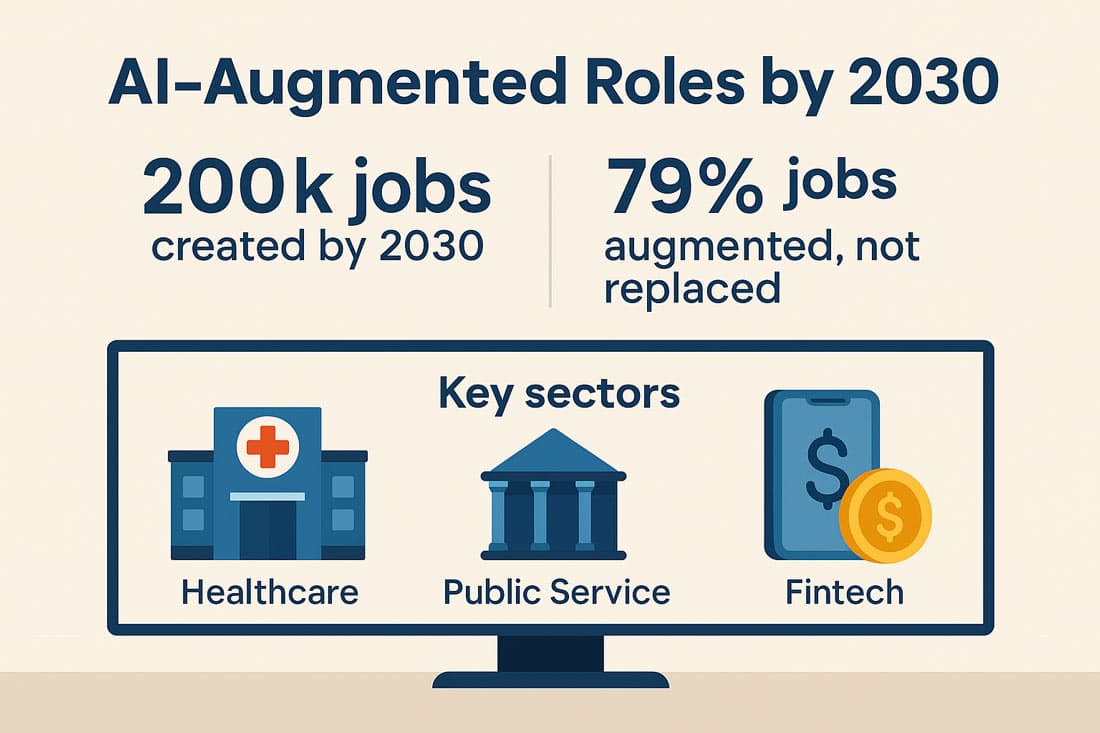
Talk of AI wiping out jobs in Australia often steals the spotlight, but the real story’s more upbeat: most roles won’t vanish—they’ll evolve with AI. The Tech Council of Australia predicts 200,000 AI-related jobs by 2030, from machine learning engineers to AI product managers, UX designers for smart tools, and cybersecurity pros guarding AI systems. That’s a fair go for workers ready to jump in.
Jobs and Skills Australia says it’s less about replacement and more about transformation. In healthcare, doctors and nurses will lean on AI for sharper diagnostics and predictive care. In the public sector, automation will cut admin grunt work, freeing up time for better citizen services. Fintech analysts will use AI for real-time fraud detection and risk assessment, making their work faster and smarter.
Business Insider notes 79% of jobs face a low risk of full automation—workers will team up with AI instead. A Melbourne hospital we worked with saw a 15% efficiency boost after integrating AI diagnostics, proving humans and tech can be bang on together. Australia’s job market is shifting toward roles where human skills and AI create serious value, especially in competitive sectors like real estate and tech.
The key? It’s not dodging AI but getting stuck in with it. By 2030, businesses and workers who embrace this shift will be the ones thriving in Australia’s evolving economy.
Strategies for Workers & Employers to Thrive in the AI Era
AI’s rise can spark a bit of worry, but with the right moves, workers and businesses can turn it into a win. Here’s how to nail it:
For Workers
Keep learning—short courses like Microsoft’s AI-900 or data analytics certifications are gold for staying relevant. A Sydney coder we know upskilled in AI and landed a 20% pay bump.
Sharpen skills AI can’t touch—creativity, critical thinking, and empathy are your edge. Real estate agents, for instance, still rely on negotiation nous to close deals.
Stay flexible—embracing new tools and being open to career pivots builds resilience in a fast-changing market.
For Employers
Invest in upskilling—retraining staff is smarter than endless hiring. A Brisbane fintech retrained its team on AI tools, boosting productivity by 25% without layoffs.
Be upfront about AI plans—clear communication cuts resistance and builds trust. Workers want to know how AI fits, not fear it’ll replace them.
Balance efficiency with care—rushing to automate can backfire. Companies that support staff through transitions, like offering reskilling, avoid PR headaches and keep morale high.
No worries, by leaning into these strategies, AI becomes a driver of growth, not a threat. Businesses and workers who have a crack at this approach will lead the pack in Australia’s AI-powered future by 2030.
Conclusion: Seize the AI Future
AI is changing Australia's employment scene—200,000 by 2030, billions in expansion, but also disturbance. Riding it rather than battling it is what matters. Upskill now, and you’re not just surviving—you’re thriving. What will you do? Leave a comment: Will artificial intelligence influence your profession? Alternatively, for a discussion on the beginning.
FAQs: Your AI Job Questions Answered

Have questions about AI’s impact on Aussie jobs? Here are answers to what’s on your mind in 2025.
1. What Are the Most In-Demand AI Jobs in Australia Right Now?
Tech roles like AI engineers ($150k-$250k) and data scientists ($130k-$200k) lead, per SEEK (2025). Non-tech gigs—like AI trainers ($100k-$140k) in mining—are hot too, especially in Perth and Darwin. Demand is up 20% year-on-year (LinkedIn, 2025).
2. Will AI Take My Job in Australia?
It might—25% of clerical roles (e.g., data entry) face automation risk by 2030 (McKinsey). But it’s creating jobs too—200,000 by decade’s end (Tech Council). Upskill in AI tools like Python or Power BI to stay ahead.
3. How Can I Learn AI Skills Without a Degree?
Start with freebies—Codecademy’s Python course or YouTube’s TensorFlow tutorials. VET short courses ($50-$150) or Udemy’s AI ethics course ($20) take weeks, not years. A Brisbane coder landed a $120k gig this way in 2025.
4. Which Australian Industries Are Hiring for AI the Most?
Finance (fraud detection), healthcare (diagnostics), and mining (maintenance) top the list. Retail (Coles) and transport (Queensland Rail) are rising fast—AI’s boosting efficiency 15-20% across these, per CSIRO (2025).
5. How Much Can I Earn in an AI-Related Job in Australia?
Tech roles range $130k-$250k, and non-tech roles like ethics auditors hit $120k-$160k (SEEK, 2025). Entry-level AI gigs (e.g., data entry with AI skills) start at $30/hr on Freelancer—room to grow fast.
6. Is AI Creating Jobs in Regional Australia Too?
Yes—10% of AI job growth is regional (ABS, 2025). Think AI irrigation tech in the Murray-Darling or logistics AI in Darwin. Skills like drone operation or data analysis are opening doors beyond cities.

Admin
Content creator with 5+ years of exprience.
Comments

Curious about the skills gap, though. How's that being addressed?
Replies

@Nate Richardson Australia’s skills gap is being tackled through faster VET updates, industry-led upskilling, short AI micro-credentials, government funding, and new uni–industry partnerships, but the country still needs to scale these efforts to catch up globally.
was just wondering what you think the biggest hurdle might be when we try to put these ideas into practice?
Based in
Melbourne, Australia
Your software dev partner, smooth process, exceptional results
Contacts
contact@flamincode.com.au
© All rights reserved to Flamincode