6 Signs Your Website Is Losing Customers Without You Realising

M Chetmars
Author
A lot of business owners assume their website is doing its job because nothing appears obviously wrong. The site is live, the pages are there, and the contact form works.
So when enquiries feel inconsistent or sales feel harder than they should, the problem is often blamed on traffic, advertising, SEO, or market conditions.
Sometimes that is true.
But in many cases, the real issue is much closer. The website itself is creating hesitation, weakening trust, and quietly pushing potential customers away before they ever make contact.
Short Answer:
If your website feels slow, unclear, outdated, difficult to use, or weak in trust, it is likely losing customers before they ever contact your business. Most businesses do not notice it immediately because the site still “works.” The problem is that it does not help real visitors feel confident enough to move forward.
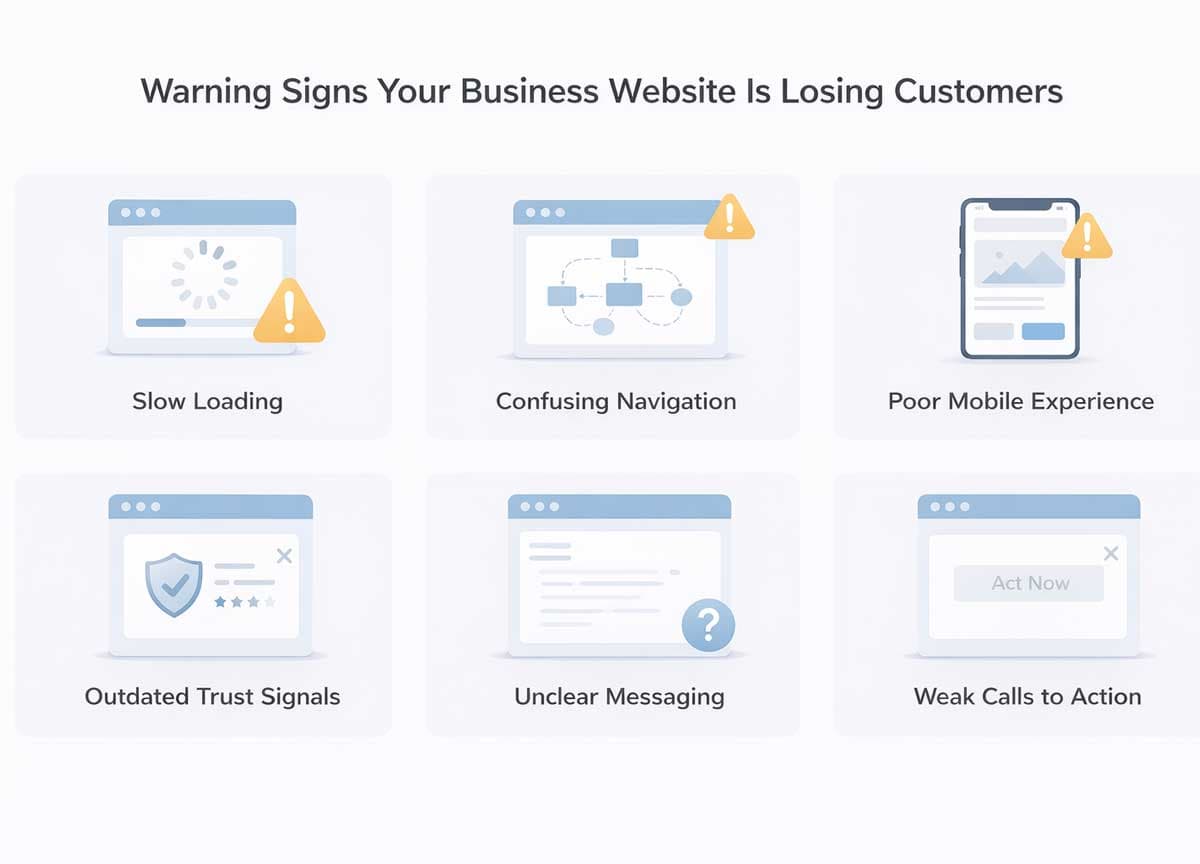
Sign | What It Usually Causes |
Slow loading | Visitors leave before engaging properly |
Confusing structure | People struggle to find what they need |
Weak mobile experience | Potential leads drop off on phones |
Outdated presentation | Trust drops faster than expected |
Weak messaging | Visitors do not fully understand the offer |
Poor calls to action | Interested users never take the next step |
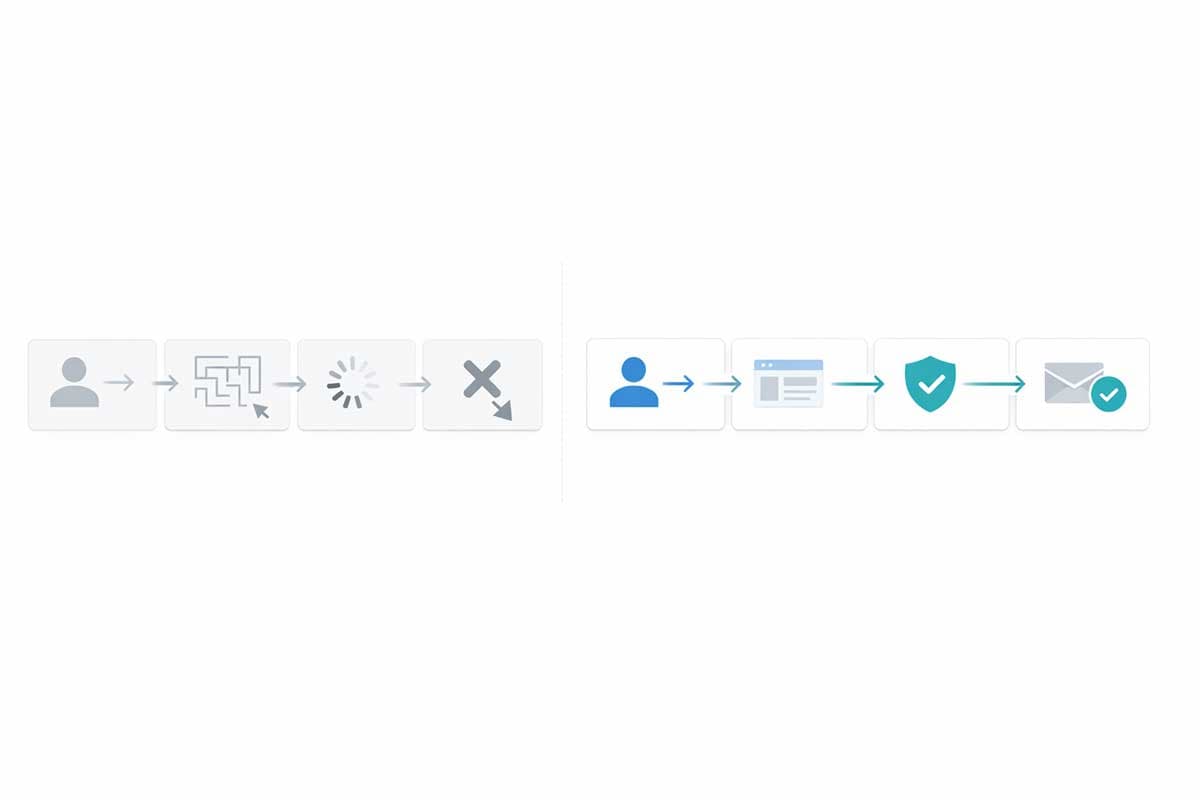
Why This Happens More Often Than Businesses Realise
One of the biggest problems with a weak website is that it often feels perfectly acceptable to the people who built it or use it every day.
That is because they already understand the business.
They already know what each service means. They already know where to click. They already understand the offer, the process, and the next step. A first-time visitor has none of that context.
They arrive cold.
Usually, they are distracted. Often, they are on mobile. Almost always, they are comparing you against other options. That means they are not browsing your site with patience or generosity. They are scanning quickly and deciding whether your business feels worth their time.
If your website makes that decision harder instead of easier, you lose people long before they become leads.
1. Your Website Feels Slow Enough to Create Doubt
Website speed is often discussed as a technical issue, but for most businesses, the bigger problem is what slow performance communicates.
A slow website makes people hesitate.
That hesitation matters because first impressions online happen extremely fast. Before a visitor has read your services, looked at your work, or considered reaching out, they are already forming an opinion about how professional your business feels.
If the site loads sluggishly, shifts around while opening, or takes too long to become usable, it creates a subtle but important impression. It makes the business feel less organised, less current, and in some cases, less trustworthy.
That is especially dangerous for service-based businesses. If someone is considering working with your business, they are not only evaluating what you offer. They are evaluating whether you feel competent enough to deal with.
A slow website quietly weakens that confidence.
This is one of the reasons many businesses overestimate the value of “having a website” and underestimate the value of having one that performs properly. The difference between the two is often the difference between a passive online presence and an active lead-generating asset.
2. People Cannot Quickly Understand What You Do

This is one of the most common conversion problems on business websites, and one of the easiest to miss internally.
The business owner understands the business so well that the messaging feels clear to them. But to a new visitor, the website often feels vague, generic, or harder to interpret than expected.
When someone lands on your site, they are trying to work out a few things almost immediately.
What do you actually do?
Who is this for?
Why should I trust you?
What happens if I contact you?
If your homepage or service pages do not answer those questions quickly, people start dropping off mentally before they leave physically.
This is where many websites lose customers through language that sounds polished but says very little. Broad statements about helping businesses grow, delivering innovative solutions, or creating tailored experiences often feel safe from the inside, but from the outside they create friction.
Clear websites reduce mental effort. Weak websites increase it.
And when people have to work too hard to understand what a business offers, they usually move on to the next option.
Read More: Why Your Website Is Not Generating Leads
3. Your Website Works on Mobile, but Does Not Feel Good on Mobile
A lot of businesses assume they are covered here because their website is technically responsive.
But being responsive is not the same thing as being genuinely easy to use on a phone.
That difference matters more than many businesses realise, because for a huge share of visitors, mobile is not a backup device. It is the first experience they have with your business.
If the mobile version of your site feels cramped, awkward, or slightly annoying, many people will leave before they ever reach the point of contacting you.
This usually happens through small moments of friction rather than one obvious problem. The menu feels clumsy. The text feels too dense. The important button is not visible soon enough. The form feels tedious. The page scrolls, but does not guide.
None of those issues feel dramatic on their own. Together, they create a poor decision environment.
And that is the real issue.
A strong business website should not only display correctly on mobile. It should support the way people actually behave on mobile, which is fast, selective, and low patience.
If the site makes action feel harder than expected, many potential customers will not fight through it. They will simply disappear.
4. The Website Looks Fine, but It Does Not Build Trust

This is where a lot of business websites quietly fail.
They do not look terrible. They are not embarrassing. They might even look reasonably modern. But they still do not create enough confidence.
That is because trust online is not built through surface design alone.
Visitors are constantly scanning for signals that answer a simple internal question:
Does this business feel legitimate enough to contact?
That judgment is influenced by far more than colour palettes or page layout. It is shaped by the overall structure of the site, the clarity of the offer, the professionalism of the writing, the confidence of the positioning, and how easy it feels to move through the experience.
A business website does not need to look flashy to perform well. But it does need to feel organised, credible, and intentional.
If the content feels thin, the structure feels generic, or the site feels like it was assembled rather than strategically built, visitors start hesitating.
And hesitation is expensive.
Because once trust weakens, everything else becomes harder. Your ads work harder. Your SEO works harder. Your referrals convert worse. Even strong services start looking weaker than they really are.
Read More: Why Your Website Doesn’t Rank on Google in Melbourne
5. Your Website Makes the Next Step Feel Unclear
A surprising number of websites lose customers not because the visitor is uninterested, but because the next action feels vague, awkward, or too effortful.
This is a major issue because a visitor does not need to be “fully sold” to convert. They usually just need enough confidence and a low-friction path forward.
If the site fails at that point, you lose people who were already close.
This often happens when the website does not clearly guide the visitor toward action. The site might technically have a contact page or a button, but the experience still feels passive.
There is a difference between allowing someone to contact you and helping them feel ready to do it.
That difference is where a lot of lead generation is won or lost.
When a website performs well, it reduces uncertainty. It helps the visitor feel what the next step is, why it matters, and what they can expect after taking it.
When that is missing, people delay. And in online behaviour, delay usually turns into abandonment.
6. Your Website Is Not Built Around How People Actually Decide

This is usually the deeper issue underneath everything else.
Many business websites are still built as if people will arrive with patience, read carefully, move page by page, and gradually figure out why the business is the right fit.
That is not how most people behave anymore.
Most visitors are doing something much faster and more instinctive than that. They are scanning. Comparing. Filtering. Looking for reasons to trust you or reasons to leave.
That means a business website should not simply present information. It should support decision-making.
That is a very different standard.
A website built around decision-making helps users orient themselves quickly. It removes confusion. It answers key concerns early. It creates momentum. It supports confidence before the user has to ask for it.
A website built like a digital brochure does almost none of that.
This is why many businesses end up feeling disappointed with websites that are technically “fine” but commercially weak. The site exists, but it does not do enough of the heavy lifting required to turn interest into action.
And when that gap exists, the business feels it everywhere else.
Why More Traffic Will Not Fix This Problem
Many businesses respond to weak website results by trying to increase traffic.
More SEO.
More ads.
More campaigns.
It feels logical. If more people arrive, more of them should convert.
But this approach often misses the real issue.
If your website is creating hesitation, confusion, or weak trust, increasing traffic does not fix the problem. It simply exposes more people to the same experience.
Traffic Without Conversion Becomes Expensive
When a website underperforms, it quietly reduces the value of every marketing channel feeding into it.
Paid ads become less efficient.
SEO traffic produces weaker results.
Referrals convert less often than they should.
The problem is not always the traffic.
It is what happens after the click.
That is why some businesses keep increasing their marketing spend while still feeling disappointed with the outcome. The volume grows, but the results do not scale with it.
A Website Bottleneck Slows the Entire Business
A weak website often acts as a bottleneck between interest and action.
People are interested enough to visit, but not confident enough to take the next step.
That gap affects more than just enquiries. It impacts how efficiently the entire business grows.
Once the website starts reducing friction and improving clarity, the effect is usually noticeable across multiple areas at once. Marketing performs better. Leads improve. Conversations become easier.
That is why fixing the website often delivers a stronger return than simply trying to increase traffic.
Read More: Why Most Melbourne Business Websites Break at Scale
How This Usually Shows Up in the Business
The frustrating part is that website underperformance often does not show up in a clean, obvious way.
It usually appears through symptoms.
A business sees traffic, but not enough enquiries. Paid campaigns bring clicks, but not enough leads. Referrals land on the site, but do not convert as often as expected. The business feels stronger in real life than it looks online.
That mismatch is usually a signal.
It often means the website is underrepresenting the quality of the business and creating more resistance than the owner realises.
What the Business Notices | What It Often Means |
Plenty of visitors, weak enquiries | The site is not converting trust into action |
Good services, poor online response | The offer is not being communicated clearly |
Strong referrals, inconsistent leads | The site is not supporting confidence well enough |
Decent traffic, low conversion | Visitors are dropping off before committing |
High mobile traffic, weak results | The mobile experience is leaking leads |
What Better Websites Usually Do Differently

The best-performing business websites are often not the loudest or most visually impressive.
Usually, they are simply much better at reducing friction.
They make it easier for people to understand the offer, trust the business, and move forward without overthinking.
That sounds simple, but in practice it changes everything.
Because once a website starts doing those things properly, other parts of the business usually improve too. Marketing performs better. Referrals convert more easily. Sales conversations start from a stronger place. The business stops fighting its own online presence.
That is why a website should not be treated as decoration or as a one-time design task.
It should be treated as part of the business system.
And if it is losing customers today, fixing that has a much more direct commercial impact than many businesses expect.
Final Thoughts
A website rarely loses customers in dramatic ways.
It usually loses them quietly.
A small moment of hesitation here.
A weak first impression there.
A confusing page.
An unclear next step.
A mobile experience that feels slightly too annoying.
One by one, those moments do not look catastrophic.
But over time, they add up to missed enquiries, weaker conversion, and a business that grows more slowly than it should.
That is why one of the most useful questions a business can ask is not, “Do we have a website?”
It is, “Is our website helping customers feel ready to choose us?”
That is a much higher standard. But it is also where a website starts becoming commercially valuable.
At Flamincode, that is usually the difference we care about most. Not whether a site simply exists, but whether it is doing enough to support the business behind it.
When a website starts working properly, the difference is rarely subtle.
Better enquiries. Stronger trust. More efficient marketing. Easier sales conversations.
That shift is what turns a website from a simple online presence into something that actively supports business growth.
If you need such a difference, check our services, like web development for more information.
Frequently Asked Questions
How do I know if my website is losing customers?
If your website gets traffic but enquiries stay weak, or if people visit multiple pages without taking action, your site may be creating friction or reducing trust somewhere in the decision process.
Can a website look good and still perform badly?
Yes. A website can look modern and still underperform if the messaging is weak, the structure is confusing, or the user journey does not support action properly.
Does mobile experience really affect business enquiries?
Absolutely. Many visitors first interact with your business on a phone. If the mobile experience feels awkward or frustrating, many of them will leave before reaching out.
What is the most common reason websites lose leads?
One of the most common reasons is lack of clarity. If visitors cannot quickly understand what you do, why it matters, and what to do next, they often leave.
Should I fix the website before spending more on marketing?
In many cases, yes. If the website is leaking trust or creating friction, sending more traffic to it often means wasting more marketing budget.

Admin
Mostafa is a Wordsmith, storyteller, and language artisan weaving narratives and painting vivid imagery across digital landscapes with a spirited pen, he embraces the art of crafting compelling content as a copywriter, and content manager.

Based in
Melbourne, Australia
Your software dev partner, smooth process, exceptional results
Contacts
contact@flamincode.com.au
© All rights reserved to Flamincode