Website Performance Audit Checklist and Tools 2026

M Chetmars
Author
Most websites do not fail in obvious ways.
They load. They look modern. They receive traffic.
But they still underperform.
At Flamincode, we often see businesses invest in design, content, or SEO while results stay inconsistent because the website has never been audited properly as a system. The issue is rarely one big failure. It is usually a collection of smaller performance gaps that quietly reduce trust, visibility, and conversion.
Short Answer:
A proper website performance audit in 2026 should review speed, Core Web Vitals, mobile usability, technical SEO, user journey, trust signals, and conversion flow. The goal is not simply to find what is broken, but to identify where the website is slowing down business outcomes.
Website Performance Audit Checklist 2026: Quick Overview
Audit Area | What You’re Checking | Why It Matters |
Speed & Core Web Vitals | Load stability, responsiveness, rendering | Direct effect on UX and rankings |
Mobile Experience | Readability, usability, CTA visibility | Most users arrive on mobile |
Technical SEO | Indexing, crawlability, page structure | Impacts organic visibility |
User Journey | Navigation, page flow, clarity | Helps users move with confidence |
Conversion Flow | Forms, CTA placement, friction | Determines whether traffic turns into leads |
Trust Signals | Proof, reassurance, credibility | Reduces hesitation |
Tracking & Data | Analytics, events, funnel visibility | Shows what is really happening |
Why Website Performance Means More Than Speed in 2026

A lot of website audits still focus too heavily on speed scores.
Speed matters. But speed alone does not explain why a site underperforms.
A website can load quickly and still lose leads because the messaging is unclear. It can rank well and still convert poorly because the path to action feels weak. It can look polished and still fail because trust is not being built early enough.
That is why website performance should be treated as a business system, not a technical checklist.
A high-performing website delivers a smooth experience, communicates value quickly, reduces hesitation, and makes action feel easy. If one of these layers breaks, performance drops.
Read More: Business Website Checklist Before Going Live
Core Website Performance Audit Checklist for 2026
1) Speed Audit: Look at Real Experience, Not Just Scores
A homepage score does not define performance.
The pages that matter most are the ones where users decide whether to trust the business or take action. These pages often reveal performance issues more clearly than any tool.
In practice, most websites are not slow in an obvious way. Instead, they feel slightly heavy. The main content appears a bit late. Interactions feel delayed. Layout shifts interrupt reading. None of these issues are dramatic on their own, but together they reduce confidence.
This is where Core Web Vitals still play an important role. Metrics such as LCP, INP, and CLS are useful because they describe what users experience before they describe what search engines measure.
A proper audit should therefore focus on whether key pages feel efficient and stable. If the experience feels slightly off, performance is already being affected.
2) Mobile Audit: Where Most Performance Is Lost
Desktop performance often creates a false sense of confidence.
On mobile, small issues become much more noticeable. A page that feels clean on a laptop can feel crowded or unclear on a phone. A call to action that is visible on desktop may be pushed too far down on mobile. A simple form can feel frustrating when used with one hand.
This matters because mobile users tend to make faster decisions. They tolerate less friction and abandon pages more quickly when something feels off.
A proper audit should therefore look at how quickly the page communicates value on mobile, how easily users can move through it, and whether the next step feels obvious.
A responsive layout is not enough. The experience still needs to feel smooth and persuasive.
3) Structure Audit: Can Users Understand the Site Quickly?

A website can load quickly and still underperform because users cannot orient themselves.
This happens when the structure reflects internal thinking instead of user thinking. The business understands its services, categories, and terminology. The visitor does not.
As a result, users hesitate. They spend time trying to understand where they are and what to do next instead of moving forward confidently.
A strong audit should evaluate whether the website feels easy to navigate without explanation. The relationship between pages should be clear. Important pages should be easy to reach. The site should guide users naturally from entry points toward meaningful actions.
This is especially important because many users do not start on the homepage. If the structure does not support alternative entry points, performance weakens even if individual pages are well designed.
4) Messaging Audit: Clarity Drives Performance
Many websites appear professional but still underperform because they do not communicate clearly enough.
When a user lands on a page, they are trying to understand the value quickly. If the message is vague, overly broad, or delayed, the user starts to lose confidence.
This does not always look like a problem. The design may still feel modern. The content may still look complete. But the page fails to create momentum.
Clear messaging reduces hesitation. It explains what the business does, who it is for, and why it matters in a direct and confident way. It also supports the call to action instead of competing with it.
In performance terms, clarity often has a bigger impact than visual design changes.
5) Trust Audit: Reducing Risk Before Asking for Action
Most users do not convert immediately.
They evaluate risk first.
If a website asks for action before building enough trust, users hesitate. They delay, compare options, or leave entirely.
This is why trust should be treated as a performance layer, not a branding extra.
A strong audit should examine whether the website builds confidence progressively. Proof, experience, and reassurance should appear early enough to support decision-making. If these elements appear too late, they lose impact.
The goal is not to add more content. The goal is to reduce uncertainty at the right moments.
6) Conversion Audit: Is the Path to Action Too Heavy?

This is where performance becomes measurable in business terms.
A website can look good and receive traffic while still failing to convert because the path to action feels difficult or unclear.
In many cases, the problem is not the absence of a call to action. It is the way the journey is structured.
If the user does not feel ready when the CTA appears, it is ineffective. If the form feels too long, the user hesitates. If the next step is unclear, the user delays.
A proper audit should evaluate whether the transition from interest to action feels natural. The website should guide the user forward without forcing the decision too early or making it unnecessarily difficult.
7) Content Audit: Is Your Content Supporting the Decision or Slowing It Down?
A page can load quickly, look clean, and still underperform if the content does not move the user forward.
This is where many websites lose performance quietly.
The content exists. It looks complete. But it does not help the visitor make a decision.
In practice, this happens when pages focus on describing instead of guiding.
Some pages explain what the business does but do not make the value clear. Others provide information but do not connect it to action. Some attract search traffic but fail to transition that attention into trust or intent.
None of these are technical problems.
But they still affect performance.
A proper content audit should look at whether key pages are aligned with what the user is trying to achieve at that moment.
The page should make it easy to understand what matters, why it matters, and what to do next.
If the user has to interpret too much or piece things together, the page starts losing momentum.
Content is not there to fill space.
It is there to carry the user from interest to action without unnecessary effort.
If it fails at that, the website may still look complete while underperforming underneath.
8) Goal Alignment Audit: Is the Website Optimised for the Right Outcome?
Not every website should be audited in the same way.
A common mistake is applying generic recommendations without considering what the website is actually supposed to achieve.
That leads to shallow improvements.
A website built for lead generation should be judged differently from one built for SEO traffic or product sales. The expectations are not the same, so the audit criteria should not be the same either.
A proper audit should therefore evaluate whether the website is aligned with its primary goal.
If the goal is generating enquiries, the focus should be on clarity, trust, and conversion flow.
If the goal is organic growth, content structure, indexing, and internal linking become more important.
If the site supports campaigns, then landing page performance and message alignment carry more weight.
When this alignment is missing, businesses often fix the wrong problems.
They improve secondary pages while core conversion paths remain weak.
They adjust design details while messaging stays unclear.
They optimise for traffic while ignoring what happens after the click.
The result is activity without meaningful improvement.
A strong audit should always return to one question:
What is this website meant to do, and is it performing well at that specific job?
Because performance is not abstract.
It is always tied to an outcome.
Best Website Performance Audit Tools in 2026
Tools are useful when they are applied with a clear purpose.
Each tool reveals a different aspect of performance. Some focus on speed, others on behaviour, and others on technical structure.
Read More: Free Online Website Security Testing Tools
Recommended Audit Tools
Tool | Best For | What It Helps Reveal |
Google PageSpeed Insights | Performance overview | Core Web Vitals and load issues |
Lighthouse | Technical diagnostics | Performance, accessibility, SEO |
Search Console | Search performance | Indexing and visibility issues |
GA4 | Behaviour tracking | Engagement and drop-off |
Hotjar / Clarity | UX insights | User hesitation and interaction patterns |
Screaming Frog | Technical SEO | Crawl and structure issues |
WebPageTest | Load analysis | Rendering and page weight |
The value of these tools comes from how they are used together. A performance issue should be investigated from multiple angles before deciding what to fix.
What to Fix First After the Audit
After completing an audit, prioritisation becomes critical.
Not every issue has the same impact.
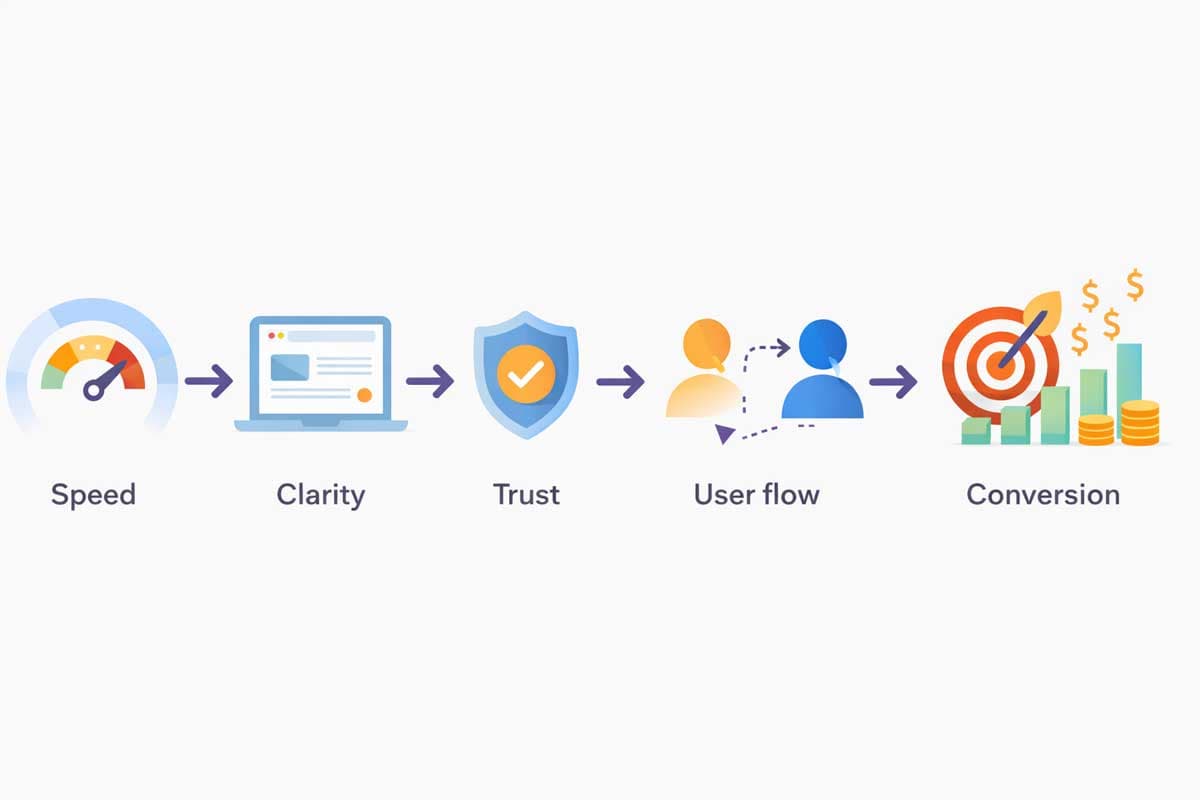
The most effective approach is to focus first on the problems that directly affect visibility, trust, or conversion. These tend to produce the most noticeable improvements.
Secondary improvements can follow once the main bottlenecks are resolved. Minor refinements should come last, after the website is already performing more efficiently.
This sequence is what turns an audit into measurable progress.
Read More: 100 Verified Web Development Statistics & Facts for 2026
Final Thoughts
A website does not need to be broken to be underperforming.
In many cases, it is functional but inefficient. It loads, but not smoothly enough. It communicates, but not clearly enough. It converts, but not consistently enough.
That gap is where performance lives.
At Flamincode, the difference between average and high-performing websites usually comes down to alignment. Speed, structure, messaging, trust, and conversion all need to support each other.
If one layer weakens, the whole system slows down.
A proper website performance audit helps identify those weak points before they become long-term limitations.
If your website feels active but results remain inconsistent, the issue is often structural rather than visual. A stronger web development approach focuses on long-term performance, not short-term fixes.
Frequently Asked Questions
What should a website performance audit include in 2026?
It should include speed, Core Web Vitals, mobile usability, technical SEO, analytics, user journey, trust signals, and conversion flow.
How often should I audit my website performance?
Every 3 to 6 months is a practical approach for most businesses.
Is speed the most important factor in performance?
No. Speed is important, but clarity, trust, and conversion flow often have a greater impact on results.
Why is my website getting traffic but not leads?
This usually indicates a gap between visibility and conversion, often caused by weak messaging, low trust, or friction in the user journey.
What is the best tool for auditing website performance?
There is no single best tool. A combination of performance, analytics, and technical tools provides the most accurate view.

Admin
Mostafa is a Wordsmith, storyteller, and language artisan weaving narratives and painting vivid imagery across digital landscapes with a spirited pen, he embraces the art of crafting compelling content as a copywriter, and content manager.

Based in
Melbourne, Australia
Your software dev partner, smooth process, exceptional results
Contacts
contact@flamincode.com.au
© All rights reserved to Flamincode