Why Your Website Doesn’t Rank on Google in Melbourne

M Chetmars
Author
A business launches a new website.
The design looks professional.
The pages load quickly.
The company invests time writing service descriptions and publishing blog posts.
Everything appears ready for search traffic.
Weeks pass.
Then months.
The website still does not appear on Google when potential customers search for related services in Melbourne.
At some point, the business owner searches for their own company and notices something strange. Even typing the service name and the city together does not bring the website into visible results.
This moment usually leads to the same question.
Why is your Melbourne business website not showing on Google?
For many companies, the assumption is simple. Google must be slow to discover new websites.
In reality, the explanation is usually more structural.
Most websites that fail to rank in Melbourne search results are missing several elements that search engines expect from a business site competing in a local market.
Ranking problems rarely come from a single issue. They come from a combination of architecture, content structure, and authority signals.
Why isn’t Your Melbourne Business Website Showing on Google?
If your website does not rank on Google in Melbourne, the cause usually falls into one of four areas.
Ranking Factor | What Often Happens | What Google Actually Looks For |
Local relevance | City mentioned once on homepage | Consistent location signals across the site |
Content depth | Thin service descriptions | Detailed topical authority |
Website structure | Flat page layout | Clear content hierarchy |
Authority signals | Few external references | Backlinks and brand signals |
Many business websites fail because they focus heavily on design while ignoring how search engines interpret structure and relevance.
A website can look excellent and still remain invisible in search results.
Read More: Starting a Small Business in Melbourne from Home
The Local Search Reality in Melbourne

Melbourne has one of the most competitive small business environments in Australia.
Hundreds of companies compete in the same service categories. Web development, accounting, construction, consulting, marketing, and countless other industries all rely on search visibility to attract customers.
When a user searches for services such as:
web design Melbourne
accountant Melbourne
marketing agency Melbourne
Google evaluates many signals simultaneously.
Location relevance.
Business credibility.
Content expertise.
Website performance.
New websites rarely appear immediately in these results because existing competitors already possess strong authority.
Companies that have been publishing content and earning references for years create a baseline level of trust in Google’s ranking systems.
This does not mean new businesses cannot compete. It means the website must communicate relevance and authority clearly.
The Local Signal Most Businesses Miss
One of the most common issues appears in how websites communicate location relevance.
A company might mention Melbourne on the homepage once and assume the signal is sufficient.
Search engines evaluate location signals across the entire site.
Service pages must reference the service area.
Contact pages must contain location details.
Content pages should reflect the regional market.
Without these signals, the website appears generic rather than locally relevant.
This explains why many business owners search for their services combined with the city name and fail to see their website appear.
The site does not clearly communicate its connection to Melbourne.
Why Content Depth Matters More Than Many Expect

Another common reason websites fail to rank involves content depth.
Many business websites include service pages with only a few paragraphs describing their offering.
From a marketing perspective this might feel sufficient. Visitors understand the service and can contact the company.
From a search perspective the page provides limited signals.
Google attempts to understand whether a website demonstrates expertise within a topic.
A page with minimal explanation offers little evidence of authority.
Websites that rank consistently usually provide deeper coverage of their subject area.
Service explanations.
Supporting articles.
Case studies.
Guides addressing common questions.
This network of related content signals topical expertise.
Without it, the website struggles to compete with businesses that have invested in content development for several years.
The Structural Issue Hidden Beneath Many Sites
Architecture plays another role in ranking performance.
Some business websites consist of a small set of isolated pages.
Homepage.
Services.
About.
Contact.
While this structure works for presenting a company, it provides limited opportunities for search visibility.
Search engines prefer structured content ecosystems.
A central service page supported by related content.
Articles answering common industry questions.
Pages that interlink naturally.
This structure helps search engines understand how the website covers a topic.
Without internal connections between related pages, the site appears thin and disconnected.
Read More: Free Website Builders in Australia
Why Many Melbourne Websites Remain Invisible
When businesses ask why their website does not rank, they often expect a technical explanation, such as slow hosting or indexing errors.
Technical issues occasionally occur, but most ranking problems come from strategic gaps.
The website exists.
But the search ecosystem around it remains weak.
Limited content depth.
Minimal backlinks.
Unclear location signals.
Thin page architecture.
Each factor reduces the website’s ability to compete with established businesses already occupying search results.
Search visibility emerges gradually as these signals accumulate.
Without them, the website remains present online but largely invisible in search.
Hot Take: Most Melbourne Businesses Don’t Have an SEO Problem
Many business owners assume their website does not rank because they have not invested enough in SEO services.
The reality often looks different.
Many Melbourne businesses do not have an SEO problem. They have a website structure problem.
Search optimisation cannot compensate for weak foundations. If the site architecture is unclear, the content is shallow, and the internal linking is inconsistent, optimisation alone produces limited results.
SEO tools adjust visibility signals. They do not replace the structural elements search engines rely on to understand a website.
This is why businesses sometimes invest in SEO campaigns without seeing meaningful improvements.
The marketing effort focuses on optimisation while the underlying website remains poorly structured for search visibility.
Why Your Melbourne Business Website Isn’t Showing on Google

When business owners search tfor heir services and still fail to find their own website, the reaction often leads to frustration.
The assumption is that Google has not indexed the site correctly.
In most cases, the site is indexed. The problem is ranking.
Several structural signals influence whether a Melbourne business website appears in search results.
Google evaluates topical authority.
It measures how strongly a site covers a subject area.
It looks for consistent geographic signals connected to the business location.
If these signals remain weak, the website struggles to compete with businesses that have spent years strengthening their online presence.
This explains why many companies ask the same question.
Why your Melbourne business website isn’t showing on Google.
The answer rarely involves a single missing setting. It usually reflects the overall maturity of the website’s digital footprint.
Read More: Local SEO Services in Australia
Authority Signals: The Layer Many Websites Lack
Beyond content and structure, authority signals play a major role in search rankings.
Search engines evaluate whether other websites reference a business.
These references often appear in several forms.
Industry directories.
Local business listings.
Mentions from partner organisations.
Links from articles or industry resources.
Each reference contributes to the perceived credibility of the website.
Businesses that operate in Melbourne for several years naturally accumulate these signals.
Newer websites rarely possess the same level of authority.
This does not prevent them from ranking, but it means they must compensate through stronger content and clearer structure.
Authority grows gradually as a business becomes more visible within its industry ecosystem.
The Internal Linking Layer Most Sites Ignore
Another structural factor influencing search visibility involves how pages connect within the website.
Some sites treat each page as an isolated piece of content.
A service page explains the offering.
A blog post discusses a related topic.
A contact page collects enquiries.
When these pages remain disconnected, search engines struggle to interpret the broader context of the website.
Internal linking helps create that context.
Service pages connect to supporting content.
Articles link back to core service offerings.
Related topics reference each other naturally.
This network of connections communicates topic relationships.
The website begins to appear as a structured knowledge base rather than a small set of unrelated pages.
Search engines reward this clarity.
The Difference Between Ranking and Conversion
Another important distinction often gets overlooked when businesses evaluate search performance.
Ranking and conversion represent two separate goals.
A website might attract visitors without producing enquiries. Another site might receive moderate traffic but convert visitors effectively.
Successful websites balance both objectives.
Search visibility brings potential customers to the site. Clear messaging and structured pages convert that attention into enquiries or sales.
Many businesses focus exclusively on ranking without considering how the website guides visitors once they arrive.
Search visibility creates opportunity. The website’s structure determines whether that opportunity turns into real business results.
The Long Term Nature of Search Visibility
One of the most difficult aspects of search visibility involves time.
Unlike paid advertising, organic rankings rarely change overnight.
Search engines observe how websites evolve.
Content expands.
Authority signals grow.
User engagement improves.
As these signals accumulate, search visibility gradually strengthens.
Businesses expecting immediate results often underestimate this timeline.
Websites that rank consistently in competitive Melbourne search results usually represent years of incremental development.
The process rewards consistency rather than short bursts of optimisation.
Final Thoughts
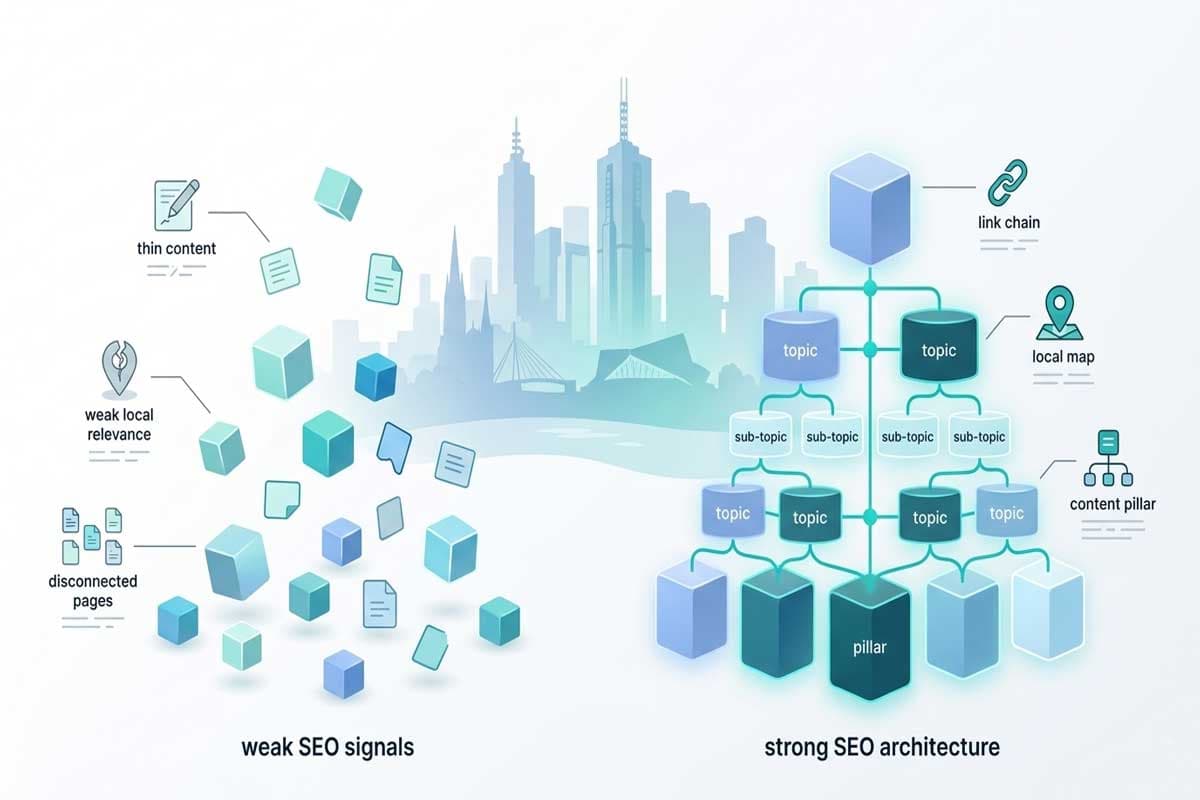
Many Melbourne businesses assume search visibility depends mainly on technical optimisation.
In reality, the foundation of ranking often lies in broader structural elements.
Clear site architecture.
Consistent location signals.
Content depth demonstrating expertise.
Authority built through references and partnerships.
When these elements align, the website begins to communicate its relevance more clearly to search engines.
Without them, the site remains present online yet difficult to discover.
For companies building long term digital visibility, search performance becomes less about isolated SEO tactics and more about how the entire website communicates authority and expertise.
At Flamincode, we frequently encounter this turning point when businesses begin expanding their digital presence. Improving rankings often requires stepping back from isolated optimisation tasks and examining the structure of the website itself.
Search engines interpret structure before they reward visibility.
If you need a well-structured web development for your business, contact us.
Frequently Asked Questions
How long does it take for a new website to rank on Google in Melbourne?
New websites often require several months before appearing consistently in search results. Authority signals, content depth, and backlinks influence this timeline.
Why does my website appear when I search the company name, but not services?
Brand searches trigger results linked to the company name. Service searches require stronger topical relevance and content depth related to the service itself.
Does Google need time to index a new website?
Indexing usually occurs quickly. Ranking takes longer because the site must compete with other websites that already possess authority on the same topic.
Do backlinks still matter for local rankings?
External references from credible websites help search engines evaluate trust. Local citations and industry mentions contribute to this authority.
Can small businesses compete with established websites?
Yes. Businesses that develop structured content, clear location signals, and consistent authority signals gradually strengthen their visibility.

Admin
Mostafa is a Wordsmith, storyteller, and language artisan weaving narratives and painting vivid imagery across digital landscapes with a spirited pen, he embraces the art of crafting compelling content as a copywriter, and content manager.

Based in
Melbourne, Australia
Your software dev partner, smooth process, exceptional results
Contacts
contact@flamincode.com.au
© All rights reserved to Flamincode