When a Template Website Starts Costing You Customers: 7 Signs You’ve Outgrown It

M Chetmars
Author
It's not always bad to use a template website. Actually, if you own a new business, it helps your business launch more quickly, lowers the costs, and gives you a basic online presence before you get fully prepared to compete with your opponents.
However, later some problems may appear. The template is limiting the business, which may outgrow it. At this stage, a website that worked well for the Business when it was smaller can no longer support the business that has become more complex.
You shouldn't blame the template for being broken. The problem is that your business now is bigger than the template, and the template website cannot handle your business anymore.
The template website that the business has outgrown still loads, still has the forms, and from the outside, everything may look fine. But when a website is responsible for building trust, showing the business values, and supporting the business growth, just “fine” Is not enough.
Template Websites Are Fine Until Your Business Outgrows Them

When the speed is more important than flexibility, a template website is the right option.
On many occasions, at the beginning, all you need is a homepage, some service sections, and probably a contact form to help people find you.
In a case like this, template websites will do the job for you.
But as the business gets bigger, things change.
Now, as a bigger business, you may need a clearer service page, stronger trust signals, better mobile flow, and forms that collect the right details.
A template is built for broad use. Yours is not.
Early Website Need | Growing Business Need |
Basic online presence | Clear positioning and trust |
Simple service list | Strong service page structure |
Standard contact form | Better enquiry or booking flow |
Generic page sections | Flexible content layouts |
Quick launch | Scalable website structure |
Bad news: this is where the template website's limitations become apparent.
Customers don’t have to wait for the website to fail completely before leaving it. They just need a small flaw, and they’ll lose their trust.
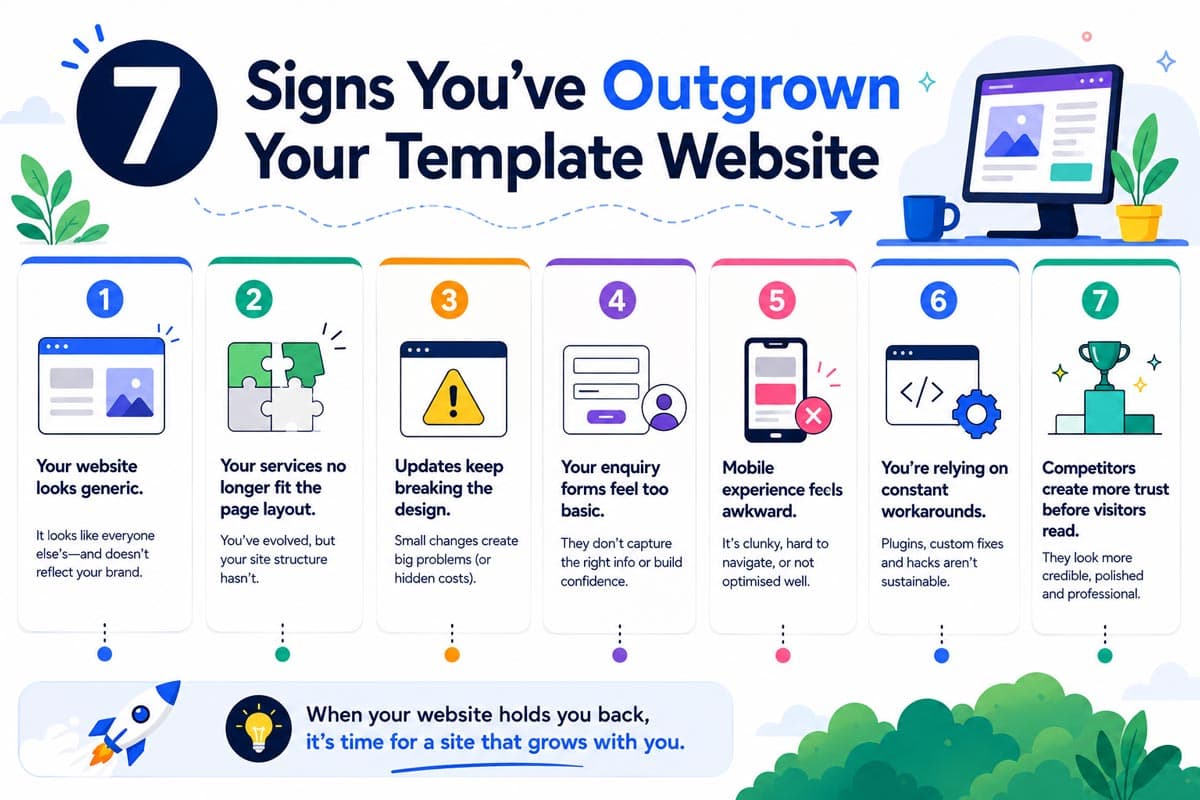
1. Your Website Looks Like Every Other Business in Your Industry

Template websites usually use a familiar pattern that you have probably seen millions of times. There is a big hero section at the top, three or four service cards, a row of icons, and a generic “about us” section before the end, where you can see a contact form.
To be honest, there's nothing wrong with this, but the problem is that almost every business uses them exactly the same way.
After a while, you and other visitors feel like this website could belong to anyone and any business. But the problem is, you may really have a unique business with unique services.
If you really have a website with premium support, careful work, and better customer experience, you should show it to your customers. They should genuinely feel it.
This is one of the problems with generic templates: they make your business look small, simple, and less trustworthy than it really is.
Also, you shouldn't forget about stock photos that make this problem even worse. Whoever has used the internet for more than a year has seen those hand-shaking photos of smiling teams and abstract tech graphics on dozens of other websites.
Yes, these photos occupy the space, but they don't bring any value to the website and your image as the business.
When your business grows, you need your website to stand out visually and have its own character. This doesn't necessarily mean that your website must look strange or unusual. It just means your design should show up your business character and your values clearly.
If people see your website and feel that they have seen it before, your template could make your business look less credible.
2. You Can't Explain Your Services Clearly Within the Template Layout
It is one of the strongest signals that shows your business has outgrown its template website.
Most template websites try to fit all your services into equal and similar boxes. It makes no problem if your services are simple and don't need much explanation. But in real life, some services need more detailed proof and extra steps.
And on the other hand, there are services that might need a whole page to explain them properly. Some might need a summary, FAQ's, booking steps, and easy ways for people to request a quote.
But templates usually limit you from having them in frames that you need in fixed structures, no matter what your business really needs. This is how you may end up with a weak service page that doesn't truly resemble your business.
In this situation, visitors can't get enough information about your business to make a decision. Their questions go unanswered, and your business values sound flat and unappealing.
You cannot consider this as just a design issue; it is absolutely a structural one. That's why, before managing a website to look polished, we need to organise information properly. If the template doesn't align with your business goals and it doesn't explain your services, your message will be limited.
This is why it helps to plan your website structure before design. A growing service business needs pages built around customer decisions, not around whatever sections came with the theme.
3. The Website Is Getting Harder to Update Without Breaking the Design
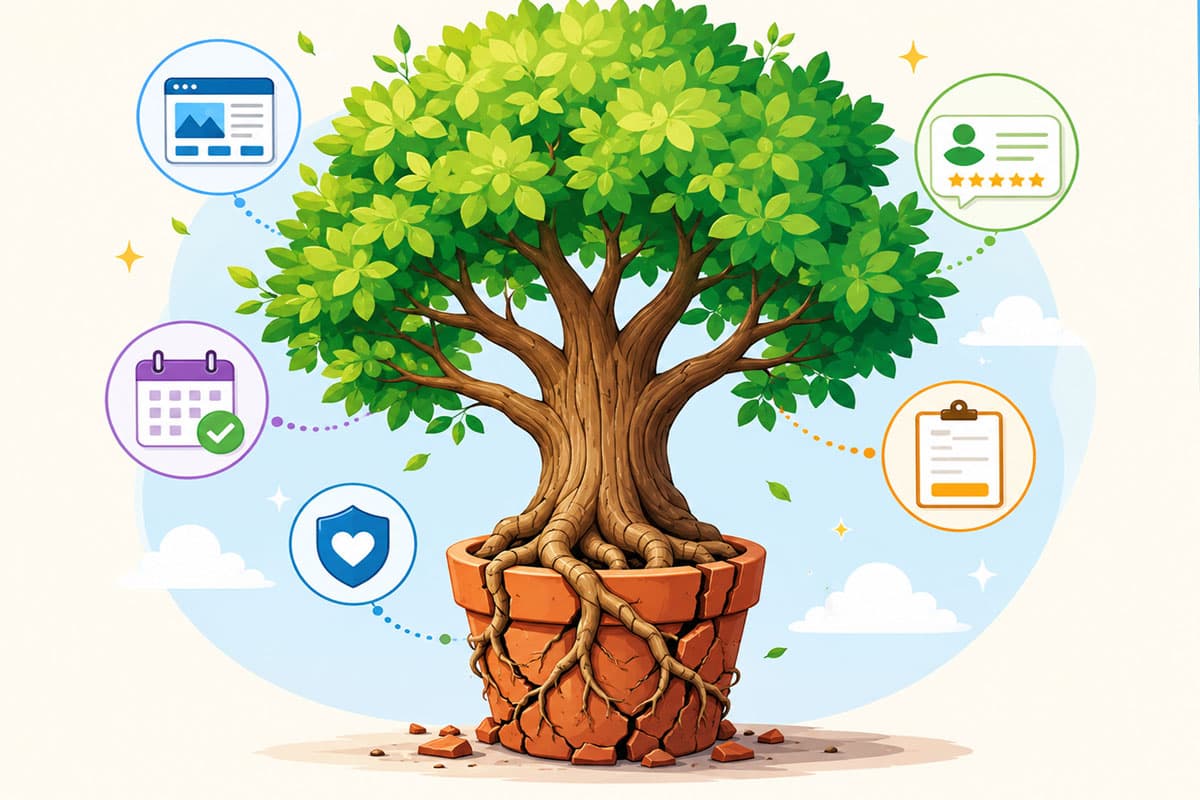
In a template website, everything looks easy and manageable at the beginning. But when your business grows, you need to add more pages, new services, plugins, extra sections, and all sorts of embeds.
Little by little, any change causes a new problem. Sometimes the layout breaks. Sometimes you feel the spacing doesn't look right. And sometimes there is a plugin that slows the site down. You may also notice that the page builder acts weirdly.
These problems are classic template website issues: They leave you fragile whenever you want to make a change.
The whole point is that a growing business should not have to fight its own website every time something must change. When adding a new service page feels risky, it’s safe to say that the website is stopping you from growing.
On the other hand, a custom website development helps you have a cleaner structure, reusable parts, a stronger design and a base to grow.
The final goal is to have a website that grows with your business without turning into a mess.
4. Your Enquiry Forms Are Too Basic for the Way You Now Sell
When every enquiry is pretty much the same, a simple contact form does the job for you:
Name. Email. Phone. Message.
That's usually enough when you're starting out, but as your business grows, your sales process gets more complicated.
You might need to know more, so you ask more questions. You might need visitors to upload some files or book appointments. Probably some of the questions are based on the location, so you ask them about their locations. A really important thing to consider when it comes to forms is to filter enquiries.
Template websites usually cannot handle all that. So you have to manage the rest of the work manually.
Sometimes customers send vague messages. And your team end up asking follow-up questions many times. Some enquiries don't have enough information, like the timeline, the budget or even the service they need.
At this stage, you can see that your website is getting inquiries, but they don't help your business handle them the right way. And if you are running a service business, you know what we’re talking about.
A better form flow makes it easier for visitors to explain their needs and also helps your team handle them faster and in the right context.
If your enquiry process has become more complex than your template can support, custom website development might be a better fit. For some service businesses, an online booking system also helps reduce friction.
5. Mobile Looks Okay, But Does Not Feel Professional
Nowadays, many template websites are technically responsive, which means the layout shifts and adjusts itself on smaller and bigger screens. But just that doesn't give your visitor a great experience.
Yes, a template website does offer a mobile experience, but it still sometimes feels awkward to use.
It means sometimes the sections stretch out, and sometimes the image gets cut off in strange ways. Menus might get messy, and crucial details about your services might go missing.
The website technically works, but it doesn't feel smooth and professional. The problem is that most people judge your website based on what they see on their phone screens.
A good mobile experience needs something more than this. It needs to show your priorities and offer a simple way for the user to get your services. And it should come with trust signals wherever they are needed.
The template website does offer the mobile experience, but you usually can’t apply your strategy on the mobile screen, because your controls are limited.
If your desktop site looks fine but your mobile version feels cramped or half-done, the template could be holding back the quality your customers expect.
6. You Are Adding Workarounds Instead of Solving the Real Problem
If, instead of developing what is necessary, you find yourself using workarounds, then the website has passed what it was meant to handle.
At the beginning, using a workaround feels harmless; it's just a quick fix, right?
But little by little, you have to compromise on what you need on the page. Sometimes you have to hide some sections, sometimes you have to drop some external forms.
And at the end, you feel it's not the website that you were trying to have.
Each little patch solves one problem. But when you stack them up, your website gets harder to manage. It’s like patching a leaky boat, and eventually, you spend more time fixing than moving forward.
The site becomes messier, slower, and a total headache. Eventually, your team starts to lose confidence when making changes.
At this stage, what started as a simple template is now acting unpredictably and is hard to trust.
As your business grows, you need a website that can keep up with you and your needs. I think new features shouldn't mean new troubles.
Repeated Workaround | What It Usually Means |
Adding plugins for every new need | The template lacks the right functionality |
Copying old sections between pages | The site needs reusable content components |
Hiding broken blocks | The layout system is fragile |
Using custom CSS fixes often | The design system is not flexible enough |
Avoiding updates | The website foundation feels risky |
A workaround is not always a problem. A pattern of workarounds is.
7. Competitors Feel More Trustworthy Before Visitors Read Their Content
You may not like this one, but it's really important:
Sometimes your competitors don't offer better services, but they do look like a safer choice online.
There could be many reasons for that, but maybe their website explains what they do in a way that is easier to understand for visitors.
That's how people feel more confident before they even read the details.
It's all about the feelings.
If your visitors feel confident right away, your templated site is doing the right job, but if not, the website is holding back your business.
If your business has grown but your website still looks like a starter template, people would think you're less established than you really are.
The whole point here is your website should show what you really are and what you really offer, not more and not less.
Template websites usually struggle at this point. They only give you the layout, not the right structure for your business.
Does Outgrowing a Template Mean You Need a Fully Custom Website?
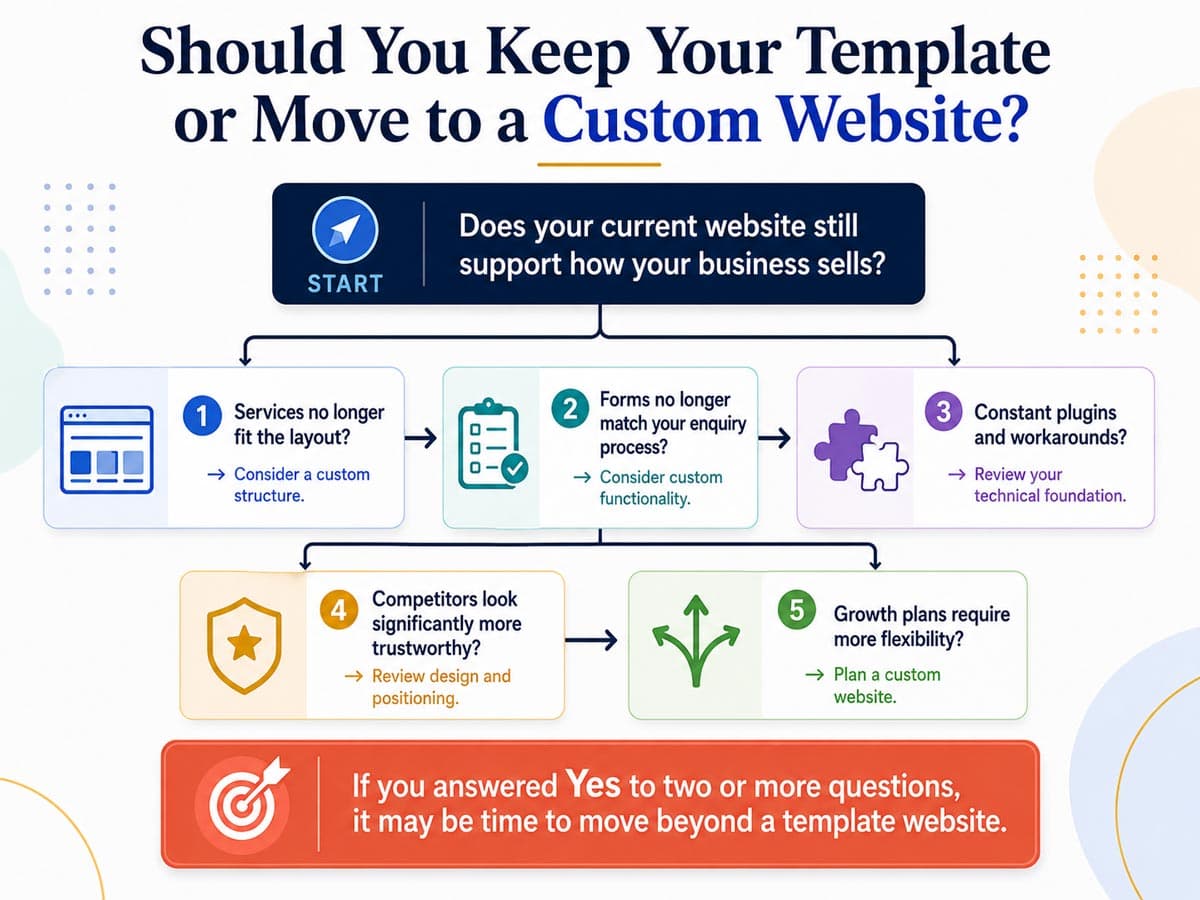
Not always. Sometimes the main problem is visual quality. Imagine the brand has grown, but the layout looks dated, or there are other visual factors that can be improved. In this case, a strategic redesign would suffice.
But what if the issue is bigger than this? What if your website needs a better quote form? Or a new special service page?
At this point, it’s more logical to consider building a custom website.
Still, the best solution depends on the factors that are slowing your business down.
If it’s just a contact form, just focus on improving it. If your website doesn’t look made for you, try enhancing the design. But if the website lacks the ability to support what you want it to do for your business, you should consider a more fundamental option: a new development.
For a deeper comparison, read Flamincode’s guide to Template Website vs Custom Website Development.
What to Do If You Think You Have Outgrown Your Template Website
Look deeply and honestly at your website, service pages, forms, mobile experience, and even “about us”, and answer this simple question:
Is this as good as my opponents' websites? Does yours build trust quickly? What in theirs make you feel that they are professionals? Does your website do the same for visitors?
If it does, well done! If not, you should find what suits your business.
After these steps, you’ll probably have a clearer idea of what should change.
You might need design improvement. You might need custom functionality. You might need a full rebuild. A Custom Website Development Requirements Checklist for Service Businesses helps clarify what the next version of the website needs to support.
How Flamincode Helps
If your template website is holding back your business, Flamincode can help you decide whether you need a new website or just a strategic redesign based on your needs. We check your customers, your services, and how you want to be shown to the people.
If you feel the website you’ve started with isn’t keeping up with your business anymore, book a free web design consultation. We’ll find out what the best next step is for you.
Frequently Asked Questions
How do I know if I have outgrown my template website?
If your website feels generic, doesn’t explain your services clearly, and/or is hard to manage for your current needs, it is lagging, and you should know that you are losing customers by sticking to it.
Are template websites bad for businesses?
No, not necessarily. They can be a really good starting point for newcomers who need a quick online presence. It might only get bad when your business needs more flexibility, more features and a better structure.
When should a business move from a template website to a custom website?
Whenever you realise your website is holding back your business and does not support your needs, it’s time to go into the details to see if it’s just a design problem or something more fundamental.
Can a template website lose customers?
Yes, it can, in fact. If your website doesn’t look like it is specialised for you, it may look like everyone else’s, and it kills the trust. Another problem is that sometimes it’s hard to find a way to get in touch. So customers may leave with a little bit of any kind of friction.

Admin
Mostafa is a Wordsmith, storyteller, and language artisan weaving narratives and painting vivid imagery across digital landscapes with a spirited pen, he embraces the art of crafting compelling content as a copywriter, and content manager.

Based in
Melbourne, Australia
Your software dev partner, smooth process, exceptional results
Contacts
contact@flamincode.com.au
© All rights reserved to Flamincode