How to Optimise Your Website for AI Search: A Technical Guide

M Chetmars
Author
AI-powered search is shaping how users discover businesses, compare them, and make decisions. This shift from SEO (Search Engine Optimisation) to GEO (Generative Engine Optimisation) might look like a lot of work, but in fact, they mostly follow the same principles. To be better ranked on both of them, you should:
Present helpful content.
Have a website that is easy to crawl.
The first part is about content, and there are hundreds of articles out there to tell you how to optimise your content for GEO. But we’re going to work on the second part. So, here’s the question:
Is your website technically ready for AI search?
What Does Technical Optimisation for AI Search Mean?
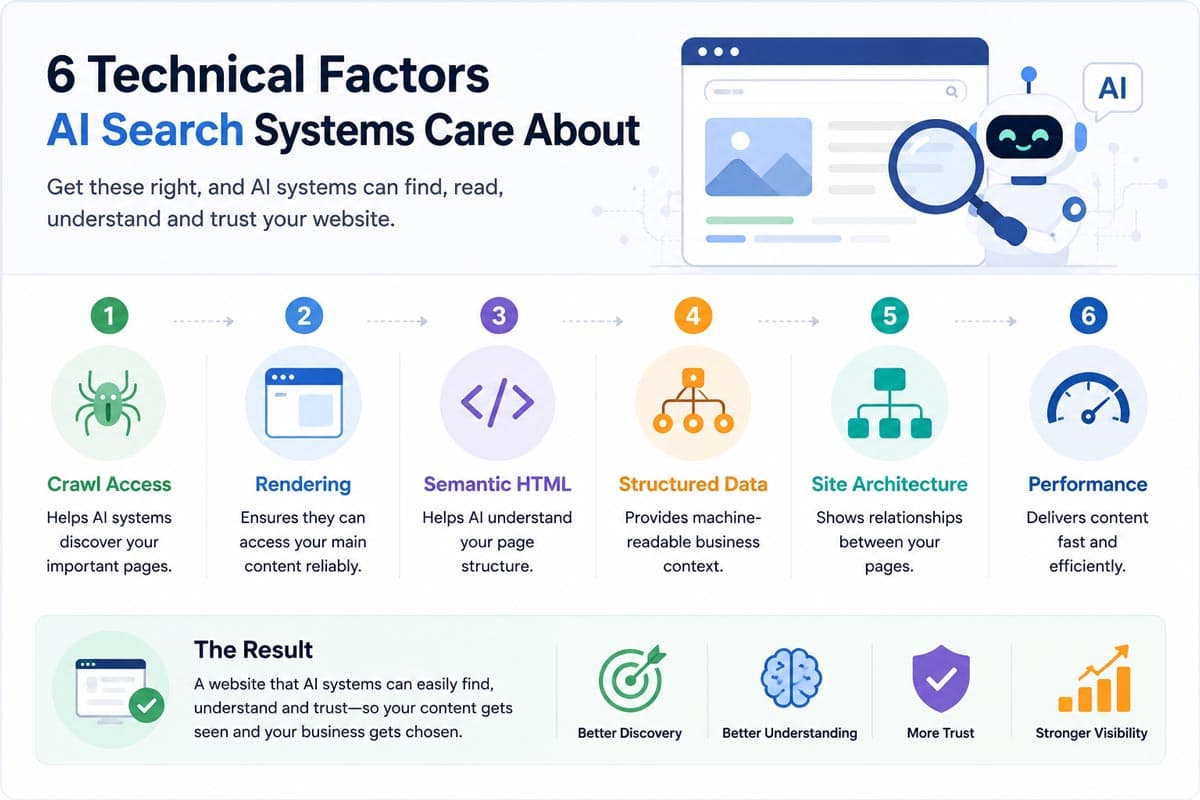
Technical optimisation means making a website accessible, understandable and reliable for users, search engines and automated systems.
Technical optimisation includes making a website accessible, understandable, and reliable for users, search engines, and other automated systems.
The challenge here is that not all platforms use the same algorithm. Some of them work with search indexes, while some work with crawlers or data providers. So, if you want to be shown in all of them, you shouldn’t stick just to one of them.
A better approach is to follow durable web development standards:
But there is a principle that works on all of them: stick to the web development and content creation standards, and they will like your website.
Here are the factors that they mostly care about:
Technical area | What it improves |
Crawl access | Discovery of important public pages |
Rendering | Reliable access to primary content |
Semantic HTML | Understanding of page structure |
Structured data | Machine-readable business context |
Site architecture | Relationships between pages |
Performance | Efficient content delivery |
As you can see, you probably have seen many of these practices before the AI SEO era. So you don't see something totally new here.
Make Important Pages Easy to Access
First things first, automated systems must be able to find your valuable content. So, errors in robots.txt, canonical tags, and redirects can bury your content.
Development teams should check that:
Important pages are not blocked or marked noindex
The XML sitemap has the latest version of canonical URLs.
Broken links and redirect chains are corrected.
Core service pages are connected through logical internal links.
Old or duplicate URLs are managed consistently.
Based on our experience, we can confirm that it’s a common thing to overlook orphan pages. These pages exist and function, but they are not related to other pages through internal linking. So, it is hard for users and crawlers to find this page through the website's normal structure.
You may think you should take care of these pages because of AI search, but, in fact, it is a normal SEO practice. Each page should bring value to your website.
Ensure Essential Content Can Be Rendered
Modern websites frequently use JavaScript to load page content. JavaScript is not inherently a problem, but essential business information should not depend entirely on scripts, pop-ups, tabs or user interaction.
It’s true that modern websites use JavaScript to load page content, but business information shouldn’t rely solely on scripts and pop-ups.
In browsers, a page may look complete, but its initial HTML might not have much useful text. Some automated systems can render complex JavaScript, but their limitations and abilities might be different.
Server-side rendering, static generation and progressive enhancement can make content delivery more reliable. The appropriate solution depends on the website’s framework, scale and functionality.
Server-side rendering, static generation, and progressive enhancement can make content delivery more reliable. So, the proper solution depends on many factors, like the framework, scale, and functionality.
No matter what type of implementation is used, important data like service descriptions, contact info, and company details should remain stable and fixed.
Use Semantic HTML and Clear Headings
Visual design helps people recognise navigation, headings and page sections. Automated systems also need structural signals.
Not only humans, but automated systems need structural signals, too. For that, they need visual design and navigation sections.
Semantic HTML uses elements like: main, nav, article, section, header and footer. These elements are used to explain the role of different sections on a page. Headings, lists, and tables should be logical and written with correct code.
Each page should have one H1 that is bold and clear. A logical hierarchy asks you to add enough H2 and H3 headings, based on your needs, to explain the content even better.
Semantic structure necessarily doesn’t make your AI search ranking better, but it reduces ambiguity and makes the pages easier to interpret.
Add Structured Data Where It Adds Context
Structured data makes a website and its content readable for machines.
Relevant schema types may include:
Organisation or LocalBusiness
Service or Product
Article
BreadcrumbList
FAQPage, where visible FAQs are genuinely present
Structured data is sometimes presented as an AI-driven SEO shortcut. In practice, its value is more straightforward: it helps clarify details such as the business name, service type, page hierarchy and content format.
Although structured data is sometimes mentioned as an AI-driven shortcut, in practice they help crawlers identify the content type, such as service type and page hierarchy.
Don’t forget to match the offered data with the markup. But don’t forget to keep vital business information fixed throughout the website.
Structured data should not be treated as a confirmed AI search engine ranking factor. It supports interpretation but cannot guarantee rankings, citations or inclusion in generated responses.
Create a Logical Website Architecture
Business websites should clarify what they offer and how the pages on the website are related to each other.
Each major service should normally have a dedicated page. Navigation should distinguish between services, industries, projects, resources and company information. Important pages should be accessible through normal links rather than hidden behind search tools or interactive components.
Each main service should have a dedicated page for itself that is easy to find from any point in the website.
Descriptive URLs and breadcrumbs also show how a page sits among other pages.
For better results in AI SEO for small business websites, usually simple structures work better than having a lot of almost similar pages with shallow content.
Enterprise websites face different types of challenges, like competitive SEO and AEO, multiple languages, locations and content management systems. So, they’re heavily dependent on technical practices.
Keep Business Information Consistent
You shouldn’t make automated systems guess about your data. Information like company names, contact details, locations, service areas and core descriptions should be found as easily as possible. Having a clear About Us, Contact page, and Service Pages sends a stronger signal to crawlers than some claims that you show on your website.
Case studies are useful, too. Probably way more than what you think. Explain a problem and bring your solution. Automated systems love this, not just some random exaggerated claims.
Keep the essential details reachable in text and images so that you can satisfy humans and robots at the same time.
Lack of consistency on your website damages your SEO and AI SEO, not a lack of special tools.
Improve Performance and Accessibility
A technically strong website should deliver information quickly and reliably.
Large scripts, unoptimised images and unnecessary third-party components can slow pages and create unstable experiences. Development teams should review image formats, caching, server response times and the amount of JavaScript needed to display essential content.
The site should also work across mobile devices and different input methods. Keyboard navigation, descriptive alternative text, labelled forms and suitable colour contrast improve accessibility.
Core Web Vitals can help identify performance issues, but they should be treated as diagnostic measures rather than the complete definition of website quality.
Short-term AI-powered SEO tactics should never come at the expense of accessibility, maintainability or user experience.
What Should a Technical AI SEO Audit Cover?
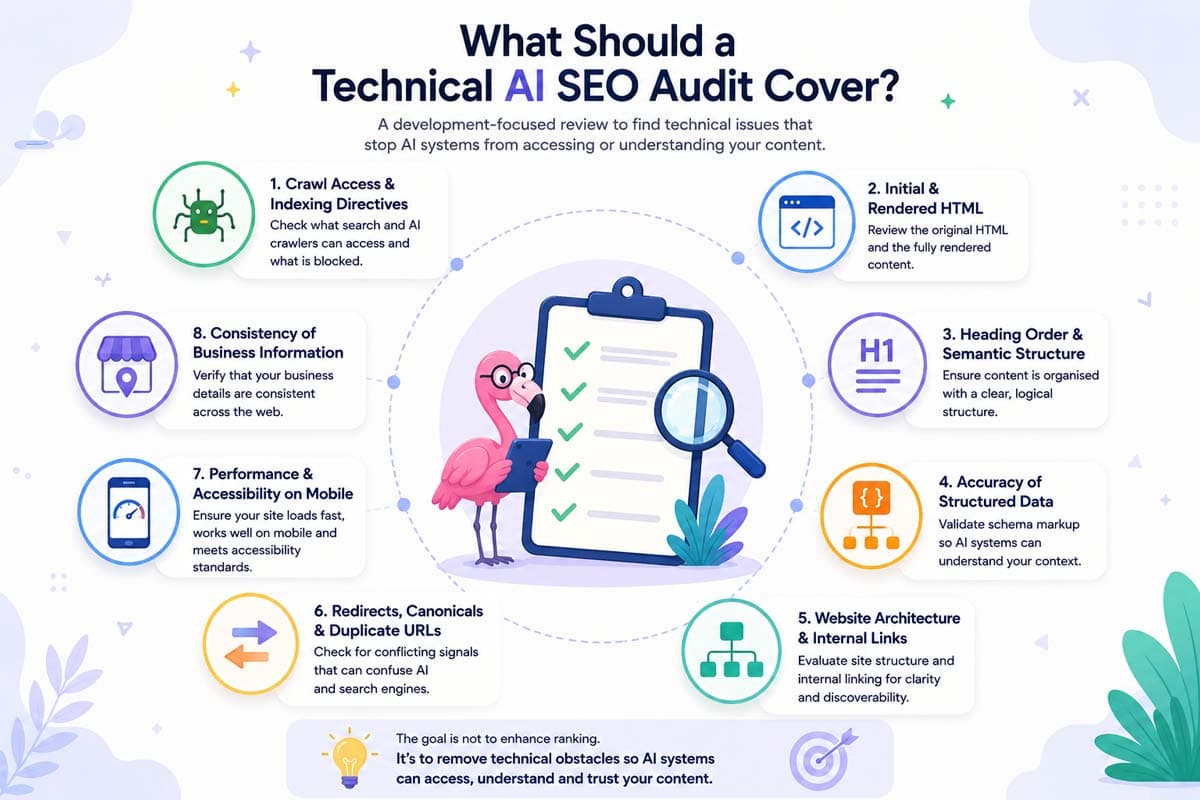
A technical AI SEO audit can identify development issues that prevent information from being accessed or interpreted correctly. It is not a complete SEO audit and does not cover keyword research, backlinks or editorial strategy.
A technical AI SEO audit can spot development problems that stop information from being interpreted correctly. It is something different from an SEO audit and doesn’t include keywords and backlinks.
A development-focused review should examine:
Crawl access and indexing directives
Initial and rendered HTML
Heading order and semantic structure
Accuracy of structured data
Website architecture and Internal links
Redirects, canonicals and duplicate URLs
Performance and accessibility on mobile devices
Consistency of business information
As you may have noticed, the goal here is not to enhance ranking; it’s to avoid technical obstacles.
Build for Clarity, Not One AI Platform
The future of AEO will change the tools we’re using currently. If we focus on just one platform in development, it’ll lead to creating technical debt in future.
Businesses are better served by investing in semantic HTML, accessible content, clear architecture, structured information, reliable rendering and strong performance.
Focusing on the main principles instead of platforms is a wise move. Pay more attention to core practices like semantic HTML, accessible content, well-structured architecture, clear information, reliable rendering, and strong performance.
These foundations benefit users first. They also give search engines and automated systems a clearer, more dependable version of the website to process.
These will help users first, and they will also provide better, richer access to the website.
A technical website review is a practical starting point for businesses planning a redesign, migrating a platform or questioning whether their current site communicates clearly to both people and machines.
Frequently Asked Questions About Optimising Your Website for AI Search
Does technical optimisation guarantee AI search visibility?
No. Its main objective is to make content and information accessible for automated systems, but to guarantee that they will rank on AI platforms, there are other factors that you should consider, like the quality of the content.
Is structured data required for AI search?
It’s not a necessity, but it makes it easier for the crawlers to recognise the type of data and the relationship between components of the website.
Can AI systems access JavaScript websites?
They have different capabilities, but many of them can render JavaScript. But, in general, crucial content shouldn’t be dependent on client-side scripts.
Is AI search optimisation the same as SEO?
They have overlap in many aspects, but in this article we covered the technical issues that mostly affect AI search results.

Admin
Mostafa is a Wordsmith, storyteller, and language artisan weaving narratives and painting vivid imagery across digital landscapes with a spirited pen, he embraces the art of crafting compelling content as a copywriter, and content manager.
Based in
Melbourne, Australia
Your software dev partner, smooth process, exceptional results
Contacts
contact@flamincode.com.au
© All rights reserved to Flamincode