Why Most Melbourne Business Websites Break at Scale

M Chetmars
Author
In the early stage of building a company in Melbourne, launching a website feels like the final step of getting the business online.
The homepage looks polished.
The contact form works.
The site loads quickly when a few people visit each day.
For many founders, this creates a sense of completion. The website exists. The digital presence is handled.
Six months later, something different starts happening.
Marketing campaigns begin sending traffic.
New service pages appear.
The blog grows.
Integrations with CRM tools and analytics platforms are added.
At first, the changes seem small. Then a pattern begins to emerge.
Pages start loading more slowly.
Updating content becomes complicated.
Certain plug-ins stop working after updates.
Small changes create unexpected issues in other parts of the site.
Eventually, the team reaches a frustrating realisation.
The website that worked perfectly during launch is now difficult to maintain.
This situation appears repeatedly across Melbourne’s startup and small business ecosystem. The cause rarely involves hosting providers or traffic volume.
The deeper reason is structural.
Most business websites are designed to launch quickly, not to support growth.
Short Answer:
Most Melbourne business websites break at scale because they are built as marketing pages, not as digital infrastructure.
They perform well while the business remains small. Problems appear when the site begins supporting real growth.
The architectural difference becomes clear when you compare the two approaches.
Structural Layer | Early Business Website | Scalable Website |
Site structure | Individual pages | Modular architecture |
Content system | Manual editing | Structured content models |
Integrations | Plug-ins | API connections |
Performance design | Basic optimisation | Traffic-ready infrastructure |
Maintenance | Reactive fixes | Planned lifecycle management |
The surface design of a website rarely determines whether it survives growth.
Architecture does.
Why the “Brochure Website” Model Breaks

A large percentage of business websites in Melbourne start with the same structure.
A homepage introduces the company.
A services page describes the offering.
An about page tells the story.
A contact page collects enquiries.
For small businesses, this format works perfectly. The website functions as a digital brochure.
The challenge begins when the company starts expanding its online activity.
Marketing teams launch landing pages.
SEO strategies introduce long-form content.
New services require new sections.
Campaigns drive new types of traffic.
The original architecture was never designed for this complexity.
Over time, the site becomes harder to manage.
Navigation grows inconsistent.
Content becomes duplicated.
Updating shared elements requires editing multiple pages.
At that point, the website stops behaving like a system. It becomes a collection of disconnected pages.
Read More: .com vs .com.au: Which Domain Should an Australian Business Choose?
The Plug-in Layer That Slowly Breaks Everything

Another pattern appears when businesses expand their websites.
New features are added gradually using plug-ins.
A booking tool.
An SEO tool.
An analytics connector.
A marketing automation script.
A security extension.
Each plug-in solves a small problem. None of them were designed to operate together long term.
As the stack grows, three things usually happen.
First, performance begins to drop because each plug-in loads additional scripts.
Second, updates start causing conflicts between components.
Third, the site becomes increasingly fragile. Small updates create unexpected issues in unrelated sections.
The problem is not the individual tools. The problem is the architecture that connects them.
A website assembled from many independent plug-ins behaves like a temporary solution.
At scale, temporary solutions accumulate technical debt.
When Content Growth Breaks the System
Content marketing introduces another stress point.
At launch, a website might contain fewer than ten pages. Editing content remains simple.
Once SEO becomes part of the growth strategy, the site expands rapidly.
Blog articles appear weekly.
Landing pages multiply for campaigns.
Case studies and resources are added.
Without a structured content architecture, managing this information becomes chaotic.
Editors duplicate page layouts.
Design patterns drift.
Updating common components requires repeated manual changes.
A scalable website solves this problem differently.
Instead of treating each page as a separate object, the system defines content types.
Blog posts follow one model.
Case studies follow one another.
Service pages follow a third.
This structure allows teams to manage hundreds of pages without losing consistency.
The Performance Illusion
One of the reasons businesses underestimate scalability problems is the performance illusion during launch.
When a website receives only a few visitors per day, almost any architecture appears fast.
Database queries remain small.
Server load stays minimal.
Caching rarely becomes necessary.
Real traffic exposes the weaknesses.
Marketing campaigns create sudden spikes in visitors.
Organic search begins sending steady traffic.
Multiple users interact with the site simultaneously.
At this stage, inefficient queries, heavy scripts, and poorly structured assets start affecting performance.
Page speed drops.
Conversion rates fall.
Search rankings decline.
What seemed like a stable system during launch becomes unreliable under pressure.
Read More: Best Free Advertising Sites in Australia
Hot Take: Most Websites Do Not Break Because of Traffic

A common belief among business owners is that websites fail under heavy traffic.
Traffic rarely causes the failure.
Architecture does.
Many Melbourne businesses assume they need better hosting or stronger servers when their websites start struggling.
In reality the underlying problem usually sits inside the application itself.
Poor content structure.
Overloaded plug-in stacks.
Unoptimised queries.
Disconnected integrations.
A well designed architecture handles traffic growth with minimal issues.
A poorly structured one struggles even with moderate growth.
The difference between the two often becomes visible only after the business starts scaling.
The Melbourne Market Pattern
Across Melbourne’s small and mid sized business landscape, websites often follow a predictable lifecycle.
The first version launches quickly. A design agency or freelancer builds a polished marketing site. The company finally has a digital presence.
At this stage, the website performs its role well. It communicates the brand and captures enquiries.
Growth introduces a different reality.
Marketing teams begin experimenting with paid acquisition. SEO strategies produce long form content. The product offering expands. Internal teams rely more heavily on the website for communication with customers.
The website gradually shifts from a simple marketing asset into an operational platform.
Many businesses reach this point without realising the infrastructure behind the site was never designed for this role.
This explains why so many Melbourne companies eventually face the same decision. Continue patching an ageing system or rebuild the architecture entirely.
The rebuild often arrives sooner than expected.
Website Builders Versus Scalable Architecture
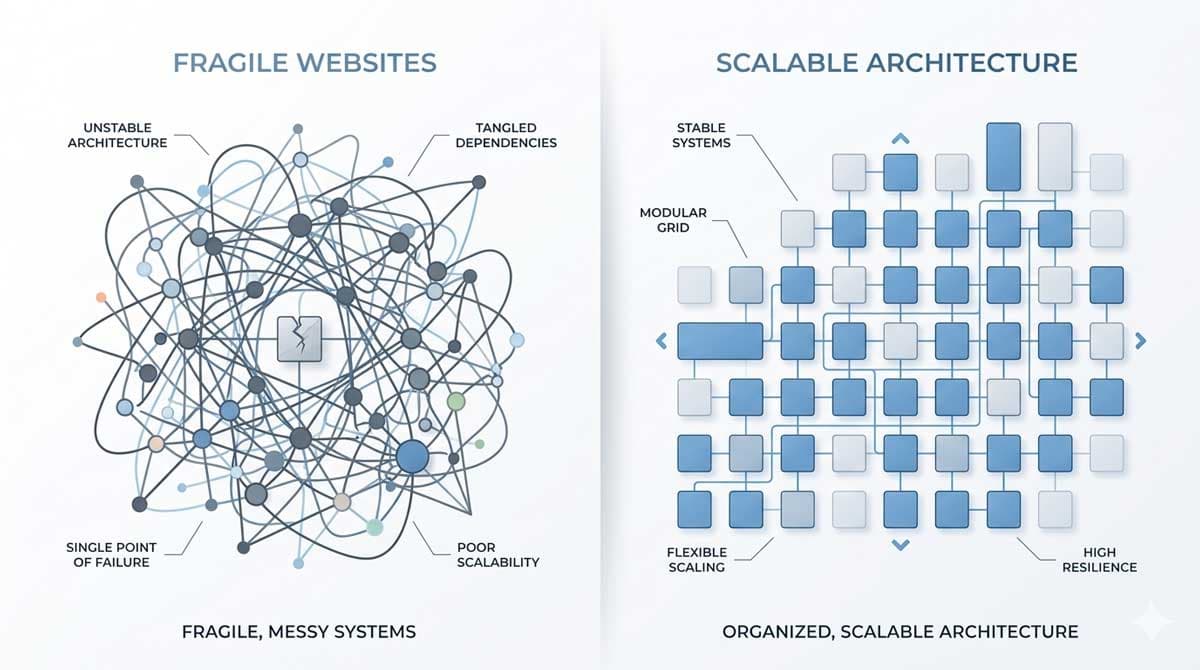
Website builders and template-driven platforms play an important role in helping companies launch quickly. For early stage businesses, this speed is valuable.
Problems appear when growth introduces structural complexity.
The underlying difference between builder platforms and engineered architecture becomes clear when comparing how each handles expansion.
Platform Layer | Website Builder Approach | Scalable Architecture Approach |
Page creation | Manual page duplication | Component driven layouts |
Content management | Page based editing | Structured content models |
Feature expansion | Plug-ins and extensions | Modular services |
Integrations | Embedded scripts | API driven communication |
Performance handling | Shared infrastructure | Optimised deployment |
Website builders prioritise accessibility and simplicity. These qualities help companies launch quickly but limit long term flexibility.
Engineered architectures prioritise modularity and system stability. They require more planning during development, but support long term growth.
Businesses often discover the difference only after their marketing activity increases.
Technical Debt Inside Growing Websites
One of the most overlooked issues in business websites is technical debt.
Technical debt appears when quick solutions accumulate faster than the system evolves. Each small workaround solves an immediate problem but increases complexity over time.
In growing websites, this debt forms gradually.
A plug-in replaces a missing feature.
Custom code patches a layout limitation.
Scripts are inserted for analytics or advertising platforms.
Individually, these decisions seem harmless. Collectively, they reshape the architecture.
Over time, the system becomes harder to update. Developers spend more time avoiding unintended side effects than implementing improvements.
Performance optimisation becomes difficult. Security updates become risky. Introducing new features becomes expensive.
Technical debt rarely appears during the first year of a website’s life. It surfaces later, once the site becomes central to business operations.
Integration Complexity in Modern Businesses
Modern businesses rarely operate with isolated digital tools.
Customer relationship management platforms manage leads. Marketing automation systems track engagement. Payment processors handle transactions. Analytics tools measure behaviour.
The website becomes the point where these systems interact.
When integrations rely on embedded scripts and plug-ins, each tool communicates with the site in its own way. Over time, the communication paths multiply.
Data flows through several layers before reaching its destination.
Errors become difficult to trace.
Performance slows as scripts compete for resources.
Security risks increase.
A scalable architecture approaches integrations differently.
Each external service connects through controlled interfaces. APIs manage how information moves between systems. The website remains the central interface rather than the place where every tool embeds its own logic.
This structure reduces instability as the system grows.
Why Architecture Determines Marketing Performance
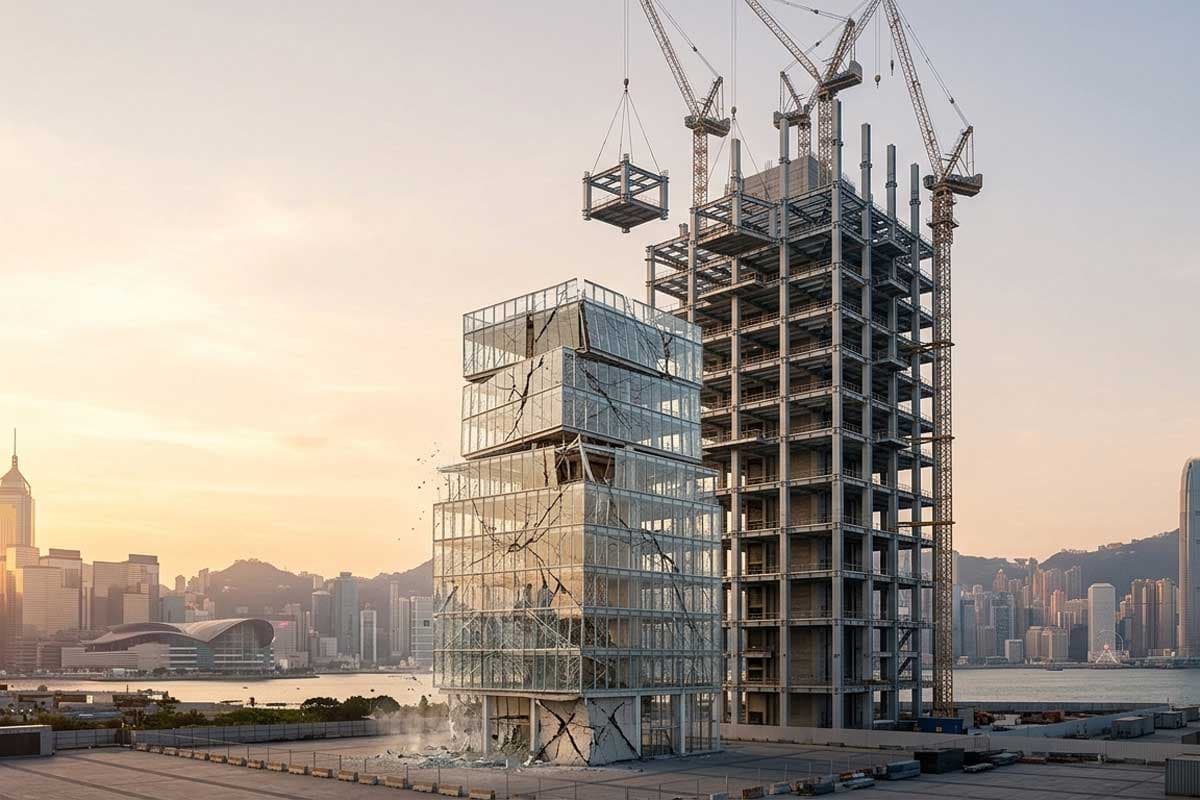
Marketing teams often evaluate website performance through design quality or advertising metrics.
Architecture influences results more than many realise.
Page speed affects conversion rates.
Content structure influences search engine indexing.
Navigation systems determine how visitors explore information.
When the architecture remains flexible, marketing teams experiment quickly. New landing pages appear without disrupting the rest of the system. Content updates propagate across the site automatically.
When architecture becomes rigid, marketing progress slows.
Launching a new campaign requires developer intervention. Updating design patterns requires manual edits across dozens of pages. Experiments become risky.
Businesses often interpret these limitations as marketing problems. In reality, they originate from a technical structure.
Read More: Best Coworking Spaces in Melbourne for Startups & Small Businesses (2026 Guide)
The Shift Toward Website Platforms
As businesses grow, their websites begin behaving less like marketing brochures and more like product platforms.
A platform supports multiple activities simultaneously.
Marketing teams publish campaigns.
Customers access resources.
Sales teams capture leads.
Internal teams manage content.
This level of activity requires architectural stability. The website must support continuous updates while remaining reliable for visitors.
Companies building digital products already understand this mindset. Their applications rely on modular systems that evolve over time.
Business websites are slowly moving in the same direction.
The difference between a temporary marketing site and a long term digital platform often determines how smoothly a company scales its online presence.
The Real Cost of Rebuilding Later
One of the most expensive patterns in web development occurs when businesses postpone architectural upgrades until problems become unavoidable.
At that stage, rebuilding becomes complex.
Content must migrate into a new system.
Design patterns require restructuring.
Integrations must reconnect to the new platform.
Teams must maintain the old website while building the replacement. The transition period introduces operational risk.
The financial cost of rebuilding often exceeds what proper architecture would have required during the original build.
For growing companies, this scenario appears frequently. The first website succeeds in launching the business, but cannot support its next stage.
Rebuilding becomes inevitable.
Final Thoughts
Many Melbourne businesses encounter website scaling problems because their first website served a different purpose.
The original goal focused on launching quickly. That approach worked during the early stage of the company’s life.
Growth changes the requirements.
Marketing campaigns increase traffic. Content strategies expand the site. Integrations connect the website with other business systems.
At this point, architecture begins to matter more than appearance.
A website designed as digital infrastructure supports these changes smoothly. One built purely as a marketing page eventually reaches structural limits.
For companies building serious online operations, the website becomes a long term platform rather than a one time project.
We often see this transition when Melbourne startups begin scaling their digital presence. The difference between a fragile site and a scalable system rarely appears in the design.
It appears in the architecture beneath it.
If you need any help in using business intelligence for your business, you already know how to find us.
Frequently Asked Questions
Why do business websites become slower over time?
Performance drops when websites accumulate heavy scripts, inefficient database queries, and poorly structured assets. Traffic growth exposes these inefficiencies.
Are website builders unsuitable for growing businesses?
Builder platforms serve early stage companies well. Businesses expecting significant traffic or complex integrations often benefit from more flexible architecture.
What defines a scalable website?
Scalable websites rely on modular architecture, structured content models, controlled integrations, and performance optimisation designed for long term growth.
When should a company reconsider its website architecture?
Signs include difficulty publishing new content, slow performance during campaigns, repeated plug-in conflicts, and complex maintenance tasks.
Do small businesses need scalable architecture from the start?
Businesses expecting long term growth often reduce technical debt by adopting structured architecture early.

Admin
Mostafa is a Wordsmith, storyteller, and language artisan weaving narratives and painting vivid imagery across digital landscapes with a spirited pen, he embraces the art of crafting compelling content as a copywriter, and content manager.

Based in
Melbourne, Australia
Your software dev partner, smooth process, exceptional results
Contacts
contact@flamincode.com.au
© All rights reserved to Flamincode