Best Coworking Spaces in Melbourne for Startups & Small Businesses (2026 Guide)

M Chetmars
Author
In 2026, one of the fastest ways for a Melbourne startup to burn runway without realising it is to move into a “professional” space too early.
Coworking feels like progress. It feels like momentum. It feels like you’ve moved from idea-stage to “real business.” But for many early-stage founders, that shift is cosmetic rather than strategic. Renting a desk in a polished building does not automatically accelerate product-market fit, revenue, or hiring quality.
That doesn’t mean coworking is useless. It means timing matters.
Before we unpack the strategic side, here’s the direct answer most founders are actually looking for.
Quick Answer
If you are a Melbourne-based startup or small business in 2026 and you’ve already validated your offer, onboarded paying clients, or started hiring, the strongest coworking environments tend to be:
Hub Australia for structured, CBD-based growth
The Commons for creative and early product teams
WeWork for premium location and national scalability
Startup-adjacent spaces influenced by LaunchVic for ecosystem proximity
These spaces offer flexibility, recognisable addresses, and infrastructure that supports scaling teams better than long-term commercial leases.
However, if you are pre-revenue, still testing positioning, or building solo, coworking is often a premature fixed cost disguised as professionalism.
Coworking Readiness Snapshot (Melbourne 2026)
Startup Situation | What Coworking Actually Becomes | Strategic Verdict |
Pre-revenue, still validating | A cosmetic credibility upgrade | Too early |
Early revenue, unstable pipeline | Controlled overhead experiment | Conditional |
Stable revenue, hiring in progress | Operational coordination tool | Appropriate |
Scaling team, client-facing growth | Infrastructure multiplier | Strong fit |
Now let’s unpack why.
The Illusion of “Looking Established”

Melbourne has a strong startup culture, but it also has a subtle status culture. Collins Street addresses, glass meeting rooms, well-designed communal kitchens — they signal legitimacy.
For founders, especially first-time ones, this signalling can be psychologically powerful. Sitting in a CBD coworking space feels different from working at home in Footscray or Preston. It changes your posture. It changes how you talk about your business.
The problem is that external legitimacy doesn’t fix internal fundamentals.
If your offer is still shifting, your pricing isn’t stable, or your target audience isn’t clearly defined, paying $700–$1,200 per person per month for a polished environment doesn’t solve those structural gaps. It simply increases monthly burn.
In early-stage companies, cash is oxygen. Every recurring expense reduces strategic flexibility. Coworking becomes dangerous when it is treated as a growth engine rather than what it actually is: operational infrastructure.
Infrastructure supports growth. It doesn’t create it.
The Melbourne Cost Reality in 2026
Let’s look at the numbers realistically.
In Melbourne, hot desks commonly sit in the mid-hundreds per month. Dedicated desks trend higher. Private offices scale quickly once you move beyond three or four team members. Add to that transport costs, coffee, team lunches, and incidental spending that naturally increase when you operate in shared environments.
For a three-person startup, even a modest coworking setup can cross well into five figures annually. For many early-stage businesses, that represents months of marketing budget, product iteration, or contractor support.
Founders often justify this by saying, “We need to get out of the house to take it seriously.”
But seriousness is a discipline issue, not a location issue.
If a startup cannot maintain structure and output from a low-overhead environment, moving into a premium building rarely fixes the underlying problem.
When Coworking Actually Makes Strategic Sense

There is, however, a clear inflection point where coworking stops being vanity and starts being leverage.
The shift usually happens when one of three things occurs.
First, hiring becomes active and regular. Bringing candidates into a credible environment matters. Interviewing engineers or account managers in a café limits perception. A neutral, professional space reduces friction.
Second, client acquisition depends on in-person meetings. Certain B2B sectors in Melbourne still value face-to-face interaction. A central location can shorten sales cycles and increase trust.
Third, internal collaboration begins to suffer remotely. Once product, marketing, and operations need faster iteration loops, physical proximity can improve decision speed.
In these scenarios, coworking is not about optics. It becomes an efficiency multiplier.
The mistake is assuming that every startup reaches that point at the same time.
Read More: Starting a Small Business in Melbourne from Home
The Psychological Trap of “Momentum Spending”
There’s a pattern we see repeatedly in Melbourne’s early-stage scene.
A founder raises a small round or secures a grant. The first instinct is to upgrade visibility: better branding, new logo, CBD address, coworking membership.
It feels like forward motion.
But growth does not respond to aesthetic upgrades. It responds to market clarity.
Coworking should be a response to operational pressure, not an emotional milestone.
This is particularly relevant in 2026, where hybrid norms are stable. Many successful Australian startups operate remotely far longer than they would have in 2019. Talent pools are wider. Remote collaboration tools are mature. The cultural stigma of “no office” has largely disappeared.
In that context, committing to fixed monthly space costs too early is less defensible than it once was.
The Other Side: Why Avoiding Coworking Too Long Can Also Stall Growth
It would be simplistic to argue that coworking is a waste across the board.
Isolation can quietly erode ambition. Working solo for extended periods narrows exposure. Melbourne’s startup ecosystem thrives on proximity. Informal introductions in shared kitchens do still happen. Partnerships are still formed across communal tables.
For small businesses, especially service-based ones, shared spaces can generate unexpected referrals simply because you are physically visible.
There is also a psychological dimension to team cohesion. At a certain size, remote-first becomes fragmented rather than flexible. Culture forms more easily in shared physical environments.
The strategic question, therefore, is not “Is coworking good or bad?”
It is: “Has my company earned the overhead?”
If revenue is consistent, pipeline visibility is strong, and growth requires coordination rather than experimentation, then space becomes a tool rather than a cost centre.
Stage Alignment: Not Every “Best” Space Is Right for You

One of the most misleading habits in startup content is ranking coworking spaces as if they operate in a vacuum. In reality, the “best” coworking space in Melbourne is entirely dependent on where your company sits on the growth curve.
Check Your Position
A pre-revenue solo founder sitting inside a premium Collins Street building is not gaining leverage. They are absorbing overhead. Meanwhile, a five-person team trying to coordinate remotely from five suburbs may be losing thousands of dollars in slowed execution simply because they avoided committing to a shared space.
Melbourne’s coworking geography reinforces this stage dynamic.
The CBD, particularly around Collins Street and Southern Cross, tends to attract later-stage startups, professional services firms, and investor-facing teams. Spaces like Hub Australia and WeWork in these precincts carry a certain level of polish. The buildings are impressive. The meeting rooms feel investor-ready. The addresses signal seriousness.
But seriousness only converts into advantage if your business model is ready to capitalise on it.
If you are still experimenting with messaging, pivoting pricing, or validating early traction, paying for that signal produces diminishing returns.
Are You Looking for This?
Cremorne and Richmond, by contrast, feel structurally different. These areas have quietly become Melbourne’s tech corridor. Product teams, indie SaaS founders, marketing agencies, and early-stage startups cluster here. The Commons locations in these suburbs tend to attract builders rather than presenters. The environment is less about impressing and more about iterating.
For an early product team, this atmosphere often aligns better with reality. You’re surrounded by people debugging, launching, and experimenting—not just pitching.
The distinction matters more than most founders realise.
Startup Stage Alignment Matrix
Startup Stage | Revenue Status | Team Size | Coworking Recommendation | Risk Level |
Idea / Pre-Validation | No revenue | 1 | Avoid fixed space. Use occasional hot desks only. | 🔴 High burn risk |
Early Validation | Inconsistent revenue | 1–3 | Hybrid use. Flexible plans only. | 🟠 Moderate |
Post-PMF / Growing | Stable revenue | 3–6 | Dedicated desks or small private office | 🟢 Strategic |
Scaling / Funded | Strong pipeline | 6+ | Private office or structured CBD space | 🟢 Low |
The Lease Comparison Most Startups Ignore
Coworking often gets compared only to “working from home.” That’s a false comparison.
The real strategic comparison is between coworking and a traditional commercial lease.
In Melbourne, even modest office leases typically require multi-year commitments, bonds, legal agreements, and fit-out costs. The capital required to furnish and configure a small office can easily exceed what many early-stage startups have available without sacrificing runway.
Coworking eliminates fit-out risk and long-term lock-in. It externalises infrastructure. Utilities, cleaning, security, internet redundancy, and reception services are bundled into a predictable monthly cost.
From a financial modelling perspective, this converts capital expenditure into operating expenditure. For funded startups, this preserves liquidity. For bootstrapped businesses, it preserves optionality.
However, the hidden trade-off is density pricing. Once teams exceed five to eight people, per-desk coworking pricing can approach or exceed the effective cost of a modest leased office.
This is where founders need to calculate honestly. Coworking is efficient at a small scale and flexible at a medium scale. Beyond that, it becomes convenience-priced rather than cost-efficient.
Understanding where your team sits on that curve is critical.
Infrastructure Cost Reality (Melbourne 2026)
Option | Upfront Cost | Monthly Cost Predictability | Flexibility | Best For |
Work From Home | $0 | Very High | Maximum | Solo founders |
Coworking (Hot Desk) | Low | Medium | High | Early validation |
Coworking (Private Office) | Low–Medium | Medium | Medium | Growing teams |
Traditional Lease | High (Bond + Fitout) | Low | Low | Stable scaleups |
The Community Myth and the Reality of Serendipity

Coworking brands heavily market the concept of “community.” In theory, you’re buying access to introductions, referrals, partnerships, and spontaneous collaboration.
In practice, the community varies wildly between buildings.
Some spaces foster meaningful interaction. Others operate more like quiet libraries where everyone wears headphones and avoids eye contact.
The presence of a recognisable ecosystem actor like LaunchVic in the broader Melbourne landscape does influence where ambitious founders cluster. Proximity to startup programs, pitch nights, and accelerator events can genuinely increase exposure.
But no coworking space guarantees opportunity. Serendipity cannot be scheduled.
Founders who expect coworking to generate leads passively often leave disappointed. Coworking is not a distribution strategy. It is a context amplifier. If you are already networking, selling, and building publicly, the shared environment can enhance that. If you are not, it simply becomes a more expensive desk.
This is an uncomfortable truth, but it matters.
Read More: 10 Interesting Facts About Melbourne
Hybrid Is No Longer a Compromise
One of the biggest structural changes since 2020 is that hybrid work is now fully normalised in Australia. Clients are comfortable meeting over Zoom. Engineers expect flexibility. Interstate collaboration is standard.
This changes the coworking equation.
Startups are no longer choosing between “real office” and “home office.” They are choosing how often and why they gather physically.
Many Melbourne startups now operate with partial coworking usage. Two or three core days per week in a shared office. Remote flexibility otherwise. This reduces cost while preserving team cohesion.
The mistake is committing to full-time space before testing the hybrid discipline. Coworking providers are increasingly flexible, but founders still default to traditional workweek assumptions.
A smarter approach is to treat coworking as modular infrastructure rather than a permanent identity marker.
The Hiring Signal Question
There is one area where coworking can deliver disproportionate value: recruitment.
Talented candidates still interpret the environment as a signal. A credible workspace in Melbourne’s CBD or tech corridor can increase perceived stability. For certain hires—particularly mid-level professionals leaving established firms—the absence of any physical footprint can raise doubts.
That does not mean a premium address is mandatory. It means clarity is mandatory.
If your business model relies heavily on attracting in-person collaboration talent, coworking may accelerate hiring confidence.
If your model is distributed, remote-first, or contractor-driven, the signal is weaker.
Again, the theme repeats: alignment over aesthetics.
Choosing Deliberately, Not Emotionally
The biggest risk in Melbourne’s 2026 startup environment is copying what “looks right.”
Seeing other founders in polished shared offices creates pressure. Social media reinforces the image. It feels like a rite of passage.
But strategic founders reverse the question.
They ask: does this expense unlock leverage, or does it simply reduce my runway?
Coworking can absolutely support growth. It can increase velocity, sharpen culture, and strengthen external perception. It can also quietly drain resources when adopted prematurely.
The difference is rarely the building itself. It is the timing and the clarity of purpose behind the move.
In the next section, we’ll break down specific coworking environments in Melbourne and map them directly to startup stage, so the decision becomes tactical rather than emotional.
Mapping Melbourne Coworking Spaces to Startup Stages
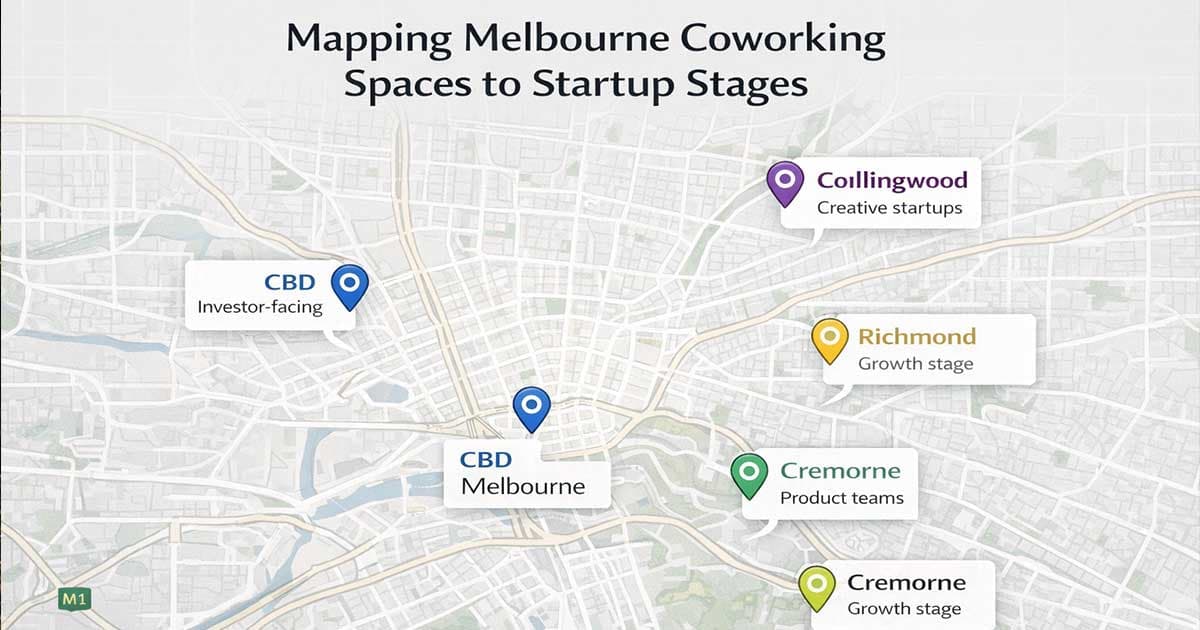
Now that emotion is out of the equation, the real question becomes practical: not which coworking space in Melbourne is “best,” but which one fits your company’s operational maturity.
Solo Founders or Early-Stage Teams
For solo founders or very early-stage teams still validating demand, a full-time dedicated desk in a premium CBD tower is rarely justified. At this stage, optionality matters more than optics. If coworking is used at all, it should remain flexible—occasional hot-desk access for focus sessions or meetings rather than fixed monthly infrastructure.
Creative corridors like Collingwood and Richmond tend to suit this phase better. Spaces such as The Commons attract builders rather than presenters. The atmosphere is iterative, not corporate—aligned with teams still shaping product and positioning.
Phase Two Teams
Once startups move from experimentation to execution—typically two to six people with stable revenue—the calculus shifts. Coordination becomes expensive when fragmented. Hiring becomes deliberate. Client meetings become frequent. At this point, structured CBD environments like Hub Australia begin to offer leverage through credibility and predictable infrastructure without long-term lease exposure.
Scaling Teams
For venture-backed or rapidly scaling teams, continuity outweighs flexibility. Providers like WeWork can support multi-city expansion and team stability. However, at this level, founders should compare per-desk pricing against small private leases; convenience premiums increase as headcount grows.
Startups
Ecosystem-adjacent spaces influenced by LaunchVic are most valuable for founders actively pursuing capital or mentorship. In these environments, proximity can unlock introductions—but only if the startup is ready to capitalise on them.
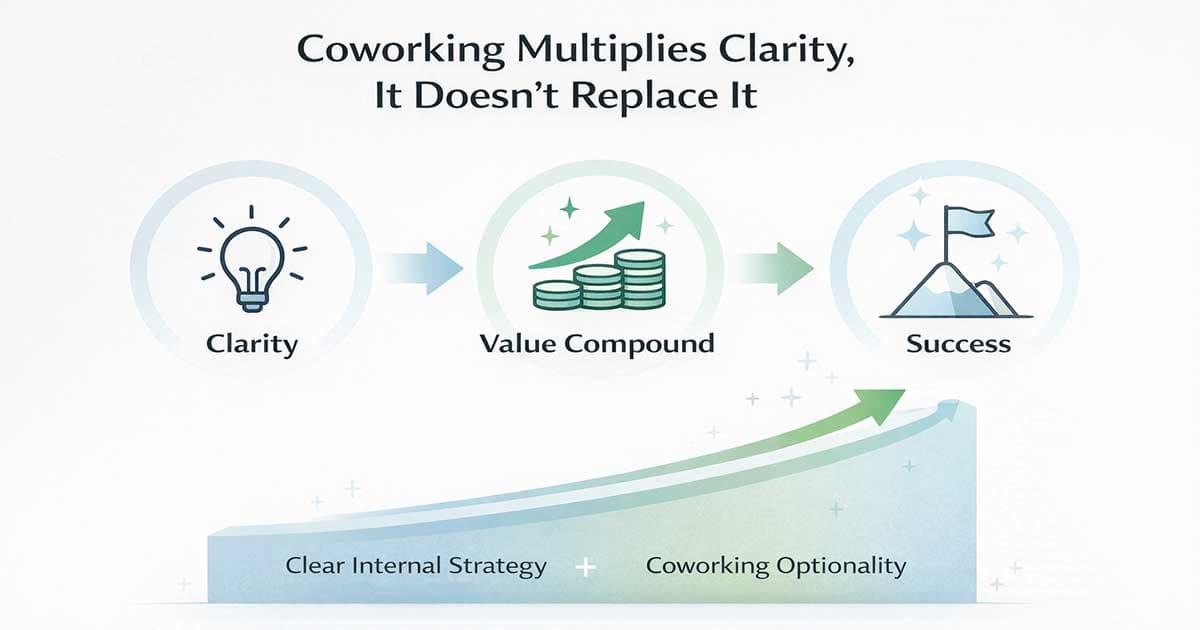
The pattern remains consistent: coworking multiplies clarity. It does not replace it.
Read More: Fun Activities in Melbourne for Adults
The Common Mistakes Startups Make When Choosing Coworking
Across Melbourne’s early-stage scene, the same selection errors repeat.
The first is confusing visibility with validation. A polished office does not validate product-market fit. Founders often upgrade the environment before upgrading the offer. The result is higher burn without higher revenue.
The second mistake is overcommitting too early. Locking into multi-person private offices before team dynamics are stable creates rigidity. If hiring shifts or strategy pivots, space becomes an anchor rather than an asset.
The third mistake is underestimating a hybrid discipline. Many teams move into coworking full-time when partial usage would achieve the same cultural benefits at significantly lower cost.
Finally, there is the social comparison trap. Seeing other founders in shared offices creates perceived pressure. But growth trajectories differ. Mimicking someone else’s infrastructure timeline rarely produces optimal results.
Strategic infrastructure decisions are rarely glamorous. They are often conservative.
The Strategic Framework: Three Questions Before You Commit
Before signing any coworking agreement in Melbourne, founders should be able to answer three questions clearly.
First, is this move responding to operational bottlenecks or emotional discomfort? If the problem is distraction or lack of discipline, structural habits may solve it more cheaply than new overhead.
Second, will this space directly increase revenue velocity, hiring confidence, or execution speed? If the answer is vague, the cost is likely premature.
Third, does the monthly commitment reduce flexibility in a way that limits future pivots? Early-stage startups thrive on agility. Infrastructure should support that, not constrain it.
If those questions produce confident, measurable answers, coworking is likely aligned. If they produce ambiguity, waiting may be the smarter move.
Where Coworking Genuinely Adds Leverage in Melbourne
Despite the caution, coworking does offer genuine strategic advantages in specific contexts.
Melbourne remains relationship-driven. Physical proximity still accelerates trust-building in certain B2B sectors. If your customer acquisition strategy depends on in-person rapport, a central address reduces friction.
Recruitment is another area of leverage. Candidates often interpret structured environments as stability signals. For startups entering competitive hiring markets, coworking can shorten trust gaps.
There is also cultural cohesion. At a certain team size, asynchronous communication slows iteration. Coworking restores feedback loops.
The key is understanding that coworking amplifies clarity. It does not create it.
Final Thoughts: Infrastructure Should Follow Traction
The most sustainable startups in Melbourne rarely chase optics. They sequence decisions.
First comes validation.
Then comes revenue consistency.
Then comes operational pressure.
Only then should fixed infrastructure expand.
Coworking, when timed correctly, is a powerful tool. When adopted prematurely, it becomes runway erosion disguised as ambition.
The best coworking spaces in Melbourne for startups and small businesses are not inherently good or bad. They are context-dependent. What matters is whether your company has reached the stage where physical infrastructure multiplies performance rather than merely improving appearance.
Infrastructure should follow traction—not precede it.
We are Flamincode, and our team talk about many different topics. I, as the writer of the team, am responsible for writing about what we talk about. But in fact, our main mission is something more than talking; it's helping Australian businesses with app development or websites.
Frequently Asked Questions
Is coworking worth it for pre-revenue startups in Melbourne?
In most cases, no. Until product-market fit or early revenue consistency exists, preserving flexibility and runway is usually more strategic than committing to fixed monthly infrastructure.
When does coworking start making financial sense?
Typically, when hiring accelerates, client meetings increase, or collaboration friction slows execution. At that point, the productivity gains can outweigh the cost.
Is the Melbourne CBD better than Cremorne or Collingwood?
It depends on your business model. CBD locations suit investor-facing and client-heavy companies, while Cremorne and Collingwood often align better with product-focused and early-stage teams.
Should startups choose private offices over hot desks?
Only if internal coordination demands consistency, early teams often benefit from flexibility before committing to fixed enclosed spaces.
Can coworking replace a traditional long-term lease?
For small to mid-sized teams, yes. Beyond a certain scale, however, leasing may become more cost-efficient depending on headcount and growth stability.

Admin
Mostafa is a Wordsmith, storyteller, and language artisan weaving narratives and painting vivid imagery across digital landscapes with a spirited pen, he embraces the art of crafting compelling content as a copywriter, and content manager.
Comments

This makes a solid point about coworking: it's not always the productivity boost founders think it is. Timing really is key.

Based in
Melbourne, Australia
Your software dev partner, smooth process, exceptional results
Contacts
contact@flamincode.com.au
© All rights reserved to Flamincode