Top 11 Best CRM Software in the World for Modern Businesses (2026)

M Chetmars
Author
Choosing a CRM platform looks simple at first.
Most companies search for “best CRM software”, compare a few popular tools, then pick the platform with the most features or the lowest price.
A few months later the problems begin.
Sales pipelines become messy. Integrations break. Reporting becomes unreliable. Teams start exporting data into spreadsheets again.
We have seen this pattern many times while working with growing companies in Melbourne’s startup ecosystem. The problem is rarely the CRM itself. The problem is choosing software that does not match the operational complexity of the business.
The best CRM systems do more than store contacts. They organise revenue operations, align sales and marketing teams, and turn customer data into decisions.
In this guide we review the Top 11 best CRM software in the world, focusing on platforms that organisations use for real business operations rather than simple contact management.
Quick Answer:
The most widely used CRM platforms in the world include:
Salesforce
HubSpot CRM
Zoho CRM
Microsoft Dynamics 365
Pipedrive
Monday CRM
Freshsales
SAP CRM
Oracle CX
Nimble
And one more option that many growing companies eventually consider:
Custom CRM systems designed for specific operational workflows.
The right choice depends on company size, integration requirements, and long term scalability.
CRM Comparison Table
CRM Platform | Best For | Pricing Level | Complexity | Typical Company Size |
Salesforce | Enterprise revenue operations | High | High | Large organisations |
HubSpot CRM | Marketing driven teams | Medium | Medium | Startups to mid market |
Zoho CRM | Cost efficient growth | Low | Medium | Small to mid businesses |
Microsoft Dynamics 365 | Microsoft ecosystem companies | High | High | Enterprise organisations |
Pipedrive | Sales pipeline management | Low | Low | Small sales teams |
Monday CRM | Visual workflow management | Medium | Low | Creative and project teams |
Freshsales | AI assisted sales workflows | Medium | Medium | SaaS and tech firms |
SAP CRM | Enterprise resource planning integration | High | High | Global enterprises |
Oracle CX | Data intensive organisations | High | High | Large enterprises |
Nimble | Relationship driven sales | Low | Low | Consultants and agencies |
Custom CRM | Unique operational workflows | Variable | Variable | Scaling companies |
Choosing CRM Software for Growing Businesses in Melbourne and Australia

While the CRM platforms listed in this guide are used worldwide, the way companies adopt CRM software can vary depending on the local business environment.
In Melbourne’s fast-growing startup ecosystem, many companies initially choose platforms like HubSpot, Zoho CRM, or Pipedrive because they are easy to implement and integrate with marketing tools.
As businesses scale, operational complexity increases. Sales teams need deeper automation, marketing teams require more advanced attribution data, and leadership teams demand reliable forecasting.
At this stage, organisations often move toward enterprise platforms such as Salesforce or Microsoft Dynamics, or begin exploring custom CRM development to align the system with their internal workflows.
For many Melbourne businesses operating in competitive technology and services markets, the real challenge is not choosing a CRM platform — it is designing the right CRM architecture to support long-term growth.
What Makes a CRM Platform “The Best”?
Popularity alone does not make a CRM system effective. Many widely adopted platforms struggle when businesses scale beyond their original workflows.
In practice, the best CRM software platforms share several characteristics.
Scalability
CRM software must support growth. As companies add sales teams, marketing automation, and customer support operations, the system must handle larger data sets and more complex workflows.
Enterprise platforms like Salesforce and Microsoft Dynamics excel in scalability because their architecture supports advanced configuration and automation.
Integration Ecosystem
Modern companies operate across multiple tools. Payment systems, analytics dashboards, marketing platforms, and support software all generate customer data.
A CRM platform must integrate with these systems to maintain a unified data environment.
Without integrations, teams quickly return to manual data transfers and fragmented reporting.
Workflow Automation
Sales teams should not spend hours updating records.
Automation allows organisations to assign leads, trigger follow up tasks, and update pipeline stages automatically. This improves operational efficiency and reduces human error.
Reporting and Forecasting
One of the main reasons businesses implement CRM systems is to improve visibility.
High quality platforms provide revenue forecasting, pipeline analytics, and customer lifecycle reporting that allow leaders to make informed decisions.
Customisation
No two businesses operate exactly the same way.
The most effective CRM platforms allow teams to customise pipelines, fields, dashboards, and permissions without destabilising the system.
Rigid CRM tools often fail when organisations attempt to adapt them to complex workflows.
Read More: Free Website Builders in Australia
A Closer Look to the Best CRM Software in 2026
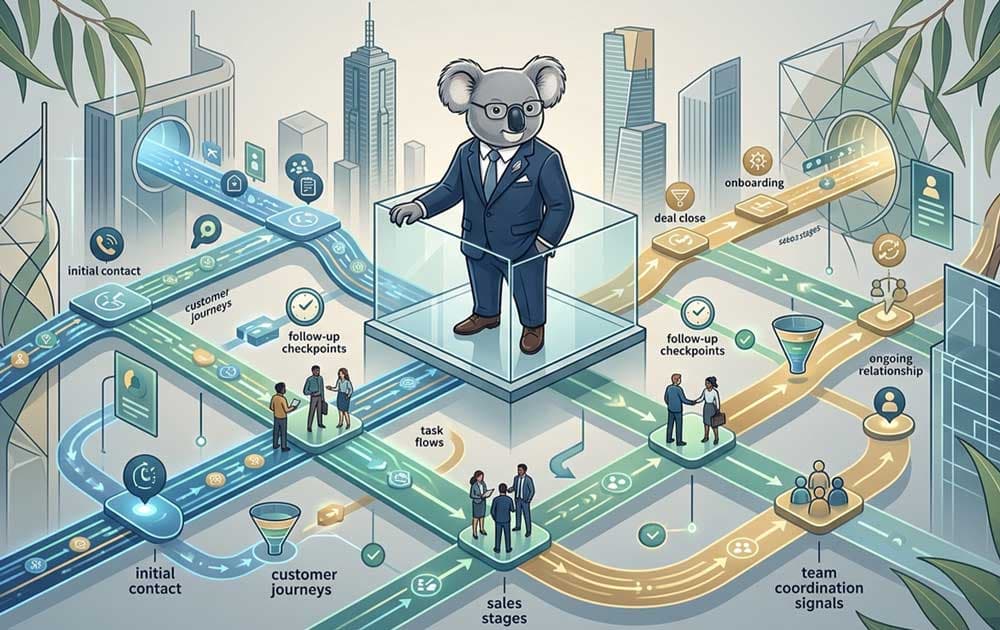
Now, let's see which one of the trending CRM software out there suits your needs the most:
1. Salesforce
Salesforce remains one of the most widely adopted CRM platforms in the world.
Large organisations rely on Salesforce because the platform supports complex operational environments. It manages multi-team sales pipelines, advanced automation workflows, and detailed customer data structures within a single system.
Another major advantage is the ecosystem surrounding Salesforce. Thousands of third-party applications integrate with the platform. This allows companies to connect marketing tools, analytics systems, communication platforms, and internal software into a unified data environment.
This flexibility explains why many enterprise organisations continue to choose Salesforce as the backbone of their revenue operations.
However, the platform requires careful implementation. Configuration often involves dedicated CRM specialists and structured planning. Without proper setup, teams may struggle with complexity and underused features.
For large companies with complex sales operations, Salesforce remains one of the most capable CRM platforms available today.
2. HubSpot CRM
HubSpot CRM earned its reputation by making CRM adoption easier for growing companies. Many organisations first encounter HubSpot through its marketing tools, then expand into sales and customer management as their operations mature.
The platform focuses on usability. Teams often begin working with HubSpot without heavy implementation projects or dedicated administrators.
This simplicity makes it attractive for startups and mid-size companies.
HubSpot combines three major operational areas into a single environment.
marketing automation
sales pipeline management
customer service tools
This unified structure reduces the fragmentation that many companies experience when using multiple disconnected platforms.
Another reason HubSpot appears in most “best CRM software” discussions is its integration ecosystem. Thousands of third-party tools connect directly with the platform, allowing companies to link marketing campaigns, analytics dashboards, and communication systems.
However, the platform becomes more expensive as organisations scale. Advanced automation features and enterprise capabilities sit behind higher pricing tiers.
For marketing driven companies that want a CRM system tightly connected to lead generation, HubSpot remains one of the most practical choices.
3. Zoho CRM
Zoho CRM built its reputation around affordability and flexibility.
Many small and mid-size businesses choose Zoho because it offers a broad feature set at a lower cost compared to enterprise CRM systems. Despite the accessible pricing, the platform still supports automation, analytics, and integration capabilities.
Zoho also benefits from a large ecosystem of related business tools.
The broader Zoho environment includes email marketing, accounting software, project management tools, and help desk platforms. When companies adopt multiple Zoho applications, they gain a tightly connected operational environment.
This integration strategy allows businesses to centralise operations without relying heavily on external software providers.
Another advantage of Zoho CRM is its customisation flexibility. Users can adjust pipelines, create automation rules, and design dashboards without deep technical expertise.
For companies seeking a balance between capability and cost efficiency, Zoho CRM remains one of the strongest contenders among global CRM platforms.
4. Microsoft Dynamics 365
Microsoft Dynamics 365 occupies a unique position within the CRM market.
Unlike many standalone CRM platforms, Dynamics sits inside the broader Microsoft business ecosystem. Organisations already using tools such as Microsoft 365, Power BI, Azure, and Teams often choose Dynamics because of the natural integration between these services.
The platform supports a wide range of operational functions.
Sales management, customer service operations, marketing automation, and financial workflows can all operate within the same system architecture.
This makes Dynamics particularly attractive for enterprise environments that require unified data across departments.
The analytics capabilities of Dynamics also stand out. Through integration with Power BI, organisations gain access to advanced reporting and business intelligence dashboards.
However, the platform typically requires professional implementation and configuration. Companies rarely deploy Dynamics successfully without structured planning and technical expertise.
For organisations deeply embedded in the Microsoft ecosystem, Dynamics 365 represents one of the most logical CRM solutions available.
5. Pipedrive

Pipedrive focuses on a single goal. Helping sales teams manage deals effectively.
Unlike complex enterprise platforms, Pipedrive emphasises simplicity and clarity. The interface revolves around visual pipelines that allow sales representatives to track opportunities as they move through each stage of the sales process.
This design approach reduces administrative overhead.
Sales teams spend less time navigating complicated menus and more time focusing on customer conversations and deal progression.
Pipedrive also includes automation features that handle routine tasks such as follow up reminders, lead assignments, and activity scheduling.
While the platform does not attempt to compete with enterprise CRM systems in terms of deep analytics or cross department integrations, it performs exceptionally well in its intended role.
For small sales teams that prioritise deal management and pipeline visibility, Pipedrive remains one of the most effective CRM platforms available.
Read More: Top Trending JavaScript Frameworks in 2026
6. Monday CRM
Monday CRM evolved from the broader Monday work management platform.
The company originally built its reputation around visual project management tools. Over time, it expanded its capabilities into CRM functionality designed for teams that value flexible workflow management.
The platform stands out because of its visual interface.
Users interact with boards that represent processes, pipelines, and operational workflows. These boards can be customised extensively, allowing teams to design CRM structures that match their internal processes.
Another advantage is collaboration.
Teams can track leads, manage customer communication, and coordinate internal tasks within the same workspace.
For organisations that want a CRM platform closely connected to operational workflows rather than traditional sales pipelines, Monday CRM offers a flexible alternative.
7. Freshsales
Freshsales belongs to the broader Freshworks software ecosystem.
The platform focuses on providing sales teams with automation and AI assisted insights that help identify high value opportunities.
Freshsales integrates customer data from email communication, website interactions, and support channels. This allows sales teams to understand customer behaviour before initiating conversations.
One notable feature is the platform’s built in communication tools.
Sales representatives can manage email conversations, track engagement, and schedule follow ups directly within the CRM environment.
Freshsales also provides lead scoring mechanisms powered by behavioural data. These systems help teams prioritise prospects who demonstrate stronger purchase intent.
For SaaS companies and technology driven organisations, Freshsales offers a modern CRM environment with automation capabilities designed to support fast moving sales cycles.
8. SAP CRM
SAP CRM serves a different segment of the market compared to most other platforms on this list.
The system integrates deeply with SAP’s enterprise resource planning infrastructure. As a result, it is often deployed within large organisations that already rely on SAP systems for finance, logistics, and supply chain management.
The primary strength of SAP CRM lies in its ability to connect customer management with broader enterprise operations.
Sales activity, product availability, manufacturing data, and distribution logistics can all interact within a unified enterprise system.
This level of integration provides large organisations with a comprehensive view of operational performance.
However, SAP CRM typically requires significant implementation resources and specialised expertise. It is rarely adopted by small or mid-size businesses due to the complexity involved.
For multinational corporations operating large scale infrastructure, SAP CRM remains one of the most integrated customer management environments available.
9. Oracle CX
Oracle CX represents Oracle’s approach to customer experience management.
The platform combines CRM capabilities with advanced analytics and enterprise level data management. Organisations that operate large customer datasets often choose Oracle CX because of its strong data architecture.
One of the platform’s defining characteristics is its analytics capability.
Oracle integrates machine learning models and predictive analytics tools that allow companies to identify behavioural trends within large customer populations.
These insights help marketing and sales teams optimise engagement strategies across multiple channels.
Oracle CX also integrates with Oracle’s broader cloud infrastructure, making it suitable for organisations that already rely on Oracle technologies.
Similar to SAP CRM, the platform targets enterprise environments where scalability and data management capacity are critical.
10. Nimble
Nimble approaches CRM from a relationship perspective.
Rather than focusing solely on structured pipelines and automation, Nimble emphasises relationship tracking across social platforms, email communication, and networking interactions.
The system automatically gathers contact information from various digital sources and builds enriched customer profiles.
This functionality proves useful for consultants, agencies, and small teams that rely heavily on personal relationships rather than complex sales pipelines.
Nimble also integrates with widely used tools such as Microsoft 365 and Google Workspace, making it accessible for teams that want CRM functionality without extensive setup.
While Nimble does not compete with enterprise platforms in terms of deep automation or advanced analytics, it provides a lightweight CRM solution for relationship driven businesses.
11. Custom CRM Systems
Every platform discussed so far belongs to the category of off-the-shelf CRM software.
These systems work well for many organisations. Yet companies eventually encounter limitations when their workflows become more specialised.
At this point many organisations begin exploring custom CRM systems.
A custom CRM platform is built specifically for the operational structure of a company. Instead of adapting workflows to match existing software, the system reflects the processes already used by the organisation.
Custom CRM solutions typically provide several advantages.
workflows designed around internal operations
integrations with proprietary business systems
tailored analytics dashboards
scalable architecture aligned with company growth
Custom development requires careful planning and technical expertise. However, for organisations with complex operations, the flexibility often outweighs the initial development investment.
Read More: Custom Web Design Services Australia
When Off-The-Shelf CRM Software Stops Working

Many companies adopt popular CRM platforms during early growth stages. At this point, operational complexity remains manageable.
As the organisation grows, new requirements appear.
Marketing teams require deeper automation. Sales teams need advanced forecasting tools. Support departments generate customer data that must integrate with existing records.
These evolving requirements often expose limitations within standard CRM software.
Common challenges include:
rigid data structures that limit custom workflows
integration constraints with internal systems
performance issues with large datasets
licensing costs that increase rapidly with team growth
At this stage companies face an important strategic decision. Continue adapting their processes to match existing software, or invest in systems designed specifically for their operational model.
Hot Take: Why Many CRM Implementations Fail
CRM software itself rarely causes failure.
Most CRM implementations fail because organisations treat CRM as a simple tool rather than operational infrastructure.
A CRM system sits at the centre of revenue operations. It connects marketing activity, sales pipelines, and customer retention processes. If the architecture is poorly designed, the entire data environment becomes unreliable.
Common failure patterns include:
implementing CRM software without clear workflow definitions
neglecting integration planning with existing tools
focusing on features instead of operational alignment
underestimating data governance requirements
Successful CRM adoption requires careful planning and alignment between technology and business processes.
Companies that treat CRM as infrastructure rather than software tend to achieve significantly better results.
Final Thoughts
Choosing the best CRM software in the world depends on more than feature lists or popularity rankings.
Each organisation operates within its own structure of processes, tools, and growth objectives. A CRM platform must support these realities rather than forcing teams to restructure their operations around the limitations of software.
Enterprise organisations often choose platforms such as Salesforce, Microsoft Dynamics, or SAP CRM because of their scalability and integration ecosystems.
Growing companies frequently adopt HubSpot, Zoho CRM, or Freshsales because these systems balance usability with automation capabilities.
Smaller teams may prefer focused solutions such as Pipedrive or Nimble that emphasise simplicity and relationship management.
Eventually some organisations reach a point where custom CRM development becomes the most effective path forward.
Regardless of the platform chosen, the underlying goal remains the same.
Transform customer data into operational clarity, and transform operational clarity into long term business growth.
If your business operates in Melbourne and your CRM system no longer supports your workflows, our team at Flamincode can help design and build a custom CRM tailored to your operations. Check our services like app development and business intelligence to get to know us more.
Frequently Asked Questions
What is the best CRM software in the world?
Salesforce often ranks as the most widely adopted CRM platform globally due to its extensive ecosystem and scalability. However, the best CRM depends on company size, workflows, and integration requirements.
Is HubSpot better than Salesforce?
HubSpot offers easier onboarding and strong marketing automation features. Salesforce provides deeper customisation and enterprise level scalability.
What CRM do startups usually use?
Many startups begin with HubSpot CRM, Zoho CRM, or Pipedrive because these platforms offer accessible pricing and relatively simple implementation.
When should a company consider a custom CRM?
Companies often explore custom CRM development when off-the-shelf systems no longer support complex workflows, integrations, or data structures required for their operations.
Which CRM integrates best with modern tech stacks?
Salesforce, HubSpot, and Microsoft Dynamics provide some of the largest integration ecosystems, making them suitable for organisations operating complex technology environments.
What CRM software do Melbourne startups usually use?
Many Melbourne startups begin with platforms like HubSpot CRM, Zoho CRM, or Pipedrive because they are easy to implement and integrate with marketing tools. As companies scale, some organisations move toward more advanced systems such as Salesforce or explore custom CRM development tailored to their operational workflows.

Admin
Mostafa is a Wordsmith, storyteller, and language artisan weaving narratives and painting vivid imagery across digital landscapes with a spirited pen, he embraces the art of crafting compelling content as a copywriter, and content manager.
Based in
Melbourne, Australia
Your software dev partner, smooth process, exceptional results
Contacts
contact@flamincode.com.au
© All rights reserved to Flamincode