Is Web Design Different from Web Development?

M Chetmars
Author
Planning on a new website? Thinking about improving the current one? So you probably have heard about web development and web design. Sometimes these terms are used interchangeably, but in fact, they are different.
Let’s say web design, as the name suggests, is about how a website feels and looks. So, it’s all about the appearance of the website.
Web development, on the other hand, is about how a website works, which can be translated to the website’s functionality and speed.
But which one should you invest in? What kind of specialist do you need? How do these work together?
In this article, we’re going to talk about these concepts. After reading this, you’ll know how each one of them supports your business goals.
Web Design | Web Development |
Focuses on appearance and user experience | Focuses on functionality and performance |
Creates layouts, colours, typography, and visual hierarchy | Builds the website using code and technical frameworks |
Prioritises usability and branding | Prioritises speed, security, integrations, and reliability |
Often starts with design tools such as Figma | Uses technologies such as HTML, CSS, JavaScript, backend frameworks, and databases |
Answers "How should the website look?" | Answers "How should the website work?" |
Which One Does Your Business Need?
It’s necessary to know the difference, but more than that, you should know which one suits your needs and which one you should invest in.
The answer totally depends on your business needs. On many websites, design and development go together. But sometimes one of them is more important than the other one.
If You Need To... | You Probably Need |
Launch a new website for your business | Both |
Refresh an outdated website | Web design |
Add new features (online bookings, payments, or a customer portal) | Web development |
Improve speed, security, or functionality | Web development |
Rebrand your business with a new visual identity | Web design first, followed by development if required |
A modern-looking website doesn’t solve your technical problems. On the other hand, a technically awesome website might feel outdated to users. So, it is important to identify what the problem is and then decide if the website needs a better look, better performance, or both.
What Web Design Actually Controls

Web design operates at the experience layer.
It determines visual hierarchy, layout logic, information architecture, interaction flow, accessibility compliance, and brand consistency.
When a user lands on your website, design answers silent questions within seconds:
Is this credible?
Is this relevant?
Is this easy to understand?
Do I trust this enough to continue?
Design influences conversion before a single line of code matters.
However, design does not control performance under load. It does not manage database efficiency. It does not architect API integrations. It does not secure authentication layers.
It defines the blueprint of experience — not the engineering of systems.
What Web Development Actually Controls
Web development operates at the structural layer.
It determines how quickly pages render. How securely data moves. How integrations connect to CRM systems. How scalable the infrastructure is under traffic growth. How easily new features can be implemented.
Development is not just “coding.” It is architectural decision-making.
Frontend development translates design into interactive interfaces.
Backend development manages data, servers, authentication, and logic.
Infrastructure engineering ensures scalability and resilience.
When development is weak, beautiful design becomes fragile.
When development is strong but design is poor, powerful systems remain underutilised.
Where the Real Confusion Happens

The confusion rarely comes from theory; it comes from bundling.
Many agencies offer a single package, and many freelancers attempt to bridge the gap. While practical, this blurring hides structural trade-offs.
Decisions in one realm influence complexity in the other. When these two pillars are out of alignment, you either get a visually polished asset that is technically fragile, or a powerful machine that no one can navigate."
Over-invest in design without strong development, and you create a visually polished but technically fragile asset.
Over-invest in development without thoughtful design, and you build a powerful machine nobody wants to use.
The issue is not which one is more important.
The issue is alignment.
Read More: Website Design Ideas for Authors
Budget Allocation Mistakes Businesses Make
Most businesses allocate budgets emotionally.
They spend heavily on visual redesign because it feels tangible. Or they over-invest in backend development because “technology” sounds strategic.
The correct allocation depends on business model maturity.
A marketing-heavy brand repositioning may require deeper design investment.
A SaaS product or operational platform may require heavier development investment.
But neither should be ignored.
When businesses confuse web design with web development, they often under-scope one discipline. The result is friction after launch, unexpected costs, and delayed improvements.
The Structural Perspective
At a structural level, design influences how users move.
Development influences how systems behave.
Design reduces cognitive friction.
Development reduces technical friction.
One optimises perception.
The other optimises performance.
Treating them as interchangeable reduces both.
The Three-Year ROI of Design–Development Imbalance
Most leadership teams evaluate website investments on a per-project basis. Design budget. Development budget. Launch timeline. Immediate impact.
But digital systems do not behave in one-year cycles. They compound.
Let’s model two hypothetical companies over a three-year period.
Company A invests heavily in visual design but under-invests in development architecture. The website looks modern, brand perception improves, early engagement increases slightly. However, performance under traffic load remains inconsistent. Integrations with CRM are fragile. Marketing automation requires manual workarounds. Adding new features takes longer than expected.
Company B balances design and development from the beginning. User journeys are intentionally mapped, and infrastructure is engineered for scalability. Performance remains stable under growth. Automation reduces operational friction. Feature deployment cycles shorten over time.
In year one, Company A appears cost-efficient.
By year three, Company B operates with structural leverage.
Here is the compounding reality:
Slight improvements in page speed increase conversion rates.
Cleaner backend architecture reduces maintenance overhead.
Integrated data systems enable better business intelligence decisions.
Faster deployment cycles accelerate product iteration.
When businesses confuse web design with web development, they often optimise for perception in year one and pay structural cost in years two and three.
This is not about aesthetics versus code. It is about capacity versus limitation.
Scenario-Based Decision Matrix: Where to Prioritise
The real question is not “Which one is more important?” It is “Where should emphasis be placed right now?”
Business Scenario | Primary Priority | Why |
Early-stage brand launching first website | Design-led with lean development | Establish trust and clarity quickly while keeping architecture adaptable |
Growing service company with stable traffic | Balanced investment | Improve conversions while maintaining scalability |
Rapidly scaling SaaS platform | Development-led | Infrastructure must handle integrations, data flow, and performance under load |
eCommerce store with high abandonment | Design and UX refinement first | Conversion friction likely stems from user journey clarity |
Enterprise digital transformation | Development-heavy with structured design systems | Infrastructure alignment across departments is critical |
Notice that none of these scenarios eliminate one discipline. The difference lies in emphasis.
Businesses that treat design and development as separate silos often fail to prioritise correctly.
The Hidden Cost of Prioritising the Wrong Discipline

Imagine investing primarily in design while your backend architecture remains outdated. The site launches beautifully. Six months later, marketing requests new landing pages. Development becomes slow because the architecture was not modular. Analytics tracking becomes inconsistent because integration logic was not cleanly implemented.
Alternatively, imagine investing heavily in backend systems while ignoring user experience. The platform is fast and technically robust, but users struggle to navigate. Conversion rates stagnate. Trust signals are weak.
In both cases, the problem is not incompetence. It is an imbalance.
When leadership does not understand that web design and web development operate on different value layers, budget allocation becomes distorted.
Design drives emotional trust and clarity.
Development drives operational scalability and resilience.
You cannot compensate for weakness in one with strength in the other.
Read More: Website Design Ideas for Architects
The Psychological Bias in Hiring and Procurement
There is a predictable bias in how organisations hire.
Founders with marketing backgrounds lean toward design.
Technical founders lean toward development.
Procurement teams lean toward cost efficiency.
This creates uneven investment patterns.
Design feels tangible. You can see it. Approve it. Comment on it. Show it to stakeholders.
Development feels abstract. Architecture diagrams are harder to evaluate emotionally. Infrastructure decisions are less visible but more consequential.
Because of this, companies often overvalue what they can visually assess and undervalue what silently determines system health.
Understanding the distinction between web design and web development is therefore not just educational. It protects against procurement bias.
The Hybrid Reality: Why Integration Matters More Than Separation
The most mature organisations do not debate design versus development. They integrate them early.
Design systems are created with development feasibility in mind.
Development frameworks are selected with design flexibility in mind.
When design and development teams collaborate from day one, friction decreases dramatically.
Instead of throwing finished mockups over the wall to developers, interaction patterns are validated alongside technical constraints.
Instead of building rigid backend systems first, infrastructure is architected to support design adaptability.
This hybrid model reduces rework, accelerates launch timelines, and improves long-term maintainability.
The real advantage is not choosing one discipline over the other.
It is synchronising them strategically.
When Web Design Becomes a Strategic Differentiator

There are moments when design carries disproportionate weight.
Brand repositioning.
Entering competitive markets.
Targeting emotionally driven consumers.
Launching premium services.
In these scenarios, perception shapes competitive advantage.
Clear messaging hierarchy, intuitive navigation, refined micro-interactions, and visual credibility directly influence user trust.
However, even here, development must support design ambition. Complex animations, interactive elements, and personalised experiences demand technical stability.
Design may lead the conversation, but development sustains it.
When Web Development Becomes a Strategic Lever
There are other moments when development defines advantage.
Scaling SaaS platforms.
Handling large data volumes.
Integrating AI systems.
Centralising operations across multiple digital products.
In these cases, infrastructure strength determines growth potential.
Clean APIs enable integration.
Efficient database structures improve performance.
Scalable hosting ensures uptime during traffic spikes.
Without strong development, strategic ambitions stall.
This is where web development overlaps naturally with app development, data administration, and business intelligence integration. When systems connect, insight improves. When insight improves, strategic decisions sharpen.
Design alone cannot enable that layer.
Executive-Level Framing
At an executive level, the distinction can be summarised differently.
Design answers:
How do customers experience us?
Development answers:
How does our digital system operate?
Experience influences revenue conversion.Operation influences revenue scalability.Both influence long-term competitiveness.
The risk of misunderstanding their difference is not cosmetic. It is a strategic misalignment.
The Cost Question Reframed
Instead of asking which one costs more, ask which one is under-optimised.
If your site feels outdated and conversion rates lag behind industry averages, design may be underperforming.
If your deployment cycles are slow, integrations break frequently, and performance struggles under growth, development may be underperforming.
Investment should follow the bottleneck.
Not the trend.
Not the louder department.
Not the visually obvious problem.
The Core Distinction Revisited
Dimension | Web Design | Web Development |
Primary Objective | Shape user experience and visual clarity | Engineer functionality and system performance |
Core Output | Wireframes, UI systems, interaction models | Working codebase, databases, integrations |
Value Driver | Conversion psychology and brand perception | Speed, scalability, automation, stability |
Risk Without It | Confusing journey, low engagement | Technical instability, slow performance |
Long-Term Impact | Influences trust and usability | Influences growth capacity and flexibility |
Web design and web development are not synonyms.
Design shapes how users perceive and navigate.
Development shapes how systems function and scale.
They operate on different layers of value creation.
Confusing them leads to imbalanced investment.
Balancing them creates sustainable digital assets.
Read More: Custom Web Design Services Australia
Final Strategic Perspective
If your website is simply a digital brochure, the distinction may feel academic.
If your website is a revenue engine, operational platform, or data gateway, the distinction becomes foundational.
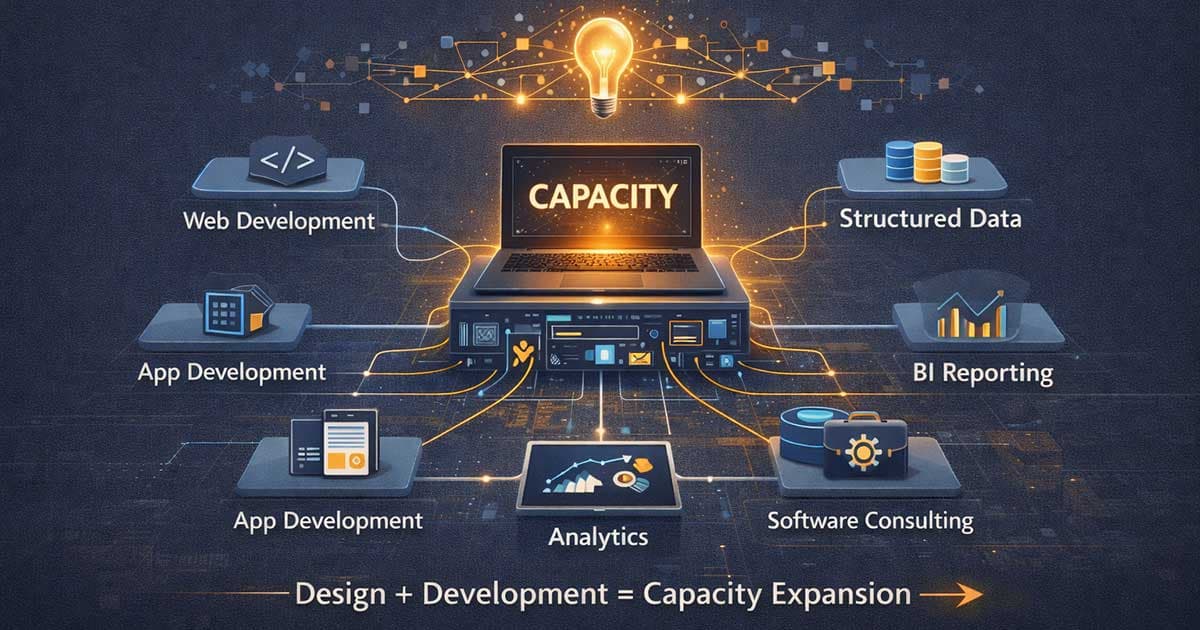
Businesses that understand this difference treat web development as infrastructure planning, not just coding. They align design systems with backend scalability. They integrate analytics pipelines intentionally. They view their website as part of a broader ecosystem that may include app development, structured data administration, business intelligence reporting, and long-term software consulting for growth planning.
When design and development operate in alignment, your website becomes more than an interface.
It becomes capacity.
And capacity compounds.
Frequently Asked Questions About the Difference Between Web Design and Web Development
1. I only have a budget for one — should I prioritise web design or web development?
Prioritise the bottleneck, not the trend.
If users are visiting but not converting, the issue is likely experience-driven and design should lead.
If performance is unstable, integrations fail, or feature deployment is slow, development must take priority.
Choosing based on appearance rather than structural constraint is where most businesses misallocate budget.
2. My website looks modern but still underperforms. What could be wrong?
Visual appeal does not guarantee operational strength. Slow database queries, poor hosting architecture, inefficient code, or broken analytics pipelines can silently damage performance and conversion. When aesthetics and results don’t align, the issue is usually architectural, not visual.
3. Can strong development compensate for weak design?
Only temporarily. A technically powerful system without intuitive user flow creates friction. Users may trust your capability less if navigation feels confusing. Development can create capacity, but design translates that capacity into usable experience.
4. At what stage should design and development teams collaborate?
From the beginning. When design decisions are made without technical feasibility checks, rework increases. When development architecture ignores future design flexibility, rigidity appears later. Alignment early reduces cost later.
5. How do I know if my business needs strategic web development, not just a visual refresh?
If your roadmap includes automation expansion, CRM integration, AI personalisation, data centralisation, or scalable digital products, you are dealing with infrastructure — not just presentation. In that case, you are not simply improving appearance. You are engineering growth capacity.

Admin
Mostafa is a Wordsmith, storyteller, and language artisan weaving narratives and painting vivid imagery across digital landscapes with a spirited pen, he embraces the art of crafting compelling content as a copywriter, and content manager.

Based in
Melbourne, Australia
Your software dev partner, smooth process, exceptional results
Contacts
contact@flamincode.com.au
© All rights reserved to Flamincode