Progressive Web Apps vs Native Mobile Apps

Flamincode Software
Author
Mobile experiences shape how people interact with businesses across Australia. Whether someone is booking a service, tracking a delivery, checking their balance, following a fitness routine, or simply browsing products, the interface they use becomes part of how they perceive the brand behind it.
That’s why, when a business decides to build an app, one question always rises to the surface:
Should we build a Progressive Web App (PWA) or a Native Mobile App?
It feels like a technical decision, but it isn’t really. It’s an experience decision. A strategic one. And it has long-term implications for cost, scalability, user engagement, and the future direction of the product.
The Quick Answer
A Progressive Web App is ideal when you want broad reach, fast development, lower costs, and the flexibility to update instantly without app-store bottlenecks. It’s the best fit for many content-driven, transactional, and booking-style products.
A Native Mobile App becomes the stronger option when your product depends on deep device integration, fluid performance, advanced interactions, or features that must feel truly seamless. For apps in finance, fitness, health, or real-time data environments, native remains unmatched.
Neither approach is inherently better. The right choice is the one that supports how your product is meant to be used — today and at scale.
PWA vs Native Apps: A Quick Comparison
Feature | Progressive Web App (PWA) | Native Mobile App |
Installation | Runs in browser; optional home-screen install | App Store / Google Play |
Performance | Excellent for most business use cases | Highest performance; best for complex UI |
Cost to Build | Lower; one codebase | Higher; separate iOS + Android builds |
Device Access | Partial | Full access to sensors, camera, biometrics |
Updates | Instant; no approvals | Requires resubmission and user updates |
SEO | Google-indexed | Not discoverable via search |
Ideal For | E-commerce, SaaS, bookings, content | Fintech, fitness, real-time apps, gaming |
This table helps set the stage. But the real decision becomes clearer when you understand how users behave, what expectations look like in the Australian market, and how your product will evolve over time.
Why This Decision Matters More in 2026

A decade ago, mobile was a secondary channel. Businesses often started with a website and added an app later—sometimes simply because competitors had one.
Today, users expect more. They expect responsiveness, speed, intuitive interactions, and zero friction. And because Australians generally have strong mobile connectivity, high device standards, and a willingness to abandon poor experiences quickly, businesses feel this pressure more intensely.
The question isn’t “Do we need an app?”
It’s “What kind of mobile experience will best serve our users?”
A local service provider in Melbourne may prioritise accessibility and speed. A SaaS platform in Sydney may need an interface that works consistently across devices. A fintech startup might require rigorous performance and secure device-level integrations. The market context shapes the decision as much as the technology does.
This is why choosing between PWA and native isn’t about picking a side. It’s about understanding what you’re building and who you’re building it for.
Understanding PWAs Beyond the Basics

PWAs are often described as “websites that behave like apps,” but that undersells what they actually do. A well-built PWA loads quickly, feels stable, adapts to different screen sizes, and can be “installed” without any traditional download process.
For users, the absence of friction is powerful. They tap a link and they’re in—no waiting, no commitments.
In Australia, where mobile adoption is high but download fatigue is real, that matters. Many users don’t want to install an app they’re unsure about, and PWAs let businesses meet customers where they already are: the browser.
A strong PWA feels modern, reliable, and familiar. It’s consistent. It’s practical. And for many businesses, that simplicity is not a limitation—it’s a strategic advantage.
However, PWAs don’t aim to compete with native apps on depth. They’re built to provide a unified experience across devices, not a deeply integrated one. And that distinction becomes important when your product depends on functionality the browser cannot fully support.
Where PWAs Reach Their Limits
Every technology has a boundary, and PWAs are no exception. Their limits usually become visible when the experience you’re building relies on real-time interaction, advanced animations, or continuous background processes.
A fitness app measuring live biometric data, a banking app requiring strong device-level authentication, or a tool that interacts heavily with sensors all sit beyond what PWAs comfortably support.
Browser APIs have expanded dramatically, and Android in particular handles PWAs well. iOS, however, remains more restrictive. Things like background sync, persistent push notifications, or deeper hardware access aren’t always available—or behave inconsistently across devices.
These constraints don’t make PWAs a weaker technology. They simply define where the web ends and where native engineering begins.
Why Native Apps Still Hold an Edge
Native mobile apps deliver something PWAs can’t replicate: a sense of physicality.
Interactions feel anchored to the device. Animations feel fluid. Scrolling feels immediate. Gestures feel natural. Users may not articulate these differences, but they experience them.
Native apps integrate with the operating system at a deeper level. They respond quickly, operate smoothly under load, and have complete access to sensors, biometrics, cameras, storage, and background tasks.
In categories where performance, security, or precision define the product, native development isn’t just an upgrade—it’s the only viable foundation.
Fintech platforms, health and fitness trackers, real-time communication tools, and apps that depend on continuous syncing all rely on capabilities that sit beyond the comfortable reach of a PWA.
This is why many businesses that begin with a PWA eventually evolve toward native once the product matures and user expectations sharpen.
The UX Differences That Actually Matter

Users rarely think about the technology behind an app; they think about how it feels. At first glance, the difference between a good PWA and a good native app may not be very big, but as the experience gets more complicated, it becomes clear.
PWAs have simple, quick-loading interfaces that work the same on all devices. One of the best things about them is that they are always the same. This is especially useful for apps where the main actions are linear, like browsing products, reading content, booking services, or managing simple dashboards.
When the focus is on clarity and ease of use, a PWA can feel just like a regular mobile app.
Native apps, however, introduce a level of responsiveness and micro-interaction quality that is difficult to match in a browser. The small feedback from a gesture, the smooth scrolling, and the tight integration with system UI parts all add up to a feeling of fluidity that users can recognise right away, even if they can't explain why it feels better.
The key difference is intention.
PWAs prioritise accessibility and reach.
Native apps prioritise embodiment and immersion.
In 2026, users can tell which one you’re aiming for.
Cost, Timeline & Long-Term Sustainability
Development isn’t just about technology — it’s about investment. Australian businesses, especially those in competitive markets like Sydney, Melbourne, and Brisbane, often need to balance ambition with budget.
PWAs are attractive because they let teams move quickly. A single codebase covers all devices, deployment cycles are faster, and updates reach users immediately. That simplicity helps keep costs low and deadlines clear.
This is why many early-stage startups choose PWAs: they want to make sure there is demand before they spend a lot of time and money on a complicated technical build.
Native apps require more planning and more resources. Two platforms means two builds, two testing processes, and two long-term maintenance tracks. Timelines stretch. Costs rise.
But the payoff is long-term strategic stability. A native app, once built, becomes a durable foundation that can grow into complex features without bending under its own weight.
That difference becomes visible when products evolve.
PWAs scale horizontally — more users, more pages, more content.
Native apps scale vertically — deeper features, richer interactions, more sophisticated logic.
Your growth model determines which path makes sense.
A Second Comparison Table: How Each Approach Handles Growth
Growth Dimension | PWA | Native App |
Feature Expansion | Excellent for incremental features; limited for hardware-heavy extensions | Ideal for complex, performance-sensitive expansions |
User Engagement | Strong for simple tasks; limited push behaviour on iOS | Highest engagement; rich notification capabilities |
Offline Capability | Good for cached workflows | Full offline workflows possible |
Maintenance Over Time | Low overhead | Medium to high overhead |
Ability to Scale into a Premium Product | Good for utility or transactional tools | Best for long-term product ecosystems |
This second table isn’t about development — it’s about trajectory.
Where is your product heading?
What will users expect from it a year from now?
That’s where clarity emerges.
When PWAs Win: Real Scenarios in the Australian Market
There are situations where a PWA doesn’t just work — it outperforms a native app. These scenarios typically involve accessibility, simplicity, or audience reach.
Scenario 1: A Melbourne-based café chain introducing online ordering
Users want speed, not commitment. A PWA lets customers browse the menu, place orders, and save favourites without downloading an app they might only use occasionally. The frictionless entry is a competitive advantage.
Scenario 2: A national education platform offering modular content
PWAs excel at content consumption. Students can read lessons, watch lightweight videos, and submit tasks without installing anything. SEO visibility also helps with enrolment growth.
Scenario 3: A SaaS dashboard used across different devices in workplaces
Consistency is more important than deep interaction. Employees log in, review key metrics, update data, and move on. A PWA ensures identical behaviour on desktop, tablet, and mobile without dual maintenance.
PWAs win when accessibility, speed, and universality matter more than polish or hardware capability.
When Native Apps Win: Depth, Precision and Trust
There’s a different class of products where native isn’t just preferable — it’s essential.
Scenario 1: A fintech startup in Sydney handling real-time transactions
Security, biometrics, encryption, and high-frequency updates demand native-level integration. These businesses also compete in a trust-heavy market where app-store presence adds legitimacy.
Scenario 2: A fitness app using live GPS, accelerometer data, and background tracking
PWAs simply cannot support this reliably on iOS. A native build ensures accurate data and a pleasant, battery-efficient experience.
Scenario 3: A social or communication tool requiring instant sync and continuous feedback
Low latency, background processes, push notifications, and gesture-heavy interfaces all depend on native-level control.
Native apps win when performance and sensory integration define the product.
The Australia Factor
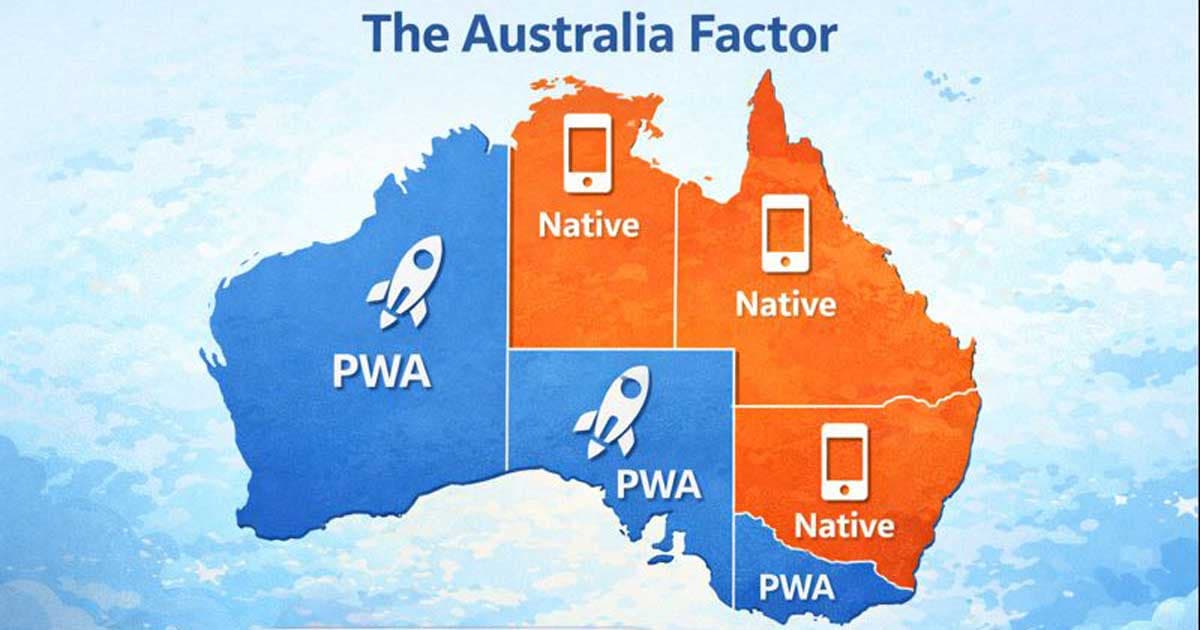
When you choose between PWA and native, it's not just about the technology; where you are also matters.
There are a number of things that affect mobile strategy in Australia:
iOS is very popular, especially in big cities. People who use iPhones expect things to work well and be consistent.
Connectivity varies outside major cities, making offline capability more important for some industries.
Customers abandon clunky onboarding quickly, meaning download friction can impact conversion rates substantially.
Local competition is strong, especially in service-driven industries where digital experience becomes a differentiator rather than a bonus.
Because of these conditions, many Australian businesses begin with a PWA and evolve into native when their product matures. It’s not a compromise — it’s a sensible growth strategy.
The Strategic Lens: What Are You Really Building?
Technical debates often distract from the real question.
It's not about frameworks, APIs, or operating systems when you have to choose between PWA and native. It’s about the story your product is trying to tell.
Are you building something people visit occasionally, or something they live inside?
Does speed of development matter more today, or will depth matter more tomorrow?
Is your app a tool, or is it an experience?
These questions redirect the conversation toward intent — not hype.
A PWA tells the story of accessibility, reach, and speed.
A native app tells the story of craft, immersion, and performance.
Neither story is universally better. But every product belongs more naturally to one of them.
Conclusion: Choose for Today, Build for Tomorrow
Progressive Web Apps and native mobile apps both hold an essential place in the digital landscape. PWAs help businesses move quickly, reduce risk, and meet customers where they already are. Native apps help teams build experiences that feel richer, smarter, faster, and more refined.
The decision becomes clear when the product’s behaviour, not the technology, drives the conversation.
That’s where teams like Flamincode come in. Our work in app development, custom web development, and technical consulting helps Australian businesses choose the architecture that serves them best — not just at launch, but as they grow.
Frequently Asked Questions

1. What is the main difference between a PWA and a native mobile app?
A Progressive Web App runs in a browser and can be accessed instantly, while a native mobile app is installed through an app store and integrates deeply with the device. PWAs put speed and reach first, while native apps put performance and access to the system first.
2. Are Progressive Web Apps suitable for serious business applications?
Yes. Many business uses, like booking, dashboards, e-commerce, and content platforms, work well with PWAs. Native development is better for apps that need to run in the background all the time or need access to advanced hardware.
3. Why do many Australian startups choose PWAs first?
PWAs allow faster launches, lower development costs, and immediate updates without app-store approvals. This makes them perfect for checking demand before spending money on a more complicated native build.
4. When does a native mobile app become the better choice?
When performance, security, real-time processing, or deep device integration are important to the product, native apps are a must. Industries like fintech, fitness tracking, and health often need native architecture from the beginning.
5. Which option performs better in terms of user experience?
Native apps usually work better with the operating system, which makes them better for users. PWAs are still great for most everyday tasks, but they're not as good for tasks that need a lot of interaction or depend on sensors.

Admin
Your software dev partner
Comments

Interesting breakdown! Seems like the right choice really hinges on what you want users to experience.

Based in
Melbourne, Australia
Your software dev partner, smooth process, exceptional results
Contacts
contact@flamincode.com.au
© All rights reserved to Flamincode