Security Threats Web Devs Are Facing In 2026

M Chetmars
Author
March 2026 Live Update: As cyber-attacks become more autonomous, we have updated this guide with the latest intelligence on Machine Identity Sprawl and Adversarial AI. Staying protected this year requires moving beyond traditional MFA to a Zero-Trust for Entities model.
Web security has not become more dangerous because attackers are smarter. It has become more fragile because modern web systems rely on more trust than they can realistically verify. Layers of abstraction, automation, and third-party dependencies have quietly expanded the surface area, often without teams realising how much responsibility has shifted into places they no longer control directly.
In 2026, many of the most serious security incidents do not begin with a clever exploit. They start with normal development decisions that assume the ecosystem will behave as expected.
That assumption is no longer safe.
The Short Answer:
The biggest security threats web developers face in 2026 come from how modern web systems are built, connected, and trusted—not from individual vulnerabilities or outdated code.
Security failures increasingly emerge from ecosystems, dependencies, and system behaviour—not isolated technical flaws.
Top Web Security Threats Developers Face in 2026
While traditional vulnerabilities like injection flaws and authentication bypasses still exist, many of the most serious risks now come from the way modern systems are connected.
Instead of isolated weaknesses in application code, threats increasingly emerge from dependencies, automation, distributed services, and trusted systems that behave in unexpected ways.
The table below summarises the most important web security threats shaping the current landscape.
Threat | What It Means | Why It Matters |
|---|---|---|
Supply Chain Attacks | Compromised libraries, dependencies, or development tools introduce malicious code into trusted systems | A single compromised component can affect thousands of applications |
AI-Assisted Cyber Attacks | Attackers use AI tools to automate reconnaissance, phishing, and vulnerability discovery | Automation allows attackers to scale attacks dramatically |
Adversarial AI | Machine learning systems are manipulated to reveal training data or behave incorrectly | AI systems increasingly handle sensitive business data |
Machine Identity Sprawl | APIs, services, containers, and IoT devices accumulate unmanaged identities | Every identity becomes a potential attack entry point |
Quantum-Ready Threats | Attackers store encrypted data today with the goal of decrypting it using future quantum computers | Long-term data confidentiality is at risk |
Behaviour-Based Attacks | Attackers exploit legitimate system behaviour rather than vulnerabilities | These attacks are harder to detect using traditional security tools |
Understanding these threats becomes easier once we recognise how the nature of web security itself has changed.
How The Nature Of Web Security Has Shifted
Then | Now |
Attacks targeted application code | Attacks target ecosystems and trust chains |
Security focused on known vulnerabilities | Failures emerge from normal behaviour |
Web apps were clear targets | Web apps are part of larger attack surfaces |
Control lived inside the codebase | Control is distributed across services |
Defences reacted to exploits | Risk accumulates through assumptions |
Everything that follows in this article builds on this shift.
Understanding web security in 2026 requires stepping back from individual vulnerabilities and looking at how attacks have evolved alongside modern development practices. Only then does it become clear why certain threats—once considered edge cases—are now structural.
That is where the real risk begins.
The Evolution Of Web Attacks
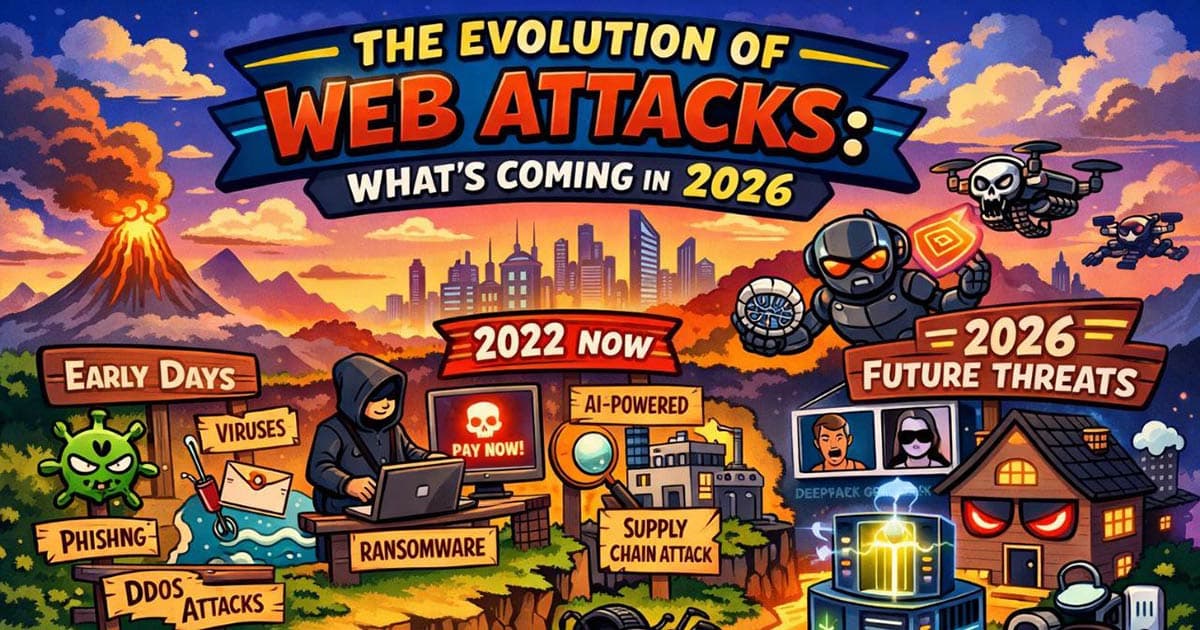
For a long time, web attacks followed a familiar pattern. An application exposed a flaw, an attacker exploited it, and the response was to patch the vulnerability. The mental model was simple: find the bug, fix the bug, move on.
That model no longer explains how the most damaging security failures occur.
Modern web attacks are less about breaking into systems and more about moving through them. They exploit assumptions rather than mistakes. They succeed not because something is obviously wrong, but because everything appears to be working as intended.
This shift matters because web development itself has changed.
Web applications are no longer self-contained. They depend on layers of tooling, services, APIs, platforms, and third-party code. Each layer behaves correctly on its own, yet the system as a whole becomes harder to reason about. The attack surface expands not through negligence, but through ordinary architectural decisions.
In this environment, attackers do not need to be creative. They need to be patient.
From Exploits To Behaviour
Traditional web security focused on exploits: injection flaws, scripting vulnerabilities, and authentication bypasses. These were concrete problems with concrete fixes. Once addressed, teams could move forward with reasonable confidence.
In 2026, many attacks no longer resemble exploits at all.
They blend into legitimate behaviour. Valid requests, authorised access paths, trusted dependencies, and automated processes operate exactly as designed. The difference lies not in what happens, but in how behaviour is combined, extended, and scaled.
This is why many modern incidents are difficult to detect early. Logs show normal traffic. Systems report a healthy status. Nothing appears broken. Yet over time, trust erodes, data is exposed, or control shifts quietly.
Security, in this context, becomes a question of system behaviour rather than code correctness.
Read More: Custom Web Design Services Australia
When The Web Lost Its Clear Boundaries
Earlier generations of web applications had clearer edges. There was an application, a database, and a limited set of integrations. Security models relied on these boundaries to define what needed protection.
Those boundaries have largely dissolved.
Modern web systems blur the line between frontend and backend, internal and external services, development and production tooling, build-time and runtime behaviour. As these distinctions fade, so does the idea that security can be handled in a single place.
Decisions made during development—package selection, deployment workflows, platform choices—now shape security posture as much as any line of application code. The risk emerges when teams continue to think in old categories while operating in a new reality.
Why Fixing Vulnerabilities Is No Longer Enough
Many teams still approach security as a remediation process. A vulnerability is identified, fixed, and tracked. This remains necessary, but it is no longer sufficient.
The most damaging failures often occur without a critical vulnerability to point to. Instead, they arise from over-trusted integrations, excessive permissions that appear reasonable in isolation, automation pipelines with unintended reach, and dependencies assumed to be safe by default.
These issues rarely surface in scans. They require recognising security as an emergent property of the system—not a checklist item.
The question is no longer whether an application is vulnerable, but whether the system it belongs to remains coherent under pressure.
AI-Powered Cyber Attacks
In 2026, we are seeing the rise of Adversarial Machine Learning (AML), where attackers use Model Inversion to probe corporate AI systems and extract sensitive training data. Defense now requires AI-driven Behavioral Heuristics to detect 'low-and-slow' exfiltration patterns that mimic legitimate user behavior.
Quantum Computing
The focus has shifted toward Post-Quantum Cryptography (PQC). To combat 'Harvest Now, Decrypt Later' strategies, businesses must achieve Crypto-Agility by adopting Lattice-based Cryptography. This ensures long-term mathematical integrity against evolving quantum decryption capabilities.
IoT Vulnerabilities
We've moved beyond simple device flaws to Machine Identity Sprawl. Securing the IoT ecosystem in 2026 demands Automated Certificate Management and Hardware Root of Trust (RoT) to ensure that every sensor and actuator is a verified entity within the network.
Supply Chain Attacks 2.0

Once the logic of modern web attacks shifts from exploitation to behaviour, supply chain attacks stop looking like a specialised threat and start looking inevitable. They are not a separate category of risk. They are the most visible outcome of how modern web development distributes trust.
Earlier supply chains were smaller and slower. External dependencies existed, but they were fewer, easier to audit, and updated less frequently. Trust was explicit and limited.
Today, web applications are assembled rather than built. Dependencies, SDKs, build tools, CI pipelines, hosting platforms, and third-party services are woven together into systems where trust is widespread and rarely questioned.
Individually, these decisions feel safe. Collectively, they create environments where no single team fully understands the trust relationships involved.
Software Bill of Materials (SBOM)
Supply chain security is now centered on the Software Bill of Materials (SBOM). By maintaining a real-time, machine-readable inventory of every software component, we can implement Binary Authorization to prevent untrusted code from executing within the production pipeline.
When Supply Chain Attacks Do Not Look Like Attacks
The defining feature of modern supply chain attacks is how normal they appear. Nothing crashes. No alarms are triggered. Systems continue to function as designed.
A dependency update introduces unexpected behaviour. A build pipeline gains access it does not strictly need. A trusted service becomes an attack vector rather than a safeguard. Each step follows approved workflows. Each action is authorised.
From the system’s perspective, nothing unusual is happening.
This is why traditional detection struggles. There is no exploit to patch, no obvious entry point to secure. The attack surface lives inside trust relationships rather than technical weaknesses.
In many cases, attackers never need to break in. They simply operate within the boundaries the system already allows.
Read More: Debugging in 2026
Trust As The Dominant Attack Surface
Supply chain attacks succeed because modern web development optimises for speed, reuse, and abstraction. These are rational choices, not mistakes.
The risk emerges when trust becomes implicit rather than intentional.
Dependencies are trusted because they are popular. Automation is trusted because it saves time. Platforms are trusted because they reduce operational burden. Over time, these trust decisions fade into the background, becoming assumptions rather than choices.
Control does not disappear dramatically. It dissolves gradually across layers of tooling and services, making it harder to reason about where security decisions are actually being made.
That dissolution is what modern attackers exploit.
Why Traditional Security Thinking No Longer Works
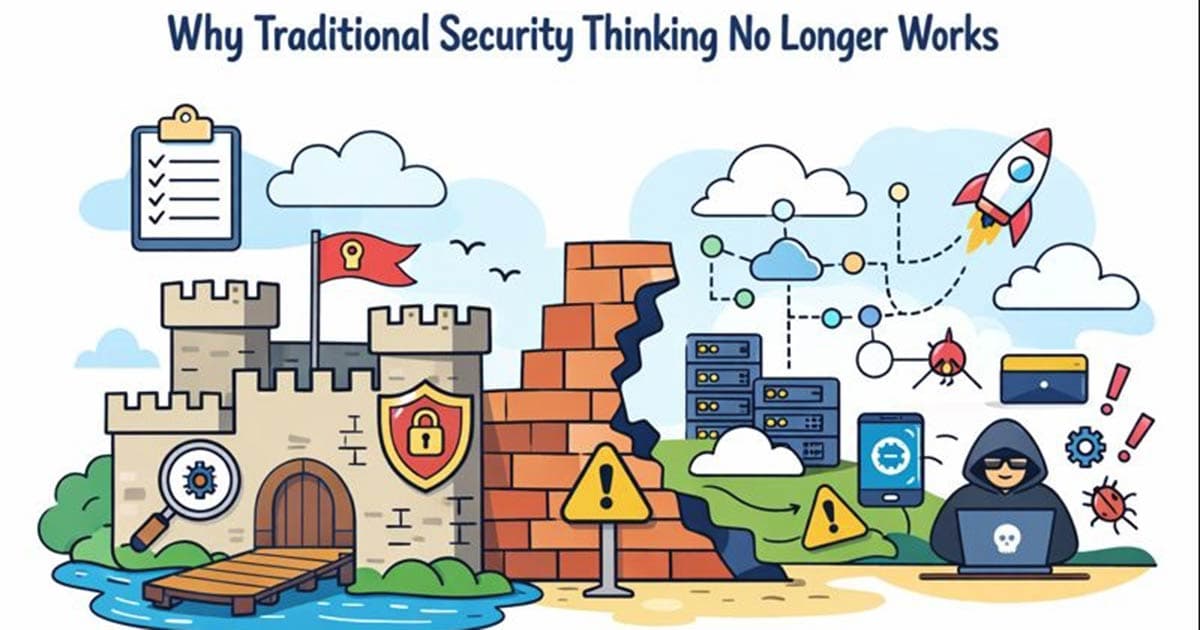
Much of today’s security thinking is inherited from a time when web systems were smaller and easier to reason about. The core assumption was that risk could be isolated. If something went wrong, there would be a vulnerability to find, a patch to apply, and a clear moment when the issue was considered resolved.
That assumption no longer holds.
In modern web systems, failures often emerge without a single mistake to point to. Nothing is misconfigured in an obvious way. No component is behaving incorrectly. Security breaks down because the system allows combinations of behaviour that were never fully examined together.
Traditional security models struggle here because they expect risk to be local. Modern web development distributes risk by design.
When responsibility is spread across frameworks, dependencies, platforms, pipelines, and services, security stops being a layer that can be added later. It becomes a property of how the entire system behaves under pressure. Treating security as a checklist inevitably leaves blind spots that only appear once systems are already under stress.
Security Risks Introduced By Modern Web Tooling
Modern web tooling has dramatically improved the developer experience. Setup is faster. Defaults are smarter. Abstractions remove friction. These are genuine advances—but they come with trade-offs that are easy to overlook.
When tools make decisions automatically, those decisions become harder to inspect. When environments are provisioned instantly, it becomes less clear which assumptions are embedded in them. When deployment pipelines gain broad permissions, small misjudgements can have wide consequences.
The risk is not that modern tools are insecure. The risk is that teams stop questioning what those tools are doing on their behalf.
As abstraction increases, visibility often decreases. Security does not fail because tooling is wrong, but because its behaviour is no longer fully understood. Over time, confidence replaces clarity—and confidence scales faster than awareness.
What This Shift Means For Web And App Development Teams

For web and app development teams in 2026, the implication is not that security must dominate every decision. It is that security can no longer be deferred until development is “finished.”
Security now emerges from everyday choices: how systems are composed, how trust is inherited, how automation is scoped, and how changes propagate across environments. These decisions are made continuously, often without explicit security intent.
Teams that treat these concerns as purely technical or operational miss their security impact. Teams that acknowledge them early tend to build systems that fail more transparently and recover more predictably.
This is less about adopting new frameworks or processes and more about updating mental models. Once developers understand where risk actually accumulates, security discussions become calmer, more deliberate, and far less reactive.
Read More: Marketing Trends 2026
The Australian Context: Scale, Distance, And Assumptions
For Australian teams, these dynamics are often amplified.
Many organisations operate with relatively small teams, distributed users, and infrastructure hosted far from their primary audience. Growth tends to be steady rather than explosive. Systems evolve incrementally, often without dedicated security departments or constant oversight.
In this context, assumptions matter more than tooling—because they scale quietly and fail late.
Security issues rarely come from dramatic oversights. They emerge from reasonable decisions made under real constraints. When systems are built to move fast and grow gradually, trust boundaries can expand without anyone explicitly redefining them.
Understanding how modern web threats operate allows Australian teams to make clearer trade-offs, without importing security models designed for very different environments.
Rethinking Security As A Development Concern
One of the most useful shifts web developers can make is to stop treating security as something external to development. Security is not a parallel discipline running alongside code. It is shaped by how code is written, assembled, deployed, and evolved.
This does not mean developers must become security specialists. It means the most effective security outcomes occur when development decisions are made with an understanding of their systemic impact.
In that sense, modern web security is less about prevention and more about coherence. Systems that are easier to understand under pressure tend to fail in more controlled ways. Systems that hide complexity tend to fail silently.
Conclusion: Security In 2026 Is About Behaviour, Not Barriers

The most important security threats web developers face in 2026 are not new techniques or exotic exploits. They are the result of a fundamental shift in how web systems are built, connected, and trusted.
As web attacks evolve from exploiting flaws to exploiting behaviour, security becomes inseparable from architecture, tooling, and decision-making. Supply chain attacks are not anomalies. They are signals that trust has become the dominant attack surface.
For web developers, this means security is no longer something to bolt on after the fact. It is something to be understood.
At Flamincode, this perspective shapes how we approach web development, app development, database administration, business intelligence, and software consulting—not as isolated services, but as interconnected parts of systems that must remain understandable, resilient, and intentional as they grow.
Because in 2026, secure systems are not the ones with the most defences.
They are the ones whose behaviour still makes sense—especially when everything appears to be working.
Security is not a feature; it's an architectural property. At Flamincode, our Custom Web & App Development follows a 'Zero-Trust Architecture' by default. We don't just write code; we secure the entire supply chain of your Database Administration and Business Intelligence systems.
Frequently Asked Questions

Why are security threats for web developers changing so rapidly in 2026?
Modern web systems rely on more interconnected services, dependencies, and automation than before. Security risks increasingly emerge from trust relationships and system behaviour, not from isolated coding mistakes.
How are modern web attacks different from traditional exploits?
Modern web attacks focus less on breaking systems and more on abusing expected behaviour. Instead of exploiting obvious vulnerabilities, attackers leverage normal workflows, trusted components, and distributed responsibilities.
Why have supply chain attacks become such a major security concern for web developers?
Supply chain attacks scale easily because they exploit shared dependencies and trusted tooling. When trust is embedded across ecosystems, a single compromised component can affect many systems simultaneously.
Why do traditional security practices fail to address modern web threats?
Traditional practices assume security risks can be isolated and patched. In modern web systems, risk is systemic, emerging from architecture, automation, and accumulated assumptions rather than single points of failure.
What role do web developers play in modern application security?
Web developers shape security through everyday decisions about dependencies, tooling, and system structure. In 2026, security is inseparable from development choices, even when no explicit security work is being done.

Admin
Mostafa is a Wordsmith, storyteller, and language artisan weaving narratives and painting vivid imagery across digital landscapes with a spirited pen, he embraces the art of crafting compelling content as a copywriter, and content manager.
Comments

Seems like security's all about understanding behavior now, not just patching up code. Makes you rethink everything, huh?

Based in
Melbourne, Australia
Your software dev partner, smooth process, exceptional results
Contacts
contact@flamincode.com.au
© All rights reserved to Flamincode