Selling on Marketplaces vs Your Own Website in Melbourne

M Chetmars
Author
Many Melbourne businesses begin selling online through marketplaces such as Amazon, eBay, or Etsy. The appeal is clear. The platforms already have traffic. The setup process is simple. A small retailer or startup can list products and begin selling within hours.
For many businesses this feels like the easiest entry into ecommerce.
However, over time many owners notice something important. Sales grow, yet margins shrink. Customer relationships remain weak. Brand recognition stays low even after hundreds of orders.
This is where the core question appears.
Should a Melbourne business continue selling through marketplaces, or build its own ecommerce website?
Understanding the difference between these two models helps businesses decide which path leads to sustainable growth.
Short Answer:
Marketplaces provide fast access to buyers but limit control over brand, pricing, and customer relationships. An independent website requires more effort to launch but offers long term ownership, higher margins, and stronger brand development.
Factor | Marketplaces | Own Website |
Setup time | Very fast | Moderate |
Traffic | Built in platform traffic | Must generate through marketing |
Branding | Limited | Full control |
Customer ownership | Platform controls data | Business owns customer data |
Profit margin | Lower due to fees | Higher long term |
Many successful Melbourne retailers use marketplaces early to test products. As the business grows they build their own website to gain control and improve profitability.
Why Many Melbourne Businesses Start With Marketplaces

For new businesses, marketplaces remove many early barriers.
A small Melbourne brand selling handmade products or niche goods often faces three initial challenges.
First, building trust with customers. New websites often struggle because buyers hesitate to purchase from unknown brands.
Second, generating traffic. Without marketing experience or budget, attracting visitors to a new ecommerce site is difficult.
Third, technical setup. Building and managing an ecommerce website requires planning, design, and development.
Marketplaces address all three problems.
Customers already trust platforms such as Amazon and eBay. Millions of shoppers visit these sites every day. Payment processing, security, and product listing systems already exist.
Because of this, a Melbourne business can begin selling products without investing heavily in marketing or web development.
Common examples include:
Product Type | Typical Marketplace |
Handmade goods | Etsy |
Consumer electronics | eBay |
General retail products | Amazon |
These platforms provide an environment where sellers focus on product listings and inventory rather than website infrastructure.
Despite these advantages, the model introduces several limitations.
Read More: 20 Best Websites to Sell Stuff in Australia (The Ultimate Guide)
The Hidden Cost of Marketplace Selling
Many sellers underestimate the true cost of selling through marketplaces.
At first glance the fees appear manageable. Listing a product might cost only a few cents. However the full cost structure often includes several layers.
Cost Type | Typical Range |
Listing fees | $0.20 to $0.50 |
Platform commission | 8% to 20% |
Payment processing | 2% to 4% |
Advertising within platform | Optional but common |
When combined, these charges can reduce profit margins significantly.
For example, a product selling for $100 may lose between $20 and $35 to marketplace fees and related costs. For businesses operating with tight margins, this can dramatically affect long term profitability.
Another financial factor involves pricing competition.
Marketplace environments encourage sellers to compete primarily on price. Products appear next to dozens of similar listings. Buyers compare prices instantly.
This pressure often leads sellers to reduce prices in order to remain competitive. Lower prices combined with platform fees further reduce profit margins.
The Branding Problem

One of the largest strategic limitations of marketplaces involves branding.
When customers purchase through a marketplace, the platform receives most of the brand recognition. The buyer remembers buying from Amazon or eBay rather than from the individual seller.
This creates several long term problems.
The first is customer loyalty. Without a strong brand connection, customers rarely return directly to the seller.
The second issue involves communication. Many platforms restrict direct marketing contact with buyers. Sellers cannot freely build email lists or customer databases.
The third issue involves differentiation. Marketplace product pages follow standardized layouts. Sellers have limited ability to create unique shopping experiences.
Over time this prevents businesses from building strong brand identity.
For Melbourne businesses hoping to grow beyond small scale sales, brand ownership becomes increasingly important.
The Advantage of Owning Your Ecommerce Website
Building an independent ecommerce website requires more planning and initial investment. However it introduces advantages that marketplaces cannot provide.
The most important advantage is control.
A business website allows complete control over design, branding, pricing strategy, and customer experience.
Instead of competing visually with dozens of similar listings, businesses can create a unique shopping environment tailored to their products and audience.
Another major advantage involves customer data ownership.
When sales occur through a business website, the company gains access to valuable information including:
customer email addresses
purchase history
product preferences
browsing behaviour
This data enables several long term growth strategies.
Businesses can build email marketing campaigns, offer loyalty programs, and run targeted promotions for returning customers.
These strategies increase customer lifetime value and reduce reliance on constant new traffic.
Read More: Top 100 e-commerce Websites in the World
SEO and Long Term Visibility
Another critical advantage of owning a website involves search engine visibility.
Marketplaces rely primarily on internal search systems. Products appear within platform results rather than across the broader internet.
A business website, however, can appear directly in Google search results.
For example, a Melbourne retailer selling specialty kitchen equipment could create articles, product guides, and category pages optimized for search queries.
Over time these pages attract organic traffic without ongoing advertising costs.
This strategy allows businesses to develop a long term traffic asset rather than depending solely on marketplace algorithms.
Search engine optimization often becomes one of the most sustainable growth channels for ecommerce websites.
The Strategic Shift Many Melbourne Businesses Make
Because of these differences, many Melbourne businesses follow a predictable evolution.
They start with marketplaces to validate demand and generate early sales. This approach allows entrepreneurs to test products without heavy investment.
Once demand is proven, businesses begin building their own ecommerce website.
At this stage the focus shifts toward branding, customer retention, and long term marketing strategies.
This transition allows businesses to move from simple product selling to building a recognizable brand in the market.
The result is a more stable and scalable business model.
Read More: How Long Does It Take to Develop a Professional Website?
When Marketplaces Still Make Sense for Melbourne Businesses
Despite their limitations, marketplaces still play an important role in ecommerce. Many successful Melbourne businesses continue using them strategically.
Marketplaces perform well in specific situations where speed and exposure matter more than brand control.
The first situation involves product validation. When a new product enters the market, it carries uncertainty. Demand remains unknown. Customer interest remains unclear. Listing the product on a marketplace allows businesses to measure demand quickly.
If the product sells well, the business gains confidence before investing in a full ecommerce website.
The second situation involves niche communities. Certain platforms attract highly specific audiences. Etsy attracts buyers interested in handmade or artistic products. Specialized marketplaces attract collectors, hobbyists, or enthusiasts.
In these environments the marketplace functions as a targeted distribution channel.
The third situation involves limited marketing budgets. Many small businesses cannot immediately invest in advertising or SEO. Marketplaces provide visibility through existing platform traffic.
Because of these advantages, marketplaces often remain useful even after businesses launch their own website.
Situation | Marketplace Advantage |
Product testing | Fast validation |
Niche products | Built in audience |
Limited marketing budget | Existing platform traffic |
Early stage startup | Low technical barrier |
However, relying entirely on marketplaces rarely leads to sustainable growth.
The Hybrid Model Used by Many Melbourne Brands
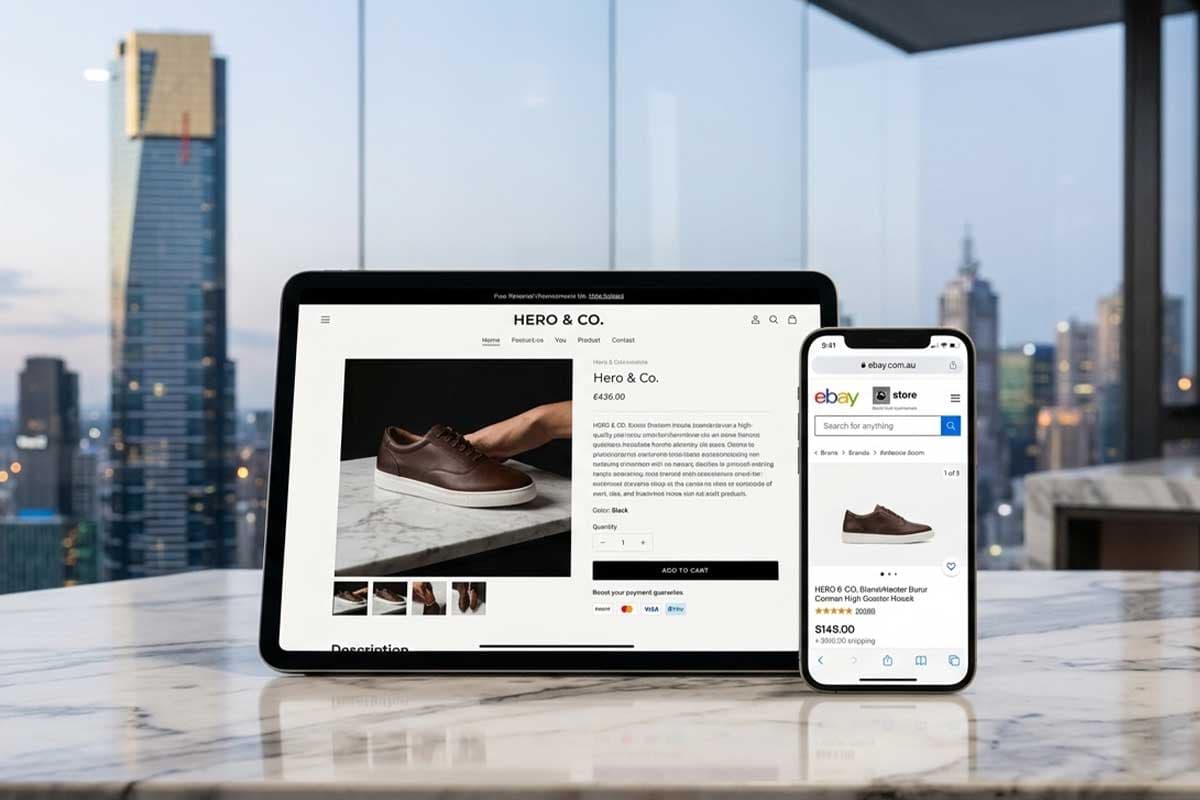
A growing number of Melbourne retailers use a hybrid approach. They combine marketplace exposure with their own ecommerce website.
In this model, marketplaces act as a discovery channel while the website becomes the primary brand hub.
The typical process looks like this.
First, a business lists products on marketplaces. These platforms generate initial visibility and early sales.
Second, the business launches an ecommerce website designed to showcase the brand and product range more effectively.
Third, marketing strategies encourage customers to interact with the brand directly through the website. Returning customers often purchase again outside the marketplace environment.
This approach balances short term traffic with long term brand ownership.
Many Melbourne ecommerce brands use this strategy to reduce dependency on marketplace platforms while maintaining their benefits.
Melbourne Market Reality
Melbourne has one of the most competitive small business environments in Australia. Retailers face strong competition across both physical and digital channels.
Several market conditions shape ecommerce strategy in the city.
Digital advertising costs have increased steadily in Australia. Paid search campaigns require careful budgeting to remain profitable.
At the same time, marketplace competition continues to grow as more sellers join platforms.
Because of this, many businesses eventually recognize the importance of building independent digital assets.
A business website allows companies to control how customers interact with their brand. It also provides flexibility in pricing, promotions, and content strategy.
Over time these advantages become increasingly valuable.
Read More: 20 Online Marketplaces in Australia You Should Know About
Marketplace vs Website Cost Comparison
The financial comparison between marketplaces and independent websites becomes clearer over longer periods.
Factor | Marketplace Model | Website Model |
Initial cost | Low | Moderate |
Transaction fees | High per sale | Low payment processing |
Customer ownership | Platform controls | Business owns data |
Marketing flexibility | Limited | Full control |
Long term profit margin | Lower | Higher |
Marketplaces reduce early barriers to entry but create ongoing operational costs. Websites require more initial work but improve profit margins and brand control over time.
Hot Take: Marketplaces Are Distribution Channels, Not Businesses
Many new entrepreneurs treat marketplaces as the core of their business. In reality, they function better as distribution channels.
A marketplace provides access to customers but does not provide ownership of the relationship.
The platform controls the rules, search algorithms, and customer communication systems. Sellers operate within those boundaries.
If the platform changes policies or ranking systems, sellers often experience sudden drops in visibility.
Businesses that rely entirely on marketplaces place their long term growth under external control.
An independent ecommerce website changes this dynamic.
The business owns its domain, customer database, and marketing strategies. These assets remain stable regardless of changes within external platforms.
This ownership forms the foundation of sustainable online growth.
Strategic Recommendation for Melbourne Businesses
For most small and medium businesses in Melbourne, a staged strategy works best.
Stage one focuses on testing products and generating initial sales through marketplaces.
Stage two involves launching a professional ecommerce website designed to represent the brand and support direct customer relationships.
Stage three focuses on marketing strategies such as search engine optimization, content marketing, and email campaigns that drive traffic to the website.
This gradual transition reduces risk while building long term independence.
Read More: WordPress vs Custom Web Design: What Works for Melbourne Startups?
Conclusion
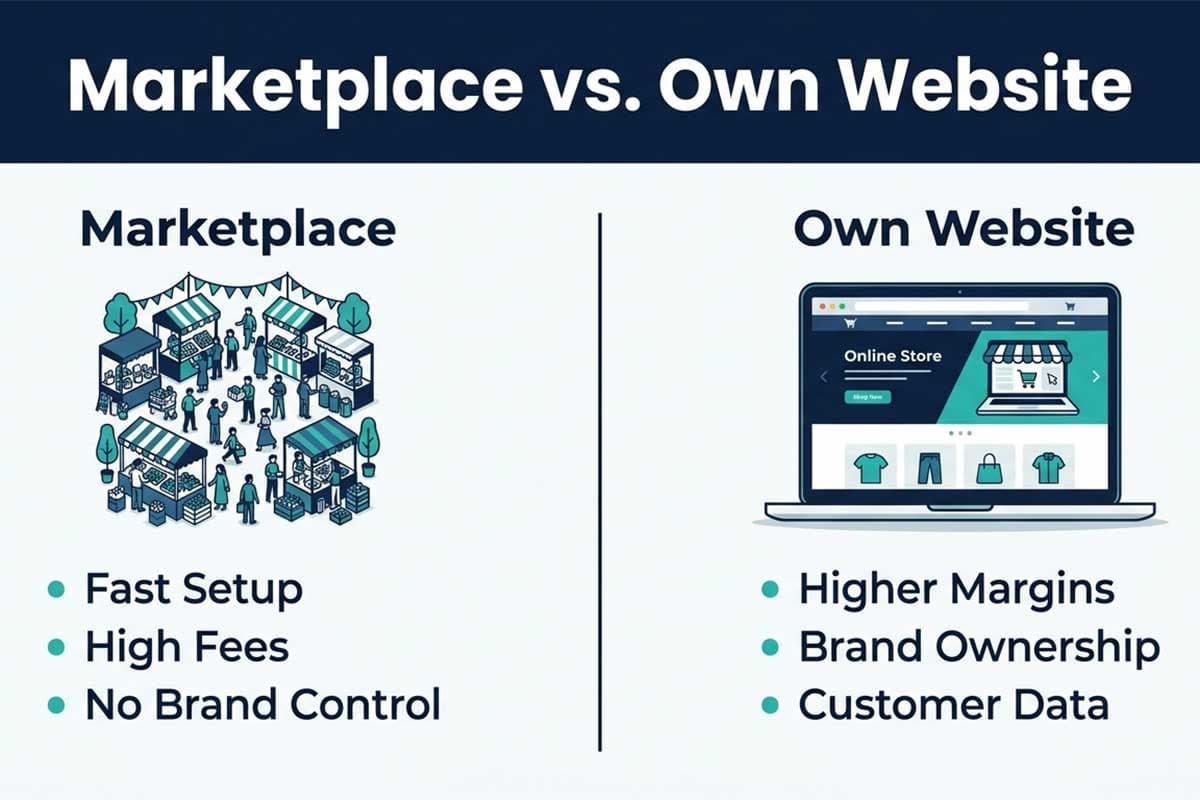
Selling on marketplaces provides speed and convenience. Businesses gain access to large audiences without building infrastructure from scratch.
However, marketplaces introduce limitations involving branding, customer relationships, and profit margins.
An independent ecommerce website requires more planning and investment, but it provides control over the most valuable aspects of a business.
Many Melbourne companies begin their online journey through marketplaces and later build their own website to support long term growth.
Businesses that eventually own their ecommerce platform gain stronger branding, deeper customer relationships, and greater strategic flexibility.
We work with Melbourne businesses that want to move beyond simple marketplace selling and build scalable ecommerce platforms tailored to their growth plans. A well designed website becomes more than a sales channel. It becomes a digital asset supporting long term business expansion. If you need one, check our web development page and contact our team of experts.
Frequently Asked Questions
Is it better to sell on marketplaces or a personal website?
Marketplaces provide quick access to buyers. A personal website offers stronger branding, customer ownership, and higher long term profit margins.
Do small Melbourne businesses need their own ecommerce website?
Businesses aiming for long term growth usually benefit from having their own website because it allows full control over branding and marketing.
How much do marketplace fees reduce profit margins?
In many cases marketplace fees and related costs reduce revenue by twenty to thirty five percent of the product price.
Can businesses sell on marketplaces and their own website at the same time?
Yes. Many businesses follow a hybrid strategy where marketplaces generate initial exposure while the website handles long term customer relationships.
How long does it take to build a professional ecommerce website?
The timeline often ranges from four to twelve weeks depending on the complexity of the store and required features.

Admin
Mostafa is a Wordsmith, storyteller, and language artisan weaving narratives and painting vivid imagery across digital landscapes with a spirited pen, he embraces the art of crafting compelling content as a copywriter, and content manager.

Based in
Melbourne, Australia
Your software dev partner, smooth process, exceptional results
Contacts
contact@flamincode.com.au
© All rights reserved to Flamincode