Website Development Cost in Australia

M Chetmars
Author
If you ask ten Australian businesses how much their website costs, you’ll probably hear ten very different numbers. Some will say they paid a few thousand dollars, others will mention figures closer to ten or fifteen thousand, and a handful will quietly admit they spent far more than they expected. It sounds chaotic, but there’s a reason for this range. A single factor doesn’t shape website development in Australia; it’s shaped by intent, complexity, expertise, and the level of quality a business expects.

When someone comes to us at Flamincode asking, “So… what does a website actually cost here?”, they’re rarely just asking about the price. They’re asking for clarity. They want to know what’s reasonable, what’s unnecessary, and what makes one quote double the other. And more importantly, they want to avoid making the wrong choice, whether that means underinvesting in something important or overpaying for things they don’t need.
Before we go deeper into specifics, here’s a quick snapshot of the landscape:
Website Type | Typical Range (AUD) | Best For |
Basic Brochure Site | $1,000–$3,500 | Early-stage businesses, simple presence |
Small Business Website | $3,500–$8,000 | Service providers, trades, studios |
eCommerce Site | $5,000–$15,000 | Online stores |
Custom Build / Web App | $15,000–$50,000+ | Platforms, dashboards |
Enterprise Build | $30,000–$150,000+ | Corporations, high-scale systems |
These are averages—not rules. Two businesses can request “the same thing” and still end up with different pricing because what they mean by “website” can be completely different.
What Shapes Website Development Cost in Australia?
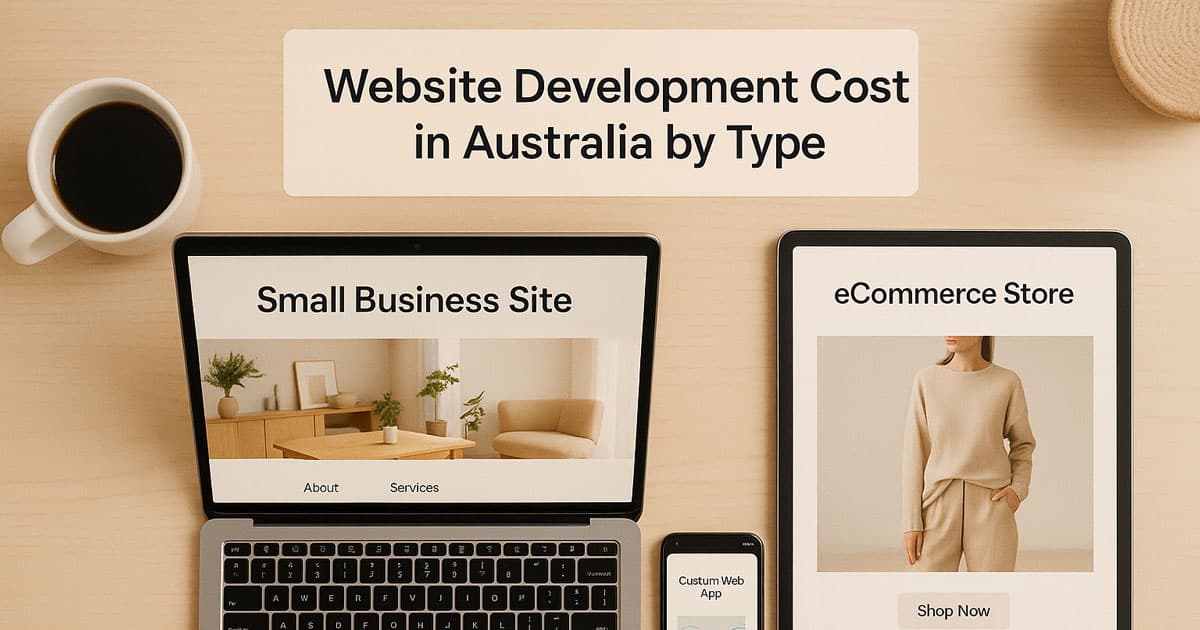
Let’s strip away the jargon for a moment. Most of the cost difference comes down to three main ideas: how much work needs to be done, how customised everything is, and who’s doing it.
The size and shape of the project: A website with five clear pages behaves very differently from a website with a full service catalogue, a blog archive, product filtering, multiple forms, and booking flows. The more structure a site needs, the more time the design and development teams spend aligning everything so it works smoothly.
How polished the design needs to feel: In Australia, design expectations are high. Businesses want something that looks clean, modern, and credible. A simple template-based layout costs less, while a custom-designed interface—especially one built around brand personality, unique layouts, and a crafted user journey—naturally requires more time and expertise.
Features that go beyond “showing information”: This is where many businesses get surprised. Things like online bookings, memberships, logins, payment gateways, calculators, dashboards, or custom flows all require careful build and testing. Even something small like an interactive gallery or multi-step contact form adds time.
The real cost of Australian labour: This is the part many people forget. Australia has some of the highest professional labour rates globally. When you hire local designers or developers, you’re paying for experience, communication clarity, compliance, and significantly fewer surprises during the project. It’s predictable—and predictability has value.
Read More: Yoga Website Design Inspirations
Breaking Down Website Types (Without the Overwhelm)

To make sense of where your project might fall, it helps to understand what each category usually includes—in real, simple terms.
1. A basic brochure website
Think of this as your “digital business card” with a bit more personality. It usually has a homepage, an about page, a services section, and a contact form. No complex interactions, no fancy logic. The goal is to look trustworthy and give people the essentials.
2. A small business website
This is the most common category across Australia. Tradies, salons, gyms, clinics, real estate professionals, cafes—most of them sit right here. These sites need clarity, proper service breakdowns, a few call-to-action moments, and a layout that feels professional and stable. They often include a blog or resources area, which makes the build slightly larger.
3. eCommerce websites
This is where the work becomes more technical. Even a small online store needs product pages, filtering, a cart, payment options, order notifications, shipping logic, and sometimes integrations with inventory systems. That’s why the price climbs—not because it’s “eCommerce,” but because each little detail has to work correctly and securely.
4. Custom builds and web apps
These projects don’t start with templates, but they start with blank pages. They often involve user dashboards, multi-step workflows, advanced integrations, or industry-specific logic. They take planning, prototyping, testing, iteration… and a team that understands architecture, not just design.
5. Enterprise projects
This is where you’re dealing with big content structures, compliance, performance requirements, and multiple teams. These projects have long timelines, heavy QA, and lots of integration work, which is why they can reach six figures.
Read More: Spa Website Design Inspiration
What’s Actually Included in “Website Development Cost”?
Most people think they’re paying for pages. They’re not. They’re paying for the process.
A typical website project includes:
Understanding the brand
Mapping user journeys
Wireframing key layouts
Designing the interface
Building responsive pages
Adding interactions and logic
Filling the site with content
Testing on multiple devices
Optimising performance
Preparing for launch
Most of this doesn’t appear in the final website in an obvious way, but it’s the difference between something that simply “looks okay” and something that feels clean, stable, trustworthy, and easy to use.
The Costs People Don’t Expect

One of the most common surprises for Australian businesses is realising that websites don’t end at launch. Updates, maintenance, plugin renewals, hosting performance, security patches—these all accumulate over time. They’re not massive individually, but they matter. A website without ongoing care ages fast, loads slowly, and becomes vulnerable.
This doesn’t add thousands every month, but it does require planning. And the businesses that understand this early usually end up with websites that last longer and perform better.
Why Website Development Prices Vary So Much in Australia
One thing that surprises many businesses is how two different agencies can look at the same brief and still return completely different numbers. It isn’t because one of them is overpriced—it’s because the approach behind the work is different.
Some agencies build websites quickly, focusing on getting things functional and online. Others move more slowly, digging deeper into brand, structure, user journeys, and long-term maintainability. And then those who sit in between—fast enough to meet deadlines, thoughtful enough to give you something that feels considered.
Pricing differences usually reflect:
How much planning is involved
How much custom design is needed
How many people are working on the project
How many rounds of refinement does the studio include
How they handle QA, performance, and launch
A website isn’t only the final product. It’s the path taken to reach that product that drives cost.
Freelancers, for example, often charge less because they work alone and take on fewer layers of polish. Agencies charge more because you’re hiring a team—a designer, a developer, a strategist, a QA tester—each with different expertise. Offshore teams cost even less, but communication patterns, time zones, and future support can become real challenges.
There’s no “right” option. There’s only what fits your goals, risk tolerance, and expectations.
How to Budget for a Website in Australia
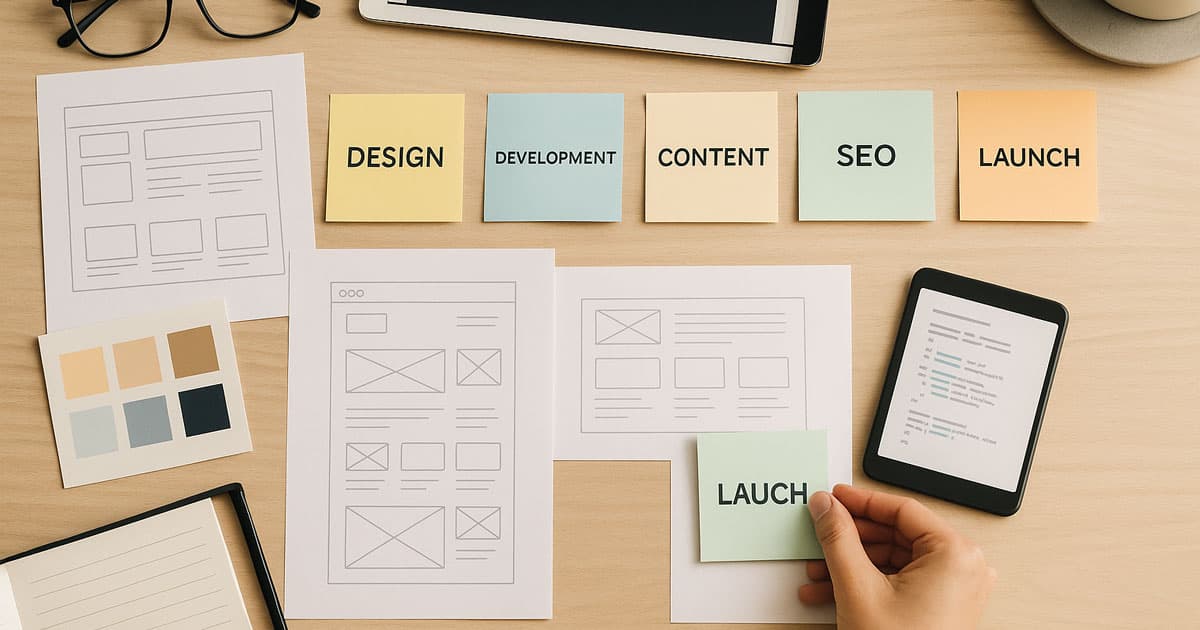
Budgeting becomes easier when you start thinking of a website as a collection of smaller components—design, build, content, integration, and launch. If you separate these mentally, you’ll understand where your money goes and where cutting corners might create future issues.
A helpful way many Australian businesses approach budgeting is by dividing the website into stages:
Design: This includes branding alignment, layout, visual direction, and UI decisions that make the site feel credible and modern.
Development: This is the technical build—the part that brings everything to life. It’s usually the largest portion of the budget.
Content: Many businesses underestimate this. Writing strong page content, sourcing images, and structuring information takes time—and affects conversions more than people realise.
Performance & SEO Setup: Even basic SEO (such as metadata, structured headings, and page speed work) adds significant value.
Post-launch support: A website doesn’t end on launch day. Small updates, security work, and tweaks always follow.
A visual way to understand this is to look at how many Australian agencies distribute the overall budget:
Category | Approx. Share of Total Cost | Why It Matters |
Design | 20–30% | Sets tone, trust, brand feel |
Development | 40–50% | Builds structure and functionality |
Content & Assets | 10–15% | Messaging clarity + engagement |
SEO & Performance | 10% | Visibility + user experience |
Launch & Support | 10% | Stability + future reliability |
This breakdown helps you understand that a $5,000 website and a $12,000 website aren’t just different in scale—they’re different in depth.
Signs You’re Paying Too Much (or Too Little)
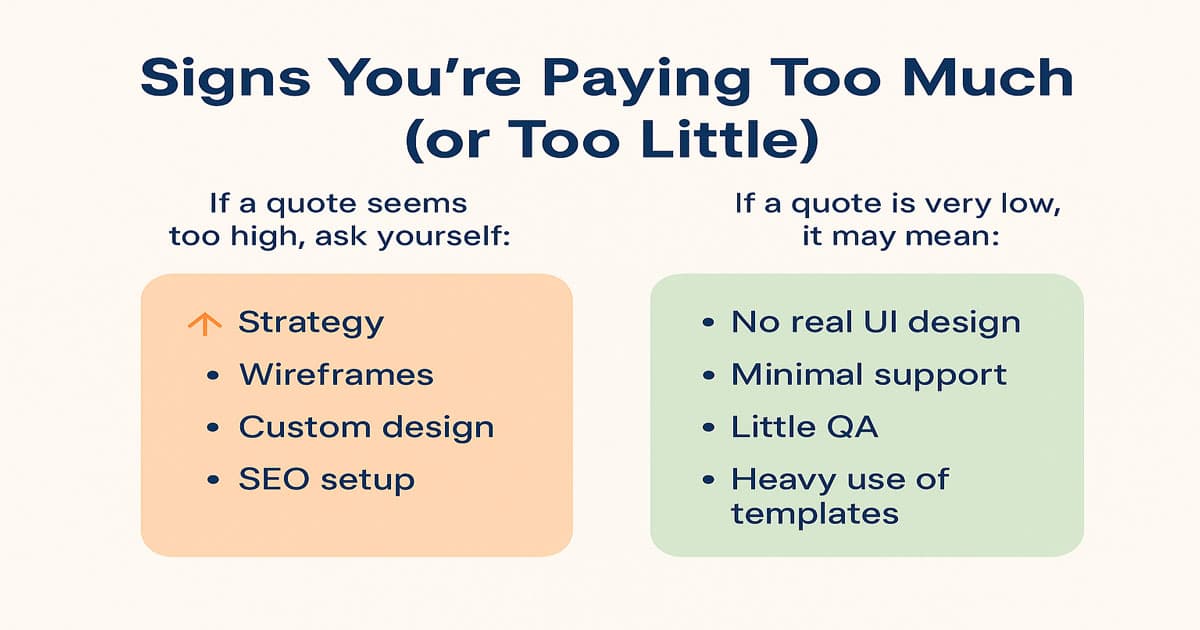
Most business owners don’t know whether their quote is reasonable—especially when they’re comparing multiple offers.
If a quote seems too high, ask yourself:
Does the agency offer strategy, wireframes, custom design, QA, responsive refinement, or SEO setup? If yes, the higher price may be justified.
If a quote is very low, it may mean:
There’s no real UI design
Limited support after launch
Minimal QA
Reliance on pre-made templates without structure
You’re expected to supply all content and assets
Cheap websites aren’t necessarily bad—but they’re usually built for short-term needs and light functionality. If your business depends heavily on its website, extremely low quotes often mean you’ll be rebuilding sooner than expected.
The best sign of a fair price is alignment: You understand what’s included, the process makes sense, and the deliverables match your business goals.
Read More: Therapist Website Design Inspiration
Understanding the Experience Gap
Something important often gets overlooked: websites aren’t just digital brochures. They’re part of how a business communicates, sells, books clients, builds trust, and expresses identity.
A developer might know how to build pages.
A designer might know how to make them look clean.
But a team that understands business logic, audience behaviour, conversions, accessibility, brand voice, and Australian customer expectations will naturally produce a different outcome.
And that difference is reflected in cost.
This is exactly why website development cost in Australia varies from project to project. You’re not paying for “a website.” You’re paying for the thinking behind the website.
Conclusion
The real question isn’t “How much does a website cost in Australia?” It’s: “What kind of website do you need—and what will it do for your business?”
When you understand the factors behind pricing, it becomes easier to choose the right partner. A website that is well-designed, well-built, and well-supported after launch is an investment that pays off in the form of trust, performance, and long-term stability.
At Flamincode, we always say a good website isn’t just something that works—it should actively work for you.
If you ever want clarity around budgeting, choosing the right build path, comparing options, or anything about web development, we’re always happy to help.
FAQs
How are website development costs calculated in Australia?
Mostly based on scope, complexity, required features, and the experience level of the team.
Is a cheaper website always worse?
Not always, but cheaper sites often rely on templates and include less design and support.
How long does a typical website take to build?
Anywhere from 2–4 weeks for small sites to several months for complex or custom builds.
Do I need to pay for maintenance?
Yes—small but regular updates keep the website secure, fast, and functioning properly.
When should I choose a custom build instead of a template?
When your business needs unique functionality, complex logic, or a strong brand-driven presence.

Admin
Mostafa is a Wordsmith, storyteller, and language artisan weaving narratives and painting vivid imagery across digital landscapes with a spirited pen, he embraces the art of crafting compelling content as a copywriter, and content manager.
Comments

definitely makes you rethink what you need for your online presence.

Based in
Melbourne, Australia
Your software dev partner, smooth process, exceptional results
Contacts
contact@flamincode.com.au
© All rights reserved to Flamincode