Website vs Landing Page: Which One Does Your Business Need?

M Chetmars
Author
Many businesses launch a website and assume the job is done.
Months later, marketing campaigns start running. Ads drive traffic. Email campaigns bring visitors.
Then a new question appears.
Should those visitors land on the website, or somewhere else entirely?
The difference between a website and a landing page often determines whether marketing traffic produces customers or disappears without action.
Short Answer:
A website builds credibility and long term presence.
A landing page focuses on one action and one conversion goal.
Businesses use websites to explain who they are. Landing pages exist to guide visitors toward a specific decision.
The difference becomes clearer when comparing their roles.
Element | Website | Landing Page |
Primary goal | Present the business | Convert visitors |
Structure | Multiple pages and navigation | Single focused page |
Audience | Broad audiences | One campaign audience |
Content style | Informational and exploratory | Action driven |
Marketing role | Brand presence | Lead or sales generation |
Both serve different purposes inside a marketing system.
Businesses rarely choose one instead of the other. They use both together.
Why Many Businesses Confuse the Two

For many companies the website becomes the centre of their digital presence.
It contains service descriptions.
It introduces the company.
It collects enquiries through a contact page.
Because the website already exists, marketing traffic is often directed there automatically.
This approach feels logical, but it introduces a problem.
Visitors arriving from advertisements or campaigns often expect a clear next step. Websites, by design, encourage exploration.
Multiple navigation options appear.
Visitors move between pages.
The original intent of the campaign becomes diluted.
Landing pages solve this problem by removing distractions.
Instead of presenting an entire company, they present a single offer.
One message.
One action.
One conversion goal.
This focus is the reason landing pages frequently outperform standard website pages in paid campaigns.
Read More: What is a Dynamic Web Page? (with Example)
The Role of Websites in Business Growth
A website still plays an essential role in the digital presence of any company.
It acts as the central hub for the brand.
Potential customers explore services, learn about the company, and evaluate credibility before making contact.
Search engines also rely on websites to understand what a business offers. Service pages, blog content, and supporting resources contribute to organic visibility.
In this sense, the website becomes a long term asset.
It grows gradually as the company publishes new information, builds authority, and expands its offerings.
Landing pages operate differently.
They support specific marketing initiatives rather than representing the entire business.
Where Landing Pages Fit Inside Marketing

Landing pages appear most often when businesses begin running targeted campaigns.
Advertising platforms send visitors with a clear intention. They clicked because a specific message attracted their attention.
A landing page continues that message.
The headline reflects the advertisement.
The content addresses the visitor’s problem directly.
The page guides the visitor toward a single decision.
Removing unnecessary navigation helps maintain focus.
Visitors spend less time exploring and more time evaluating the offer presented to them.
This structure explains why landing pages often produce higher conversion rates during campaigns.
The Strategic Difference Businesses Eventually Notice
Businesses that rely only on their main website for marketing traffic often encounter a pattern.
Advertising campaigns generate visitors, but conversion rates remain low.
The traffic arrives with intent. The website responds with broad information.
Visitors explore the site instead of acting immediately.
Landing pages align more closely with campaign intent. They focus attention on the specific problem the visitor expects to solve.
This difference becomes especially visible in paid advertising, email campaigns, and product launches.
Traffic quality remains the same. The page structure determines whether that traffic converts.
Architecture Matters More Than Page Type
The distinction between websites and landing pages is not purely a matter of design.
It reflects two different architectural roles.
The website represents the company’s digital presence.
Landing pages represent marketing entry points.
A well structured digital system connects the two.
Visitors may first arrive on a landing page through advertising. After converting or exploring further, they navigate to the main website to evaluate the company more deeply.
This relationship creates a complete marketing ecosystem.
The landing page captures attention and encourages action. The website provides depth and credibility.
Together, they form the foundation of modern digital marketing.
Read More: Progressive Web Apps vs Native Mobile Apps
Hot Take: Most Businesses Use Their Website Where a Landing Page Should Exist
Many companies assume their main website should handle all incoming traffic.
Advertising campaigns send visitors to the homepage. Email campaigns link directly to service pages. Social media promotions point toward the general website.
At first glance, this seems logical. The website already exists and contains all the company information.
The problem becomes visible when conversion data appears.
Visitors arrive with a specific expectation created by the advertisement or campaign message. Instead of continuing that message, the website introduces multiple choices.
Navigation menus appear.
Several services compete for attention.
The visitor must decide where to go next.
Each additional decision increases the chance that the visitor leaves without taking action.
Landing pages remove these decisions.
They continue the promise made in the campaign and guide visitors toward a single response. The structure supports the original marketing message instead of distracting from it.
For many businesses, the conversion problem does not come from poor advertising.
It comes from sending focused traffic to unfocused pages.
Traffic Behaviour: Website Visitors vs Landing Page Visitors

Visitors behave differently depending on how they arrive at a page.
Someone searching for a company name in Google expects to explore. Someone clicking an advertisement usually expects a direct solution.
Understanding this difference helps explain why websites and landing pages perform different roles.
Visitor Behaviour | Website | Landing Page |
Entry source | Organic search or brand search | Paid ads or campaigns |
Visitor intent | Explore information | Evaluate a specific offer |
Navigation pattern | Multiple pages visited | Limited page interaction |
Attention span | Longer exploration | Immediate decision |
Conversion expectation | Indirect or delayed | Immediate response |
The same visitor might interact with both systems during different stages of their journey.
Landing pages capture attention during marketing campaigns. Websites support deeper research once interest exists.
The Campaign Problem Many Businesses Encounter

Marketing campaigns often reveal structural issues within a company’s website.
A business launches advertising expecting enquiries to increase. Traffic numbers rise quickly but results remain modest.
Visitors arrive.
They read part of the page.
Then they leave.
This pattern frequently appears when advertisements direct visitors to pages built for general exploration rather than conversion.
Landing pages change the structure of that interaction.
The page headline reflects the advertisement.
Supporting content explains the offer clearly.
A call to action appears exactly where visitors expect it.
This alignment between advertisement and page structure reduces friction.
The visitor no longer needs to search the website for relevant information.
When a Website Alone Is Enough
Not every business requires separate landing pages.
Companies relying primarily on organic search often direct visitors to structured service pages within the main website.
Search visitors usually begin their journey in research mode. They compare providers, evaluate credibility, and read supporting content.
A well organised website supports this behaviour.
Service pages explain the offering.
Case studies demonstrate results.
Blog content answers common questions.
For businesses focused on search traffic and brand discovery, the website itself functions as the central conversion environment.
Landing pages become more valuable when campaigns introduce highly targeted traffic.
The System That Combines Both
Growing businesses eventually treat their website and landing pages as complementary components rather than competing choices.
The website remains the central information hub.
Landing pages act as specialised entry points connected to marketing campaigns.
Visitors arriving from paid advertisements encounter a focused landing page aligned with the campaign message.
Visitors arriving from organic search encounter structured service pages within the website.
Both paths eventually connect to the same brand.
Landing pages capture immediate interest.
The website reinforces credibility and depth.
Together, they form a marketing system capable of supporting both exploration and conversion.
Read More: Custom Web Design Services Australia
Final Thoughts
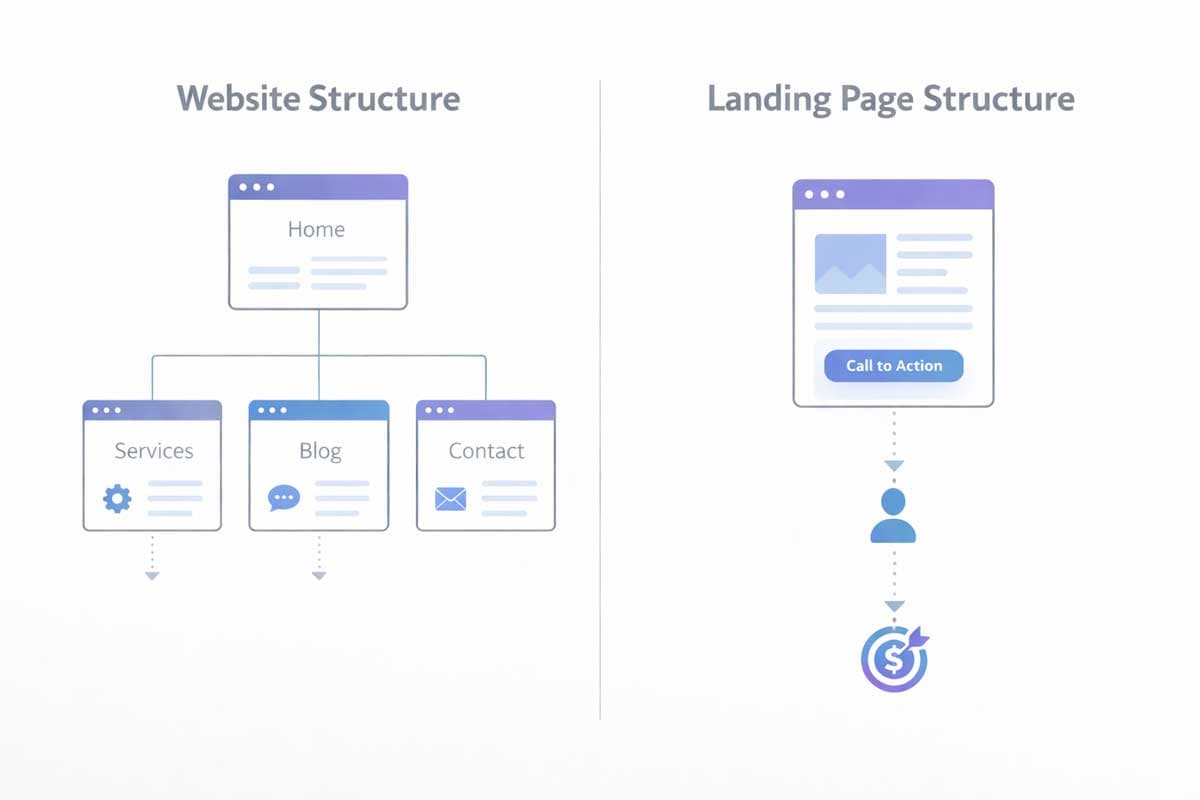
Websites and landing pages serve different roles in a company’s digital presence.
The website represents the long term structure of the brand. It provides information, credibility, and organic search visibility.
Landing pages operate as focused campaign tools. They guide visitors toward specific actions connected to marketing initiatives.
Businesses often struggle when these roles become blurred. Traffic meant for focused campaigns lands on broad informational pages. Visitors lose direction, and conversion opportunities decline.
Understanding the difference allows companies to structure their digital presence more effectively.
A strong website supports discovery and credibility. Landing pages convert targeted traffic into measurable results.
At Flamincode, we frequently see businesses improve campaign performance once these two systems begin working together rather than replacing each other.
It all depends on your strategic view. We can help you with that. Our experts know how to come up with the best solutions for your needs. Check our services, like app development, if you need any help.
Frequently Asked Questions
Can a website page function as a landing page?
Yes. A dedicated page within the website can function as a landing page if navigation distractions are reduced and the page focuses on a single conversion goal.
Why do landing pages often convert better than websites?
Landing pages remove unnecessary navigation and guide visitors toward one specific action, reducing decision fatigue.
Do small businesses need landing pages?
Businesses running paid advertisements or targeted campaigns often benefit from landing pages designed specifically for those audiences.
Should landing pages exist outside the main website?
Both approaches work. Some companies host landing pages within the same domain while others use specialised tools depending on campaign requirements.
How many landing pages should a business have?
The number usually depends on the number of campaigns or target audiences. Different offers often require separate landing pages.

Admin
Mostafa is a Wordsmith, storyteller, and language artisan weaving narratives and painting vivid imagery across digital landscapes with a spirited pen, he embraces the art of crafting compelling content as a copywriter, and content manager.

Based in
Melbourne, Australia
Your software dev partner, smooth process, exceptional results
Contacts
contact@flamincode.com.au
© All rights reserved to Flamincode