When Should You Redesign Your Website?

M Chetmars
Author
A few weeks ago, a business owner in Melbourne mentioned something we hear more often than people expect:
Our website still works, but it doesn’t feel like us anymore.
It is a quiet recognition, the kind that emerges not from something breaking but from a sense that the business has moved forward while the website has stayed still. And in a city where customers make quick judgments based on clarity, structure and trust, that feeling is rarely superficial. It is usually the first sign of a deeper question. When is it actually time to redesign your website?
Short Answer:
A redesign becomes necessary when the gap between your business as it exists today and the version of it presented online becomes wide enough to affect credibility, usability or growth. Sometimes the issue is technical, such as an outdated platform or slow load times.
Sometimes it is strategic, when the website no longer reflects your current services, brand position or operational maturity. And sometimes the issue is behavioural, when users leave quickly, hesitate to enquire or simply cannot find the information they expect.
In Melbourne’s business environment, where digital experiences are evaluated quietly but decisively, this gap is significant.
A website that looks fine on the surface can still hold a business back if the underlying structure no longer supports the expectations of customers or the internal needs of the team. Redesigning is not about chasing a trend or refreshing colours. It is about realigning the digital layer of your business with the reality of how you operate today.
Signs It Might Be Time to Redesign Your Website
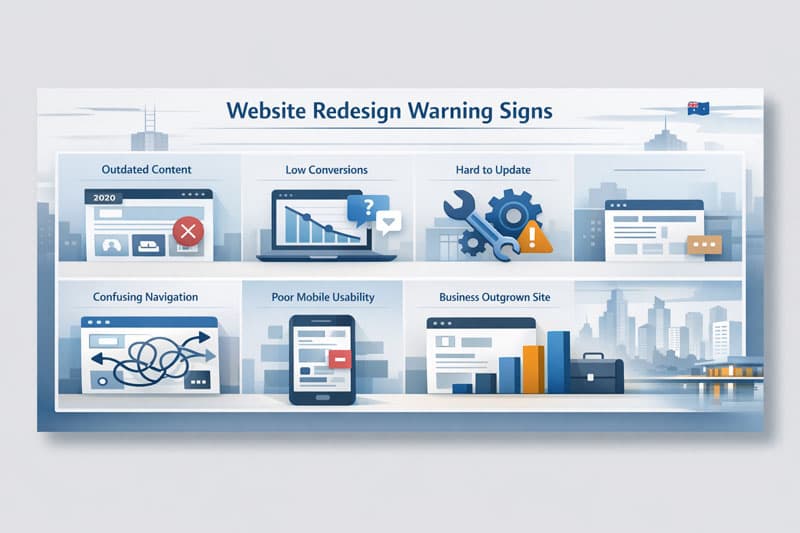
Before looking deeper into strategy and structure, many business owners simply want to know whether their current website is showing clear warning signs. The table below highlights some of the most common indicators that a redesign may be worth considering.
Situation You Notice | What It Usually Means |
Your website still reflects services or information from several years ago | The structure of the site no longer represents the current scope of the business |
Visitors land on the site but rarely submit enquiries | The user journey may be confusing or the messaging unclear |
Updating content feels difficult or requires technical help | The platform or content system may be outdated |
Competitors’ websites feel clearer and easier to navigate | Your information architecture may no longer match modern expectations |
The website works on mobile but feels uncomfortable to use | The design was likely created before mobile usability became a priority |
The business has grown but the website still feels small | The digital presence no longer reflects the maturity of the organisation |
These signs rarely appear all at once. More often, they emerge gradually. When several of them start to appear together, it usually indicates that the website is no longer aligned with the current stage of the business.
Read More: Why Your Website Doesn’t Rank on Google in Melbourne
When Your Website No Longer Matches the Structure of Your Business

Many Melbourne businesses begin with a simple website that mirrors the modest scope of their early operations. A few service pages, a small gallery, a contact form. It works because the business is still uncomplicated. But as the company grows, expands its offer or refines its internal operations, this basic structure can quietly become a limitation.
We have seen this pattern repeatedly with clients whose operations have matured faster than their websites. New services are introduced, teams expand, processes evolve, and the business takes on clients with higher expectations.
Yet the website remains anchored to an earlier moment. The information architecture becomes too shallow to contain the breadth of what the company now does. Pathways that were once efficient now require too many clicks. Key actions like requesting a quote or booking a consultation become less intuitive, not more.
Nothing necessarily looks broken, but friction builds. And in Melbourne, where customers appreciate order, clarity and predictability, these small points of friction accumulate into hesitation. The website still appears functional, but it no longer guides the visitor with the simplicity and structure that a more mature business requires.
A redesign in this situation is not about polishing aesthetics. It is a structural decision, a way of rebuilding the foundation so the digital presence reflects the organisational maturity that already exists offline. When the internal shape of a business evolves but the website remains a snapshot of a previous stage, redesign becomes a practical and often inevitable step.
When User Expectations Move Forward but the Website Stays Still
User behaviour changes gradually, which is why many businesses do not notice the shift until it affects performance. Five or six years ago, customers tolerated dense layouts, slower loading speeds and multi-step navigation. Today, expectations have risen significantly. People in Melbourne, accustomed to well-designed platforms across banking, education, real estate and healthcare, evaluate credibility through ease, clarity and efficiency.
This evaluation happens quickly and often unconsciously. A visitor senses that a website feels dated because the spacing is tight, the menu structure feels heavy or the content requires effort to interpret. Even if the information is accurate, the experience feels slower than expected. And once a user forms that impression, they rarely persist.
We see this most clearly in websites built between 2016 and 2020. Many of them still carry the design logic of a different digital era. The colours may still be appealing, the fonts still readable and the images still relevant, but the overall rhythm of the site no longer matches how users prefer to interact with online services today. People expect shorter paths, clearer messaging, lighter layouts and immediate clarity about what a business offers.
When user expectations evolve but the website does not, conversion slowly declines, engagement becomes shallow and enquiry behaviour weakens. None of this is dramatic, which is why many businesses initially blame marketing, traffic sources or seasonal changes. But in reality, the issue is that the website is no longer aligned with contemporary user psychology.
A redesign at this stage is not an attempt to modernise for the sake of looking modern. It is a realignment with how people now process information, make decisions and build trust in a digital environment that is more mature, more structured and more demanding than before.
When Mobile Experience Becomes the Main Problem

A decade ago, many business websites were designed primarily for desktop screens. Mobile compatibility was often treated as an additional feature rather than the central design priority. Today the situation is almost the opposite. For many Melbourne businesses, the majority of visitors arrive through mobile devices.
When a website was originally built with desktop in mind, the mobile version often feels like a compressed adaptation rather than a carefully designed experience. Text blocks become long and difficult to read, menus require extra taps, and forms may feel frustrating to complete on smaller screens.
Visitors rarely analyse these problems consciously. Instead, they simply sense that the process feels inconvenient. If a user cannot quickly understand what the business offers or submit an enquiry without effort, they often move on to another website that feels smoother to use.
Over time, even small usability issues can influence how trustworthy the business appears. A modern audience tends to associate a smooth mobile experience with professionalism and attention to detail. When a website struggles to provide that experience, it can unintentionally signal that the business itself may not be fully up to date.
Redesigning the website with a mobile‑first approach often resolves these issues by restructuring layouts, simplifying navigation and ensuring that the most important information appears clearly on smaller screens.
Read More: Why Most Melbourne Business Websites Break at Scale
When Updating Content Becomes Difficult

Another subtle sign that a website may need redesigning appears behind the scenes rather than in the visual design. Many businesses discover that making even small changes to their website becomes unnecessarily complicated.
Adding a new service, updating pricing information, or publishing a new article may require technical assistance each time. Sometimes the content management system feels restrictive, and sometimes the website was originally built in a way that makes editing risky or time‑consuming. As a result, updates are postponed and the website slowly becomes less accurate.
This situation creates an unusual gap between the real business and its online presence. Internally the company may be evolving, introducing new capabilities and refining its services, but the website continues to show an older snapshot because updating it feels inconvenient.
For businesses that rely on their website to generate enquiries, this can quietly reduce credibility. Visitors may encounter outdated information, incomplete service descriptions or missing details that would otherwise encourage them to get in touch.
A thoughtful redesign often focuses not only on appearance but also on flexibility. Modern website structures allow teams to update pages more easily, keep information current and expand the site as the business continues to grow.
When Design No Longer Builds Immediate Trust

Trust is one of the most important roles a website plays, particularly for service‑based businesses. Before contacting a company, most visitors form an initial impression within seconds. The layout, spacing, typography and visual balance of the site all contribute to that judgment.
Even if the information on the website is accurate, a design that feels visually outdated can subtly affect how the business is perceived. Colours may feel heavy, page layouts may appear crowded, and images might not reflect the current identity of the brand. None of these issues necessarily prevent the website from functioning, but together they influence how professional the organisation appears.
In competitive markets such as Melbourne, where customers often compare several providers before making a decision, this first impression matters more than many businesses realise. A clear and modern design helps visitors feel confident that the company is organised, reliable and attentive to detail.
When the visual identity of the website no longer reflects the maturity or professionalism of the business, a redesign becomes an opportunity to realign perception with reality. By refining layout, improving visual hierarchy and presenting information more clearly, the website can once again support the trust that the business aims to build with new clients.
Read More: Why Your Melbourne Business Needs a CRM System
When Your Website No Longer Supports Your Marketing
A website rarely operates in isolation. For most Melbourne businesses, it sits at the centre of several marketing activities, including search visibility, paid campaigns, social media referrals and content marketing. When the website structure was designed years earlier, it may not be capable of supporting these activities effectively.
This often becomes visible when marketing efforts start producing traffic but the website struggles to convert that attention into meaningful enquiries.
Landing pages may not be structured around clear search intent, important service pages might be missing, and the internal linking between topics can feel shallow or inconsistent. As a result, even good marketing strategies lose momentum once visitors arrive on the site.
Another common issue appears in content expansion. Businesses that begin publishing articles or guides often realise that their website was never designed to support structured knowledge content.
Categories are unclear, related topics are disconnected, and the overall information architecture makes it difficult for both users and search engines to understand the expertise of the business.
When this happens, the website stops acting as a foundation for growth and instead becomes a constraint.
A redesign can reorganise the structure so that service pages, educational content and conversion pathways work together in a coherent system. In that environment, marketing efforts are not only more effective but also more sustainable over time.
Conclusion
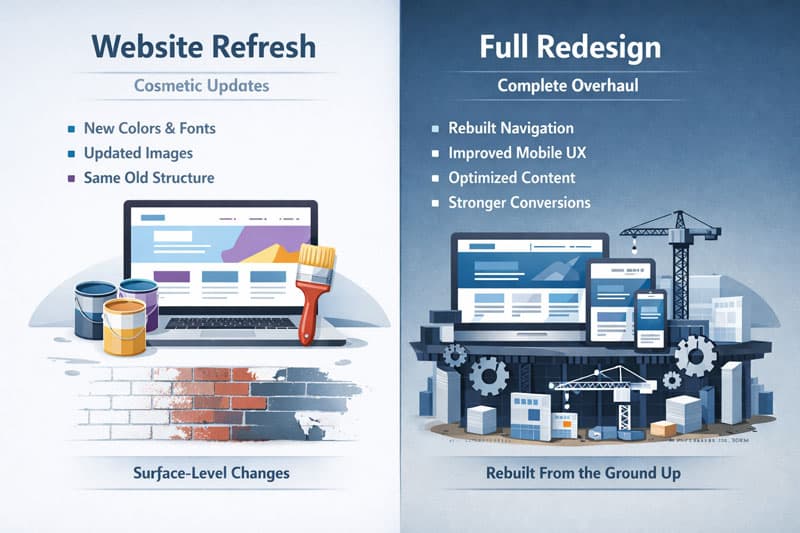
A website redesign is rarely triggered by a single dramatic problem. More often, it becomes necessary when several small signals begin to appear together. The business grows, user expectations shift, mobile behaviour becomes dominant, and marketing efforts become more sophisticated.
When the website can no longer support these changes smoothly, the gap between the business and its digital presence gradually widens.
For many Melbourne businesses, recognising this moment is less about chasing modern design trends and more about maintaining alignment.
A well‑structured website should accurately represent the services you provide today, guide visitors through information without friction, and support the long‑term visibility of the business online.
When those elements fall out of sync, a thoughtful redesign can restore clarity and strengthen the role the website plays in attracting and converting new clients.
For organisations that rely on their digital presence as a primary introduction to their work, investing in professional Web Development is often the step that reconnects the structure of the website with the real capabilities of the business.
Frequently Asked Questions
How often should a business redesign its website?
There is no fixed schedule, but many professional websites benefit from a structural review every three to five years.
Technology, design standards and user behaviour evolve continuously, and a website that was effective several years ago may no longer reflect current expectations. Regular evaluation helps businesses identify whether a full redesign is necessary or if smaller improvements will be enough.
What are the first signs that a website redesign might be necessary?
Early signals often include declining enquiry rates, difficulty updating content, slow performance on mobile devices or a growing mismatch between the services offered by the business and the pages available on the website. When several of these signs appear at the same time, it usually indicates that the structure of the website needs reconsideration.
Is a redesign always better than updating the existing website?
Not necessarily. In some situations, improving specific sections of the site can solve the problem. However, when the underlying architecture, platform or navigation structure is outdated, incremental updates often become inefficient. A redesign allows the entire system to be rebuilt around current goals and user behaviour.
Can a website redesign improve search visibility?
Yes, when it is planned carefully. A well‑structured redesign can improve page hierarchy, strengthen internal linking, and create clearer service pages that match what people are searching for.
These structural improvements often help search engines better understand the expertise of a business and increase the chances of appearing in relevant search results.
Will redesigning a website affect existing rankings?
If the process is handled incorrectly, it can. However, when redirects, page structures and content continuity are planned properly, a redesign often stabilises and even improves search performance over time. The key is ensuring that valuable pages, URLs and search signals are preserved while the user experience is improved.
How long does a professional website redesign usually take?
The timeline depends on the size and complexity of the website. For many service‑based businesses, a structured redesign typically takes several weeks to a few months. This period includes planning the information architecture, refining the visual design, rebuilding the technical foundation and ensuring that the final website supports both users and search engines effectively.

Admin
Mostafa is a Wordsmith, storyteller, and language artisan weaving narratives and painting vivid imagery across digital landscapes with a spirited pen, he embraces the art of crafting compelling content as a copywriter, and content manager.

Based in
Melbourne, Australia
Your software dev partner, smooth process, exceptional results
Contacts
contact@flamincode.com.au
© All rights reserved to Flamincode