Average Cost of Website Maintenance per Month in Australia

M Chetmars
Author
Last Updated: March 2026
This guide has been fully revised to reflect 2026’s evolving infrastructure costs, AI-driven security requirements, and the latest performance benchmarks for modern business websites.
Like keeping a car on the road, keeping a website up and running isn't just about buying it once; it's also about taking care of it so it doesn't break down when you need it most. Websites are very important for sales, trust, and visibility for businesses in Australia, especially in cities like Melbourne and Sydney. But one of the most common questions business owners have is, "How much does it really cost to keep a website up to date each month?"
The short answer is? It depends.
Let's dissect those numbers.
When people talk about website maintenance, they often think of "updates," like renewing a domain once a year or adding a new plugin. To keep your website running well and safely, though, you need to do a lot more than just technical, security, performance, and content management tasks. It costs between $50 and $1,000 a month to keep a website up and running in Australia. The price depends on whether the site is for a small business or a full eCommerce platform.
Before we move on, let's look at a list of the average monthly costs for different kinds of websites.

Average Monthly Maintenance Cost by Website Type (AUD)
Type of Website | Average Monthly Maintenance Cost (AUD) | Typical Inclusions |
Personal / Portfolio | $30 – $80 | Hosting, backups, minor updates |
Small Business Website | $80 – $250 | Hosting, plugin updates, security, and small content edits |
eCommerce Store | $150 – $500 | Product updates, SSL, security, and uptime monitoring |
Custom Web Application | $300 – $1,000+ | Technical support, uptime checks, bug fixes |
Enterprise / Government | $800 – $3,000+ | Dedicated team, integrations, server management |
How Much Does Website Maintenance Really Cost in Australia Per Month?
People often think of "updates" when they talk about website maintenance. This could mean updating a plugin or renewing a domain once a year. But real website maintenance includes a mix of tasks that keep your site healthy and trustworthy, such as technical, security, performance, and content management.
The average Australian business site — say, a local café, retail store, or small agency — typically spends around $100 to $250 per month on website upkeep. That includes server hosting, plugin and CMS updates, security monitoring, and basic support. But once you start dealing with online stores or websites that collect customer data, the cost naturally rises.
Read More:Top Creative Agency Melbourne
What Website Maintenance Really Includes
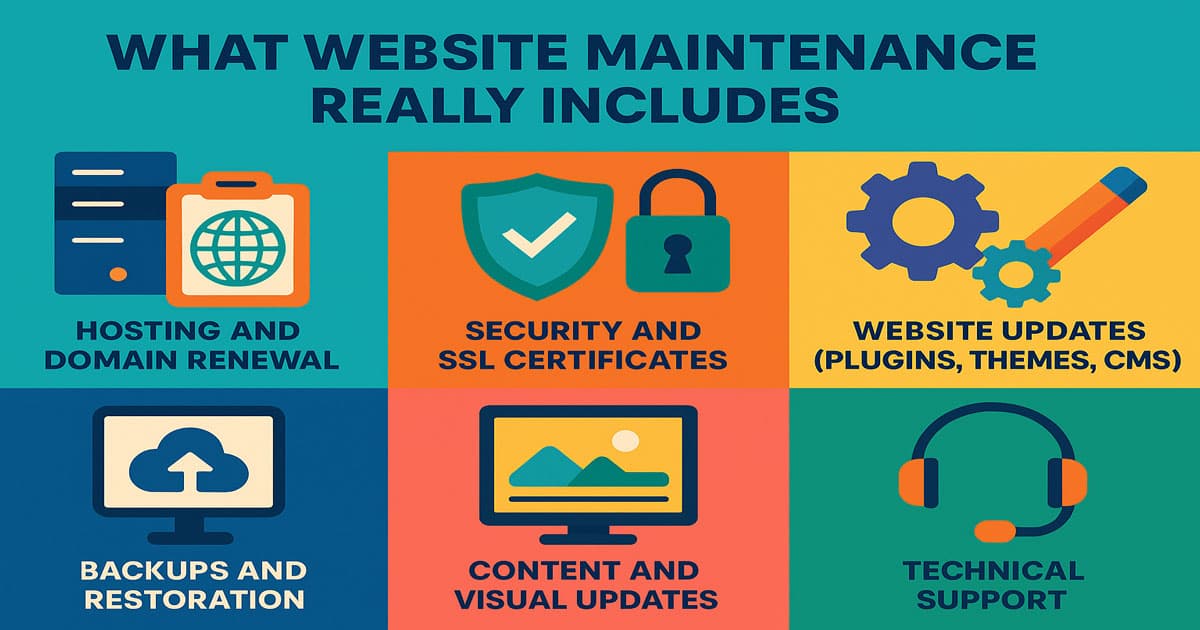
Here’s what you’re actually paying for when you invest in monthly maintenance.
1. Hosting and Domain Renewal
Hosting is the foundation of your site. Most small businesses in Australia pay around $10–$40/month for shared or managed hosting, while bigger or custom-built sites might use VPS or dedicated servers that cost $100+ per month. Domains typically renew annually for $15–$30, but many agencies include that cost in their plans.
2. Security and SSL Certificates
Cybersecurity isn’t optional anymore. SSL certificates are mandatory for SEO and user trust. Many hosting companies offer free SSL, like Let's Encrypt. However, premium SSL certificates for eCommerce or sensitive data sites can cost between $100 and $300 per year. You can also scan for malware, manage your firewall, and patch security holes, which can cost an extra $50 to $150 a month if you hire someone to do it.
3. Website Updates (Plugins, Themes, CMS)
There are a lot of plugins and dependencies that need to be updated all the time on a WordPress or custom CMS site. If you don't take care of them, your layouts will break or your websites will get hacked. Maintenance plans typically include Monthly CMS core updates, Plugin/theme updates, and Compatibility testing. On average, that’s $50–$150/month, depending on how complex your stack is.
4. Backups and Restoration
Bad things happen. Regular backups make sure that your website can get back up and running after being hacked, having files corrupted, or making a mistake. You can set up automated backups (daily or weekly) through your hosting service or with third-party tools like JetBackup or VaultPress. If a developer takes care of it, expect to pay $20 to $50 a month for safe storage and monitoring off-site.
Read More: Top 50 Creative Website Design Ideas
5. Content and Visual Updates
Even small things like changing prices, adding blog posts, or updating team photos take time. A lot of Australian companies either do this work themselves or ask their agency to make quick changes to their content. Most agencies' basic plans, which cost between $50 and $150 a month, include 1 to 2 hours of content changes each month.
6. Technical Support
When something breaks (and it eventually will), you’ll need help fast. Agencies in Australia usually offer support as part of their retainer — think bug fixes, speed optimisation, uptime checks, and email troubleshooting. Rates are usually between $80 and $150 per hour, but if you sign up for a bundle, you can get support for $200 to $400 per month.
Different Ways to Keep Your Website Running
The approach you take depends on your involvement and technical skills.
1. DIY Maintenance
If you're good with technology and your website is simple, you might be able to do everything yourself (paying only for hosting and domain renewal, manually applying updates, handling backups).
Average Cost: Around $20–$60/month
Risk: High — missing an update or backup can cause data loss or downtime.
2. Freelancer or Contractor
Freelancers are great for small, intermittent maintenance jobs. They charge by the task or by the hour, ranging from $60 to $150 per hour.
Average Cost: $100–$300/month
Risk: Response times may vary, and long-term accountability isn’t guaranteed.
3. Agency Maintenance Plans
Web companies offer structured packages that include hosting, updates, security, backups, and support. This provides stability and peace of mind, often including better uptime monitoring and proactive issue prevention.
Average Cost: $150–$600/month
Benefit: Comprehensive coverage and professional support.
4. In-House Web Team
This is usually for businesses of a medium to large size or online stores. Hiring an internal developer or IT manager ensures immediate problem resolution but is significantly more expensive.
Average monthly cost: $4,000 to $8,000 (for staff salary, not just maintenance)
Advantage: Complete control, full-time supervision, and integrated support.
Factors That Affect Website Maintenance Costs
Type and Complexity of Website: A small business landing page is easier to maintain than an eCommerce store with thousands of products or integrations. More features mean more points of failure, which means more money.
Needs for Traffic and Performance: A high-traffic website needs more powerful servers, caching, and monitoring tools. More visitors means more money for hosting. For high-performance infrastructure, you can expect to pay an extra $50 to $200 a month.
How often the content is updated: Frequent updates (weekly blogs, constant promotions) require more work and support hours.
Safety and following the rules: Industries like healthcare, finance, and government must strictly follow regulations (ISO, GDPR, HIPAA), adding costs for logging, auditing, and encryption.
Stack of Technologies: A simple WordPress site is easier and cheaper to maintain than a custom-built Laravel, Node.js, or React app.
Why Website Maintenance Costs Vary So Much in Australia
Labour costs and hosting infrastructure differ across the country. Agencies in Melbourne and Sydney usually charge more due to higher business costs, while packages may be slightly cheaper in smaller cities like Adelaide or Hobart. The quality of service also varies, with some providers focusing solely on server uptime, and others offering comprehensive services like SEO monitoring and marketing insights.
In short, you're not just paying for "fixes"; you're also paying for peace of mind, safety, and steady performance.
Types of Website Maintenance Plans in Australia
Maintenance Plan Type | Monthly Cost (AUD) | Best For | Included Services |
Basic Plan | $50 – $150 | Blogs, portfolios, small business sites | Hosting, backups, updates |
Standard Plan | $150 – $350 | Growing SMEs & eCommerce | Security monitoring, bug fixes, and limited content edits |
Premium Plan | $400 – $800 | Large stores or agencies | Priority support, speed optimisation, and advanced security |
Enterprise Plan | $900 – $2,000+ | Government, corporate, high-traffic platforms | 24/7 monitoring, dedicated dev team, performance analytics |
The main differences between these plans are the speed of response, the number of support hours offered, and how proactive the provider is.
Understanding What You’re Paying For
When comparing plans, look beyond the surface level of "security monitoring." Key factors include:
Hosting Quality: Cheap hosting often means shared servers, resulting in slower speeds. Managed cloud hosting (AWS, DigitalOcean) costs more but offers superior speed, uptime, and security.
Support Responsiveness: Guaranteed response times (SLAs) are critical, as every minute of downtime costs money. Fast, reliable help is worth the premium.
Ongoing SEO & Performance Monitoring: Some providers offer this to ensure your site not only works but also ranks well. This can cost an extra $100 to $300 a month.
Read More: Best AI for Vibe Coding
Website Maintenance Costs by Industry
Different industries in Australia have varying maintenance needs and compliance requirements.
Industry Type | Monthly Average Cost (AUD) | Key Priorities |
Local Services (Tradies, Salons) | $80 – $200 | Mobile optimisation, lead form updates |
eCommerce (Shopify, WooCommerce) | $200 – $500 | Product updates, speed, SSL, transaction monitoring |
Healthcare / Finance | $300 – $700 | Data protection, privacy compliance, encryption |
Education / Nonprofits | $150 – $400 | Accessibility, content updates, and uptime reliability |
Enterprise / Government | $800 – $2,000+ | Redundancy, 24/7 support, server security |
How to Choose the Right Website Maintenance Plan
Identify Your Site’s Purpose: Treat a sales-generating site like a store (needs protection and regular care). An informational site may be fine with lighter, quarterly updates.
Estimate Your Traffic and Tech Stack: Custom-built apps and complex integrations require more intensive (and costly) upkeep than standard WordPress or Shopify sites.
Ask About Response Times: A good agency will clearly define its guaranteed response time (e.g., “within 24 hours”).
Compare What’s Included: Ensure you know what is covered by the flat fee and what counts as “extra work.”
Why Skipping Maintenance Is Expensive
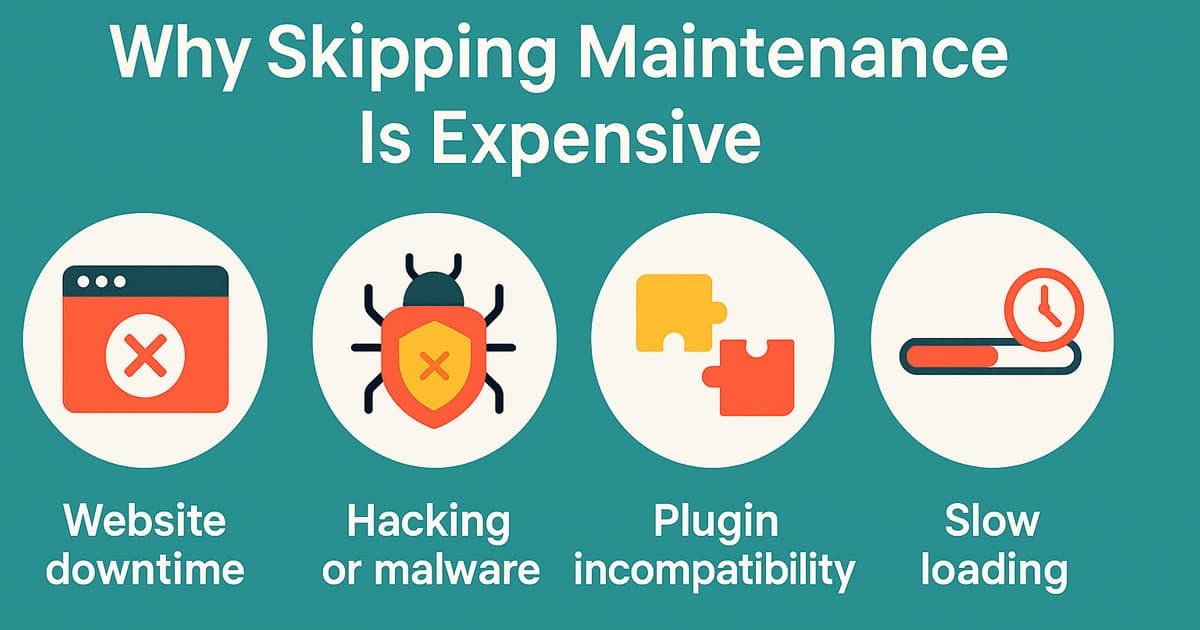
Many small business owners in Australia try to “save” money by ignoring maintenance — until something goes wrong. This often results in:
Website downtime: Lost customers and SEO drops
Hacking or malware: Cleanup can cost thousands
Plugin incompatibility: Broken features and security holes
Slow loading: Reduced conversions and higher bounce rates
Not doing maintenance is like not getting your car serviced. You'll end up paying a lot more for repairs in the long run.
Website Maintenance Is Digital Risk Management
Rethinking Cost: What’s at Stake?
Too often, businesses focus only on the monthly cost of website maintenance, missing a critical point: each dollar saved can mean accepting hidden digital risks. Instead of seeing your site as a static marketing tool, consider its operational role powering trust, transactions, and brand reputation. Effective maintenance isn’t just routine updates—it’s strategic risk management that keeps your business resilient.
Silent Risks: Why Maintenance Matters
Neglecting maintenance doesn’t create gradual problems; it seeds silent threats. An unpatched vulnerability today can lead to costly breaches tomorrow. Sluggish pages quietly chip away at conversions, impacting your bottom line before you notice. These aren’t random mishaps—they’re the result of managing a dynamic digital system with outdated assumptions.
Australian Businesses: Investing in Stability
In Australia’s competitive market, mature businesses invest in predictable maintenance to safeguard leads, sales, and their reputation. Monthly upkeep costs far less than emergency fixes, reputational repairs, or lost SEO momentum. Proactive investment isn’t just overhead—it’s the backbone of stability, protecting your most valuable digital assets.
The Benefits of Hiring Someone to Maintain Your Website
Professional website maintenance is proactive. It involves: Monitoring logs and errors, ensuring compatibility after updates, testing critical pages (forms, checkout), creating daily backups, and hardening firewalls.
Australian businesses that work with professional web agencies often report 30–50% fewer issues and significantly faster page speeds. The real value isn’t just in fixing problems — it’s in preventing them.
Why Investing in Maintenance Saves Money Long-Term: A $200 monthly plan is cheap compared to losing $1,000 in sales from a broken checkout page. Regular maintenance improves search ranking, user trust, and site longevity. Instead of seeing maintenance as a cost, think of it as insurance for your online presence.
The 2026 Landscape
In 2026, website maintenance has shifted from a "technical chore" to a core strategic necessity. Two major factors have redefined the cost structure this year:
AI-Enhanced Security: With cyber threats becoming more autonomous, standard SSL and basic firewalls are no longer sufficient. Maintenance now includes real-time, AI-driven monitoring to detect zero-day vulnerabilities. This has increased baseline security costs by approximately 15-20% compared to previous years.
INP and Performance Stability: Google’s emphasis on Interaction to Next Paint (INP) means that ongoing performance tuning is mandatory to maintain search visibility. High-performance cloud hosting costs have also stabilized at a higher tier due to increased global demand for compute power.
On average, a small to mid-sized business in 2026 should budget between $100 to $500 AUD/month for professional maintenance. This investment ensures that your digital asset remains secure, fast, and compliant with the latest search engine algorithms, preventing the much higher costs of emergency repairs or lost organic traffic.
Picking a Local Partner to Take Care of Your Website
Working with an Australian agency like Flamincode provides local knowledge, time zone alignment, cultural context, and adherence to Australian laws (like the Privacy Act 1988 and the Australian Consumer Law). A trustworthy local partner offers quick response, clear communication, transparent pricing in AUD, and the ability to scale with your business.
We are Flamincode, and we hope you liked this article. Our main purpose is to help Australian businesses with services such as web development. Give us a call, and we will be there to help you
Conclusion
Website maintenance isn’t glamorous — but it’s what keeps your digital business alive. Whether you’re spending $100 or $1,000 a month, the key is consistency. By choosing a maintenance plan that fits your business, you’re not just paying for updates — you’re buying peace of mind.
At Flamincode, we help Australian businesses keep their websites fast, secure, and ready for growth. If you’re wondering which plan suits your site, get in touch — we’ll assess your website and recommend a maintenance package that fits your goals and budget.
FAQs
How much does website maintenance cost per month in Australia?
Most small businesses spend between $100 and $300 per month, depending on site complexity and support needs.
Can I do website maintenance myself?
Yes, for simple sites — but professional plans ensure regular backups, security checks, and performance monitoring.
Does website maintenance include SEO?
Some agencies include SEO monitoring and updates, but most treat it as a separate service.
How often should I update my website?
Ideally, monthly for plugins and security patches, quarterly for design or content changes.
What’s the best maintenance plan for eCommerce websites?
A premium or enterprise plan with strong security, uptime monitoring, and priority support is ideal.

Admin
Mostafa is a Wordsmith, storyteller, and language artisan weaving narratives and painting vivid imagery across digital landscapes with a spirited pen, he embraces the art of crafting compelling content as a copywriter, and content manager.
Comments

Helps clarify what to expect for website upkeep in Australia

Based in
Melbourne, Australia
Your software dev partner, smooth process, exceptional results
Contacts
contact@flamincode.com.au
© All rights reserved to Flamincode