Can AI Build a Business Website That Actually Sells? The Truth for Melbourne Businesses

M Chetmars
Author
Over the past year, a new type of promise has started appearing everywhere online.
“Build your website in minutes.”
“No coding required.”
“AI generates everything automatically.”
For many business owners in Melbourne, this sounds almost too good to ignore.
Launching a website has traditionally required several steps. Choosing a platform. Hiring designers. Working with developers. Testing pages. Adjusting content.
AI website builders now claim to remove most of that process.
Describe your business.
Click a few options.
The system produces a complete website.
For early stage founders and small businesses trying to move quickly, this approach feels efficient. A functional website appears within hours instead of weeks.
But once the initial excitement fades, a more important question begins to surface.
A website existing online is not the same thing as a website producing customers.
A website that sells requires more than layout generation. It requires structure, messaging, and conversion logic.
That difference explains why the conversation around AI website builders is becoming more nuanced among growing companies.
Short Answer:
AI tools can generate a business website.
Building a website that consistently produces leads or sales requires more than automated design.
A website that sells depends on clear positioning, structured content, and conversion-focused architecture. AI tools can assemble pages quickly, but they rarely create the deeper structure required for marketing performance.
The difference becomes easier to understand when comparing how AI generated sites and strategically designed sites approach the same goal.
Website Layer | AI Generated Website | Conversion Focused Website |
Page creation | Automated layout generation | Intentional page structure |
Messaging | Generic text patterns | Customer specific messaging |
Navigation | Template driven | Behaviour based design |
Marketing flow | Static pages | Funnel oriented architecture |
Optimisation | Minimal testing | Continuous iteration |
The gap is not about design quality.
It is about how the website functions as part of the business.
Read More: Is Web Design Different from Web Development?
Why AI Website Builders Feel So Convincing

AI website builders succeed because they remove the most visible barrier to launching a website.
Time.
Instead of planning architecture or designing layouts manually, the system generates a full site in minutes.
For businesses at the beginning of their journey, this feels like a breakthrough. The website exists. The brand appears online. The company gains a digital presence quickly.
This convenience explains why AI website builders have gained attention across Melbourne’s startup and small business ecosystem.
Many founders test these tools during early experimentation phases.
The results often look surprisingly good at first glance.
The pages appear modern.
The layout feels professional.
The colour palette matches the brand description.
From a purely visual perspective, AI tools have improved dramatically.
The challenge appears once the website starts performing a business role rather than a presentation role.
The Difference Between a Website and a Sales System
Many businesses treat a website as a static marketing asset.
It describes services, introduces the company, and provides a contact form.
In reality, successful business websites behave more like systems.
Visitors arrive through different channels.
Search engines deliver organic traffic.
Advertising campaigns drive targeted visitors.
Email marketing brings returning users.
Each group of visitors arrives with different expectations.
A website that sells must guide these visitors toward action.
This requires a clear structure.
The homepage introduces positioning.
Service pages explain solutions.
Landing pages target specific audiences.
Content pages build trust and authority.
The structure connects these pages into a journey.
AI generated websites usually assemble pages individually rather than designing the journey between them.
That distinction becomes critical once businesses start investing in marketing.
Where AI Website Builders Usually Struggle
The first version of an AI generated website often works well as a presentation tool.
It communicates the brand and shows the company online.
Problems appear when businesses begin using the website for growth.
Marketing teams start launching campaigns.
Content strategies expand the number of pages.
Advertising traffic increases visitor volume.
At this stage, websites must handle several responsibilities simultaneously.
They must load quickly under traffic spikes.
They must guide visitors toward specific actions.
They must adapt as the business introduces new offerings.
AI generated layouts rarely account for these long term requirements.
They prioritise speed of creation rather than structural flexibility.
This difference explains why many businesses eventually redesign their websites after early experimentation with automated tools.
The Conversion Architecture Most AI Tools Miss
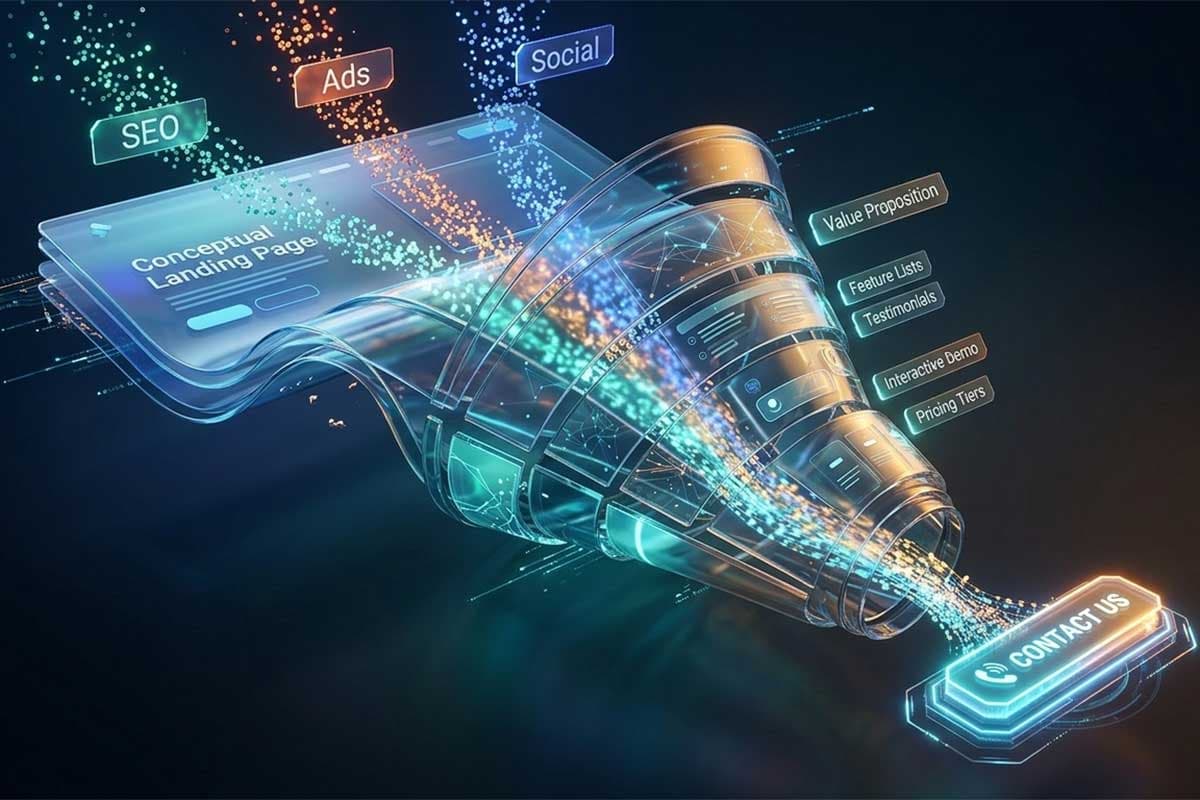
Websites that generate consistent leads usually rely on a deliberate architecture.
Each page plays a defined role inside the broader marketing system.
Some pages attract visitors through search.
Some pages educate prospects about solutions.
Some pages convert visitors into enquiries or customers.
Design decisions support this structure.
Information hierarchy influences reading behaviour.
Content blocks guide attention toward key messages.
Calls to action appear at moments when visitors are ready to respond.
These decisions emerge through strategy and testing.
AI tools generate layouts based on patterns learned from existing websites. They rarely design the strategic flow connecting those pages.
The result often looks polished while lacking the deeper structure required for reliable conversions.
Why Many Businesses Still Experiment with AI

Despite these limitations, AI website builders continue attracting attention.
The reason is understandable.
They lower the cost of experimentation.
A founder testing a new business idea can generate a website quickly and validate early interest without investing heavily in development.
For prototypes and early projects, this approach provides real value.
The challenge appears when companies treat these early prototypes as long term infrastructure.
What works during the experimentation phase rarely supports sustained marketing growth.
As businesses scale their digital presence, the website gradually evolves into something more complex than the original AI generated template.
The Strategic Question Businesses Eventually Face
At some point, many companies encounter a strategic decision.
Continue adjusting the automated website as the business grows.
Or rebuild the website as a structured marketing platform designed for long term performance.
The decision rarely happens immediately. It appears after months of gradual changes when the limitations of the original structure become visible.
Pages require constant adjustments.
Marketing experiments become harder to implement.
Performance drops under higher traffic.
The website begins resisting the growth it was supposed to support.
This turning point often leads businesses to reconsider how their digital infrastructure should evolve.
Read More: Website Design Ideas for Architects
Hot Take: AI Can Build Websites — But It Rarely Builds Businesses
AI tools are extremely good at producing pages.
They can generate layouts.
They can produce headlines and placeholder copy.
They can assemble a visually acceptable website in minutes.
But selling websites rarely succeed because of page generation alone.
They succeed because of strategic structure.
The difference becomes clear when a business begins investing in marketing.
Advertising campaigns start sending traffic.
Search engines deliver organic visitors.
Email marketing directs prospects to specific offers.
At this stage, the website stops being a digital brochure and becomes part of the business infrastructure.
AI tools usually generate pages.
Businesses need systems.
This gap explains why many AI-built websites look impressive initially but struggle to convert visitors consistently.
Where AI Website Builders Usually Break Down

AI tools typically optimise for speed of creation rather than marketing performance.
They produce pages that look modern but often lack deeper conversion architecture.
The difference appears once the website begins interacting with real customers.
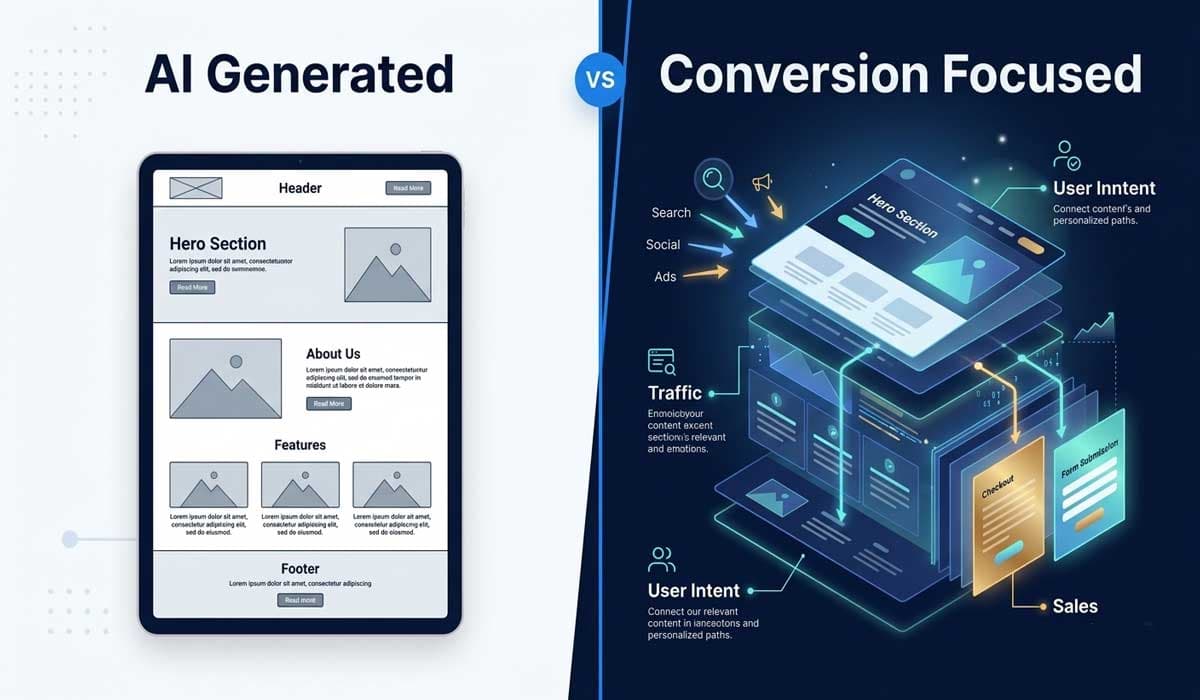
Structural Layer | AI Generated Website | Conversion Focused Website |
Page structure | Generated layout | Intentional conversion flow |
Messaging | Generic descriptions | Audience specific messaging |
Content hierarchy | Template based | Behaviour driven structure |
Marketing integration | Minimal | Funnel oriented design |
Scalability | Limited flexibility | Designed for growth |
At first glance, both types of websites appear similar.
The difference emerges when businesses start measuring results.
Traffic may arrive on both sites.
Only one structure consistently turns that attention into enquiries or customers.
The Strategic Question Businesses Eventually Face
At some point, many companies encounter a strategic decision.
Continue adjusting the automated website as the business grows.
Or rebuild the website as a structured marketing platform designed for long term performance.
The decision rarely happens immediately. It appears after months of gradual changes when the limitations of the original structure become visible.
Pages require constant adjustments.
Marketing experiments become harder to implement.
Performance drops under higher traffic.
The website begins resisting the growth it was supposed to support.
This turning point often leads businesses to reconsider how their digital infrastructure should evolve.
Why Conversion Architecture Matters More Than Design
Many people assume that website performance depends mainly on visual design.
In reality, the highest performing websites often share a deeper structural pattern.
Visitors follow a predictable journey.
They arrive with a question.
They evaluate credibility.
They compare options.
They decide whether to contact the business.
A website that sells guides visitors through this journey deliberately.
The homepage communicates positioning quickly.
Service pages explain the problem and solution clearly.
Supporting content builds trust and expertise.
AI tools generate pages individually. They rarely design this complete journey.
Without that structure, visitors often explore the site without reaching a clear decision point.
When AI Websites Actually Make Sense
AI website builders can be useful in specific situations.
Early stage startups testing ideas.
Personal projects or small portfolios.
Temporary campaign pages.
In these scenarios, speed matters more than structural complexity.
Once a business begins relying on the website for lead generation, however, the requirements change.
The website must support:
marketing campaigns
SEO visibility
content expansion
analytics and optimisation
These functions require intentional architecture rather than automated assembly.
The Long Term Role of AI in Web Development
AI will likely remain an important tool in the web development ecosystem.
Designers and developers already use AI to accelerate many parts of the process.
Content drafts can be generated quickly.
Layout experiments can be tested rapidly.
Data analysis can reveal conversion patterns.
The key distinction lies in how the tool is used.
AI works best as an assistant to structured strategy, not as a replacement for it.
The highest performing websites combine strategic planning with efficient tools.
Technology speeds up execution.
Strategy determines direction.
Read More: .com vs .com.au: Which Domain Should an Australian Business Choose?
Final Thoughts
AI has made websit
e creation dramatically faster.
Businesses can generate layouts, content, and page structures within minutes. For early stage experimentation, this capability is extremely valuable.
But speed of creation does not automatically produce marketing performance.
Websites that consistently generate enquiries usually share a deeper architectural structure.
They guide visitors through a clear decision journey.
They connect marketing campaigns to focused pages.
They support long term growth of content and services.
AI tools can assist with building websites.
Creating a website that actually sells still depends on strategic design.
At Flamincode, we often see businesses revisit their websites once marketing activity begins increasing. At that stage, the limitations of automated structures become clearer, and companies start thinking about their websites not just as pages, but as systems supporting growth.
Frequently Asked Questions
Can AI build a fully functional business website?
Yes. AI tools can generate a complete website, including layouts and content. The challenge lies in building a structure that consistently converts visitors into customers.
Why do many AI websites struggle to generate leads?
Automated tools often focus on design and layout rather than the deeper marketing architecture that guides visitors toward a decision.
Are AI website builders useful for small businesses?
They can be useful for testing ideas or launching a simple online presence. Growing businesses often require more structured platforms.
Do Melbourne businesses use AI tools for web development?
Many companies experiment with AI during early stages, especially for rapid prototyping or content generation.
Will AI replace web developers and designers?
AI will likely become a powerful tool within web development workflows, but strategic planning and architecture remain essential for high performing business websites.

Admin
Mostafa is a Wordsmith, storyteller, and language artisan weaving narratives and painting vivid imagery across digital landscapes with a spirited pen, he embraces the art of crafting compelling content as a copywriter, and content manager.

Based in
Melbourne, Australia
Your software dev partner, smooth process, exceptional results
Contacts
contact@flamincode.com.au
© All rights reserved to Flamincode