How to Improve Your Website’s ROI

M Chetmars
Author
A lot of businesses assume their website is underperforming because it does not get enough traffic.
Sometimes that is true.
But in many cases, the bigger problem is not traffic. It is what happens after the traffic arrives.
Visitors land on the site. They look around. They scroll a bit. Then they leave without enquiring, booking, buying, or moving any closer to becoming a customer.
That is where website ROI becomes the real issue.
At Flamincode, we often see businesses spending money on SEO, paid ads, branding, or social content while the website itself quietly weakens the return from all of it. The site may look fine on the surface, but if it does not guide the right visitor toward action, the business is leaving money on the table.
Improving website ROI is not about turning your website into a louder sales machine. It is about making it more commercially effective. A stronger website helps the right people understand your offer faster, trust you sooner, and take the next step with less friction.
Short answer:
To improve your website’s ROI, focus on increasing the business value created from the traffic and attention you already have. That usually comes from clearer messaging, better conversion paths, stronger trust, higher lead quality, and more accurate performance tracking.
Area | What Improves ROI | Why It Matters |
Messaging | Clear value proposition | Helps visitors understand your offer quickly |
Page structure | Better user flow | Reduces confusion and drop-off |
Trust | Social proof and credibility | Increases confidence before action |
Conversion | Better CTAs and forms | Lifts enquiries, bookings, or sales |
Lead quality | Better audience alignment | Improves sales efficiency |
Tracking | Smarter measurement | Helps you improve what makes money |
A website does not need to double its traffic to become more valuable.
In many cases, it only needs to convert the right people more effectively.
What Website ROI Actually Means
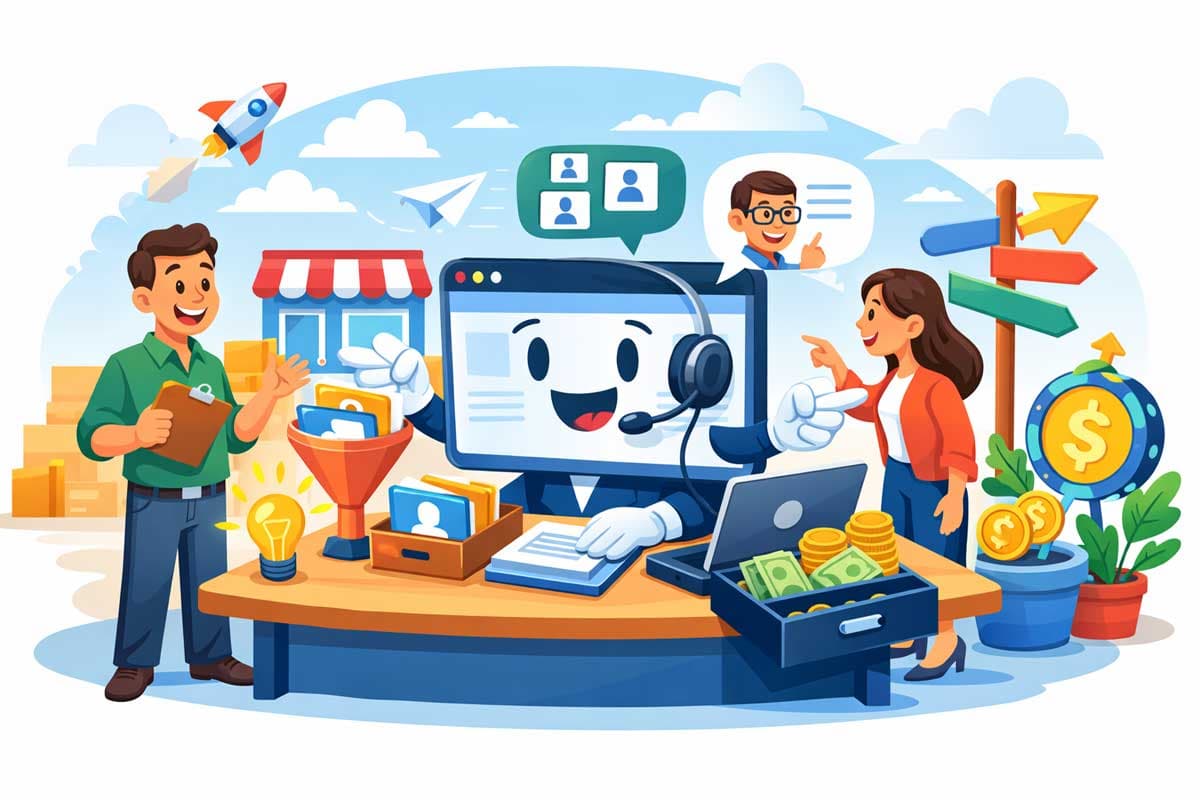
Website ROI simply refers to the return your business gets from your website compared to what you invest into it.
That investment might include:
development costs
design work
SEO
paid traffic
content creation
maintenance
hosting
team time
And the return might come through:
leads
booked calls
direct sales
quote requests
repeat customers
better sales efficiency
reduced admin time
This is where many businesses get distracted. They look at traffic and impressions first because those numbers are easy to see.
But website ROI is not really about how many people arrive.
It is about how much useful business value the site creates from the people who do arrive.
A site with 500 highly relevant visitors and strong conversion paths can easily outperform a site with 5,000 low-intent visitors and weak structure.
That is why ROI improvement starts with commercial thinking, not vanity metrics.
Read More: Why Your Website Doesn’t Rank on Google in Melbourne
Why So Many Websites Have Weak ROI
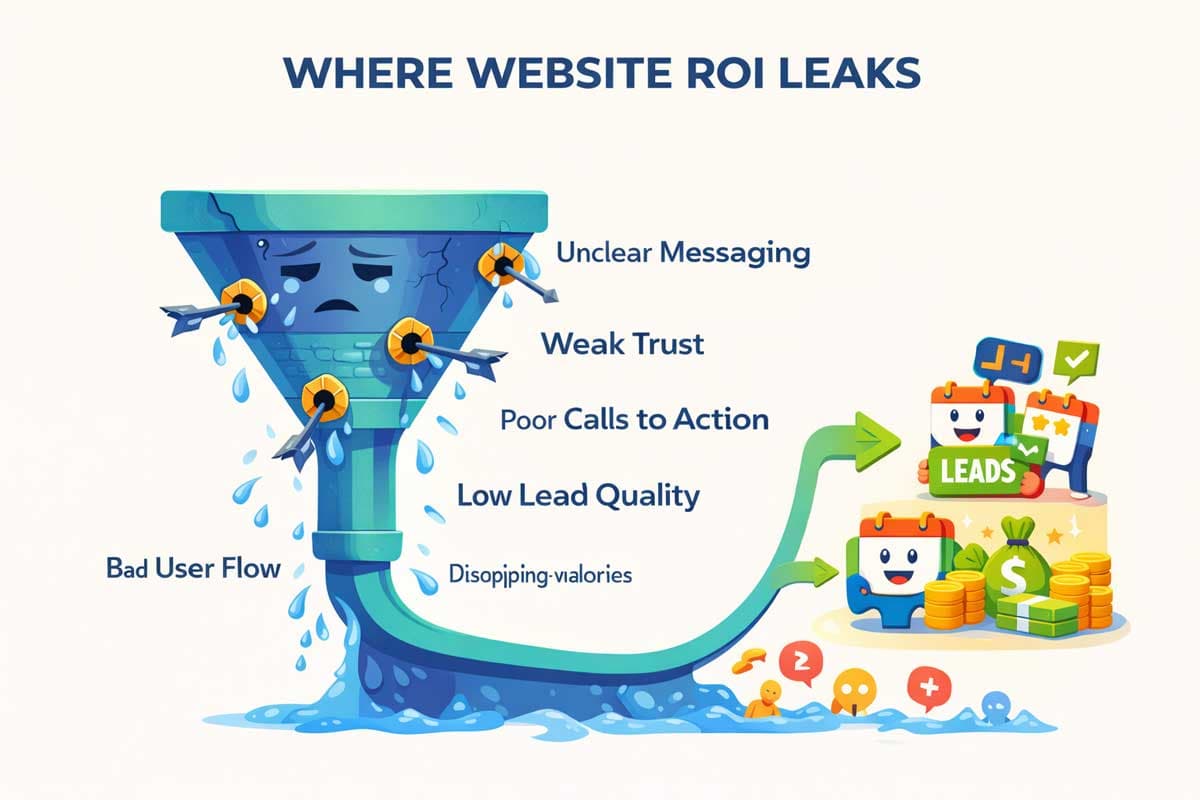
Most low-ROI websites are not broken in an obvious technical way.
They are simply not built to support business decisions properly.
A website can look modern, load correctly, and still perform poorly as a business asset.
This usually happens when the site has problems like weak positioning, vague headlines, poor service page structure, low trust, unclear calls to action, or no real conversion logic behind the page layout.
Each issue on its own may seem small.
But together, they create a site that leaks commercial value.
That means every SEO effort, ad campaign, referral, and piece of content feeding traffic into the website becomes less profitable than it should be.
That is why website ROI is rarely just a marketing issue or just a design issue.
It is usually a business performance issue.
1) Make Your Website Clearer in the First 10 Seconds
One of the fastest ways to improve website ROI is to improve clarity.
When someone lands on your website, they should not have to work too hard to understand what you do, who you help, and why they should care.
A lot of websites lose conversions because they open with vague branding language instead of useful commercial clarity.
If a visitor cannot quickly answer these questions, ROI suffers:
What does this business do?
Is this relevant to my situation?
Why should I trust them?
What should I do next?
This is especially important on the homepage, service pages, and landing pages.
A clear website reduces mental friction. It helps the right visitor move forward faster.
A vague website creates hesitation.
And hesitation is expensive.
Compare the difference:
Weak messaging:
“We create innovative digital experiences for modern brands.”
Stronger messaging:
“We design and build high-converting websites for Melbourne businesses that need better leads, stronger trust, and long term scalability.”
The second version is doing more commercial work. It is more specific. It helps the right audience self-identify faster.
That improves ROI because the website becomes easier to understand and easier to act on.
2) Improve Conversion Paths, Not Just Traffic
A lot of businesses think the next growth move is more traffic.
But if your website is not converting well enough already, more traffic often means more waste.
This is one of the biggest ROI traps in digital marketing.
If your site is already getting some visitors from search, paid ads, social media, email, or referrals, then one of the smartest moves is to improve what happens after they arrive.
This means looking closely at your conversion paths.
A conversion path is the journey a user takes from landing on your site to taking a commercially useful action.
That action might be:
submitting an enquiry
booking a call
requesting a quote
purchasing a service
moving deeper into the sales process
A strong conversion path feels natural and obvious. A weak one feels confusing, scattered, or passive.
For example, a business may have:
a good-looking homepage but no strong CTA
a useful service page but no clear next step
a decent blog article but no pathway toward a relevant service
a contact form hidden too deep in the site
When these gaps exist, the website may still get attention, but it will convert less of it into actual business value.
That is why ROI often improves faster through conversion optimisation than through traffic expansion alone.
3) Strengthen Trust Before the Visitor Talks to You
A lot of businesses expect users to enquire before they feel fully confident.
That is not how most buyers behave.
Before someone reaches out, they usually want to feel reassured first.
They want signs that your business is credible, relevant, and worth their time.
If the website does not build enough trust early, ROI drops because the visitor leaves before the sales process even begins.
This is especially true for service businesses, consulting businesses, software projects, and higher-value offers where the decision involves more risk or commitment.
Trust is often built through a combination of small but important signals:
clearer service explanations
realistic business language
visible proof of experience
strategic case-study style thinking
better structure and professionalism
pages that feel grounded rather than generic
A lot of websites rely too heavily on generic claims like “high quality,” “innovative,” or “customer-focused.” These do very little on their own.
Trust grows faster when the website feels specific, competent, and commercially aware.
The more uncertainty your website removes before the sales conversation starts, the stronger its ROI usually becomes.
4) Improve Lead Quality, Not Just Conversion Volume
Not all website conversions are equally valuable.
This is one of the biggest things businesses overlook when trying to improve ROI.
A site can generate more enquiries and still perform poorly if the leads are weak, low-intent, or not commercially suitable.
That is why better websites do not simply attract more responses. They attract better ones.
A stronger website helps the right buyer feel more aligned while helping the wrong-fit visitor self-filter out earlier.
That creates a healthier pipeline and a more efficient business.
Weak Website Outcome | Better ROI Outcome |
Random enquiries | More qualified leads |
Low-intent conversations | Better buyer readiness |
More time wasted in sales | More efficient sales flow |
Broad, messy lead volume | Cleaner commercial fit |
This is especially important if your business sells custom services, technical work, consulting, or longer sales-cycle projects.
In those cases, lead quality often matters more than lead quantity.
A website that helps you spend less time on poor-fit leads is already improving ROI.
Read More: Why Most Melbourne Business Websites Break at Scale
5) Make Your Service Pages More Commercially Useful
A lot of websites have service pages that exist mainly because they are expected to be there.
That is a missed opportunity.
Service pages are often some of the highest-value pages on the site because they are where serious visitors start evaluating whether your business is the right fit.
If these pages are too vague, too short, too generic, or too shallow, they often fail at the exact moment where ROI should be improving.
A strong service page should help the visitor understand:
what the service actually does
who it is best suited for
what kind of problem it solves
why it matters commercially
what the next step should be
This is where a lot of businesses quietly lose money.
They invest in SEO, publish content, run ads, or build brand awareness, but when the visitor finally lands on a service page, the page is not strong enough to support a buying decision.
That weakens the return from everything else.
A better service page does not need to sound overly salesy. It simply needs to do more useful work.
It should help the reader move from interest to confidence.
That is where service pages start becoming ROI assets instead of filler pages.
6) Reduce Friction in Forms and Calls to Action
One of the easiest ways to weaken ROI is to make action feel harder than it needs to be.
A lot of websites accidentally do this.
The visitor is interested. They are close to taking action. But then the site introduces friction through weak CTA wording, clunky forms, awkward next steps, or too much effort at the wrong time.
That friction might seem small, but it compounds.
If your website makes people pause right before action, your conversion rate usually drops.
That is why high-ROI websites make the next step feel easy, obvious, and commercially relevant.
Compare these examples:
Weak CTA:
Submit
Stronger CTA:
Book a strategy call
Or:
Weak CTA:
Contact us
Stronger CTA:
Get a tailored quote
The stronger versions are more specific. They help the user understand what happens next.
That matters because people convert more easily when the action feels clear and low-risk.
The same applies to forms.
If your enquiry form asks for too much too early, or feels more like paperwork than a conversation starter, you are likely losing leads you already paid to attract.
In many cases, reducing friction improves ROI faster than publishing more content or increasing ad spend.
7) Measure What Creates Business Value, Not Just Website Activity
A lot of ROI problems stay hidden because the business is measuring the wrong things.
This is more common than it should be.
Many websites are being judged mainly by traffic, clicks, impressions, or time on page. Those numbers can be useful, but they do not tell you enough on their own.
If you want to improve website ROI, you need to understand which parts of the website are contributing to real business outcomes.
That means looking at things like:
which pages generate enquiries
which traffic sources bring qualified leads
where users drop off before converting
which pages assist trust and movement
which leads eventually become revenue
Without this, a business can end up investing more in pages, campaigns, or content types that look healthy on the surface but are not generating much actual return.
That leads to poor decisions.
A page might get traffic and still be commercially weak.
A campaign might get clicks and still bring poor-fit leads.
A blog might rank and still contribute almost nothing to revenue.
Good ROI optimisation depends on better visibility.
Once you can see where money is being made, lost, delayed, or diluted, the improvement process becomes far more strategic.
8) Use Content to Support Revenue, Not Just Rankings
A lot of businesses publish blog content in a way that creates traffic but not enough business value.
This is one of the most common content strategy problems.
The site gains visibility, but the content does not connect strongly enough to commercial intent, service pathways, or conversion opportunities.
That weakens ROI.
Content becomes far more valuable when it does three things well:
First, it attracts relevant search intent.
Second, it helps the reader understand a business problem more clearly.
Third, it creates a logical path toward a commercially meaningful next step.
That does not mean every article should be pushing a sale.
It means the content ecosystem should make sense.
If your business offers web development, app development, software consulting, business intelligence, or digital growth support, then your content should help reinforce those commercial pathways over time.
That is where internal linking, topical structure, and strategic article selection start becoming important.
A website with better content architecture often produces stronger ROI because more of the traffic entering the site has somewhere commercially useful to go.
Common Mistakes That Quietly Hurt Website ROI
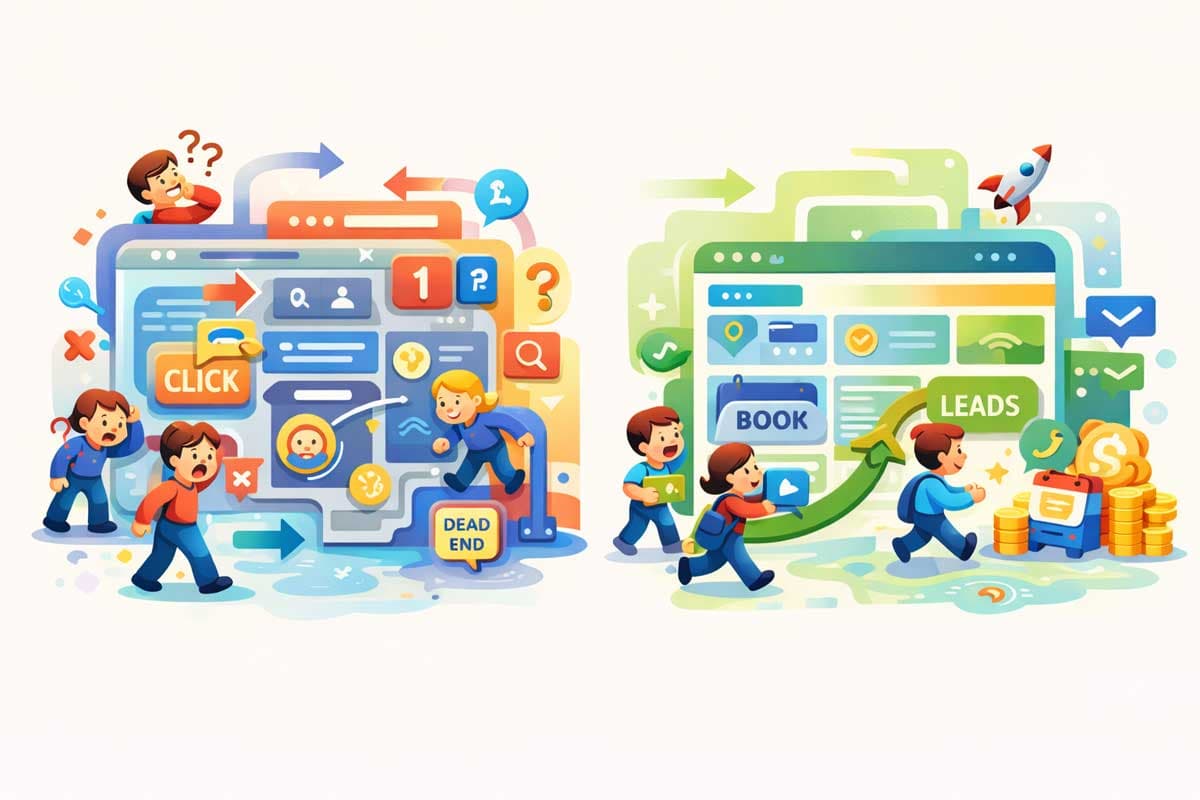
A lot of websites do not fail dramatically.
They simply underperform quietly.
That usually happens because of a stack of smaller issues rather than one obvious disaster.
Some of the most common ROI mistakes include relying too heavily on traffic as a success metric, keeping vague messaging on key pages, publishing content with weak commercial relevance, and leaving important service pages underdeveloped.
Another common issue is treating a website like a static brochure instead of a working business asset.
Once a website goes live, many businesses stop thinking strategically about it. They update it occasionally, but they do not keep refining how it converts, qualifies, and supports decision-making.
That is where long term ROI often gets lost.
A website should not be judged only by whether it exists or whether it still looks modern enough.
It should be judged by whether it is helping the business perform better.
Read More: Why Your Melbourne Business Needs a CRM System
Final Thoughts
Improving website ROI is rarely about one dramatic fix.
It usually comes from improving the commercial performance of the website layer by layer.
We often find that businesses do not need a louder website. They need a clearer, more useful, more strategically structured one. A site that helps the right visitor understand the offer faster, trust the business sooner, and take the next step with less friction.
That is where ROI improves.
A website becomes more valuable when it supports not only visibility, but also decision-making, qualification, conversion, and long term business efficiency.
That is what turns a website from an online expense into a real business asset.
A lot of ROI problems are not marketing problems at all. They are structural website problems. If that sounds familiar, our web development services are built around performance, clarity, and long term growth
Frequently Asked Questions
What does website ROI actually mean?
Website ROI refers to the business value your website generates compared to the money, time, and effort invested into building, running, and improving it.
Is more traffic the best way to improve website ROI?
Not always. If your website has weak messaging, poor conversion paths, or low trust, more traffic often increases waste rather than return.
Which pages usually have the biggest effect on ROI?
Homepages, service pages, landing pages, and high-intent blog articles usually have the strongest impact because they influence understanding, trust, and action.
How do I know if my website has poor ROI?
Common signs include low enquiry rates, weak lead quality, strong traffic with little business impact, and marketing spend that does not feel commercially efficient.
How often should a website be optimised for better ROI?
It should be reviewed regularly, especially after major campaigns, traffic changes, new service launches, or visible drops in lead quality or conversion performance.

Admin
Mostafa is a Wordsmith, storyteller, and language artisan weaving narratives and painting vivid imagery across digital landscapes with a spirited pen, he embraces the art of crafting compelling content as a copywriter, and content manager.

Based in
Melbourne, Australia
Your software dev partner, smooth process, exceptional results
Contacts
contact@flamincode.com.au
© All rights reserved to Flamincode