Local SEO Checklist: 10 Tips for Small Businesses

M Chetmars
Author
If you run a small business, local SEO is often one of the clearest ways to generate more relevant traffic without depending entirely on paid ads.
The problem is that many businesses think local SEO starts and ends with adding their suburb name to a page or setting up a Google Business Profile once and forgetting about it. That is usually not enough.
When someone nearby searches for a service you offer, Google is trying to decide which business looks most relevant, most trustworthy, and most likely to help the searcher right now. If your business does not send those signals clearly, you can still get overlooked, even if your service is strong.
A good local SEO setup helps your business appear in front of nearby customers who are already searching with intent. In 2026, that means more than “being on Google”. It means having the right local signals across your website, your Google Business Profile, your reviews, and your service structure. At Flamincode, we often see local SEO perform best when it is treated as part of the business system, not as a one-off marketing task.
Local SEO Area | What It Affects | Why It Matters |
Google Business Profile | Map visibility | Helps you appear in local pack results |
Service + location relevance | Search matching | Connects your site to nearby intent |
Reviews | Trust and click-through | Helps people choose you |
NAP consistency | Business validation | Confirms your business identity |
Mobile website quality | Enquiries and leads | Most local traffic arrives on mobile |
1) Claim and Fully Optimise Your Google Business Profile

For many small businesses, your Google Business Profile is the first real local SEO asset you need to get right.
This is often the listing people see before they even visit your website. It affects whether you show up in Google Maps, whether you appear in local pack results, and whether someone feels confident enough to call, visit, or click through.
A half-finished profile creates weak local signals. If your business category is vague, your hours are outdated, your photos are poor, or your services are unclear, Google gets less certainty and users get less trust.
Your profile should clearly reflect what your business does and where it operates. That includes choosing the right primary category, adding secondary categories where relevant, writing a strong business description, uploading current photos, listing actual services, and keeping hours accurate.
A lot of small businesses create a profile once and leave it untouched for years. That usually leads to stale information and underperformance. Local SEO works better when your business profile stays active and current.
Read More: Is SEO Worth It for Melbourne Businesses in 2026?
2) Make It Obvious What You Do and Where You Do It
One of the most common local SEO problems is simple: the website is too vague.
Many small business websites talk in broad language. They say things like “quality solutions”, “trusted service”, or “professional support”, but they never clearly connect those services to a specific place or search intent.
Google is trying to match your site with local queries. That means your website should help answer two questions quickly:
What do you do?
Where do you do it?
If someone lands on your homepage, they should not have to guess whether you serve Melbourne CBD, the eastern suburbs, or a wider service area. If they land on a service page, it should be obvious what the service is for and who it is relevant to.
This is where a lot of local SEO quietly breaks down. The business might have a decent service, a real market, and a functional website, but the site does not communicate local relevance well enough to compete.
That does not mean stuffing city names into every paragraph. It means structuring your website in a way that makes your business easier for both users and search engines to understand.
3) Build Proper Service Pages Instead of One Generic Services Page
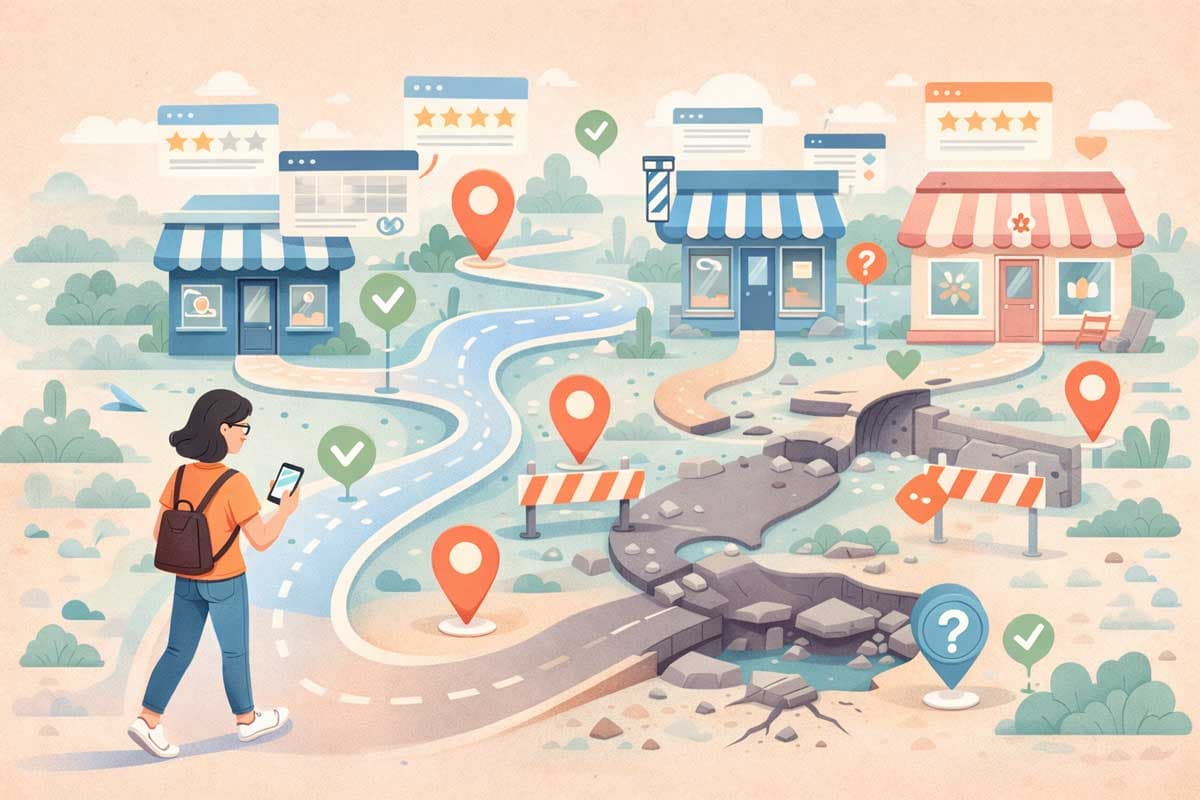
A generic “Services” page is usually not enough if you want to rank well for local intent.
If your business offers multiple services, each one should ideally have its own page with its own structure, context, and relevance. This gives Google clearer signals and gives potential customers a better path to the exact thing they need.
For example, if you are a trades business, a person searching for “emergency plumber in Melbourne” is not looking for a broad page about plumbing in general. They want a page that clearly reflects the service they need, with enough local and practical relevance to trust it.
The same principle applies across industries. A legal firm, clinic, agency, repair business, or contractor usually performs better when each major service has its own page rather than being compressed into one catch-all section.
This also improves internal linking, page titles, metadata, and search matching. More importantly, it improves clarity.
Many small businesses do not have a traffic problem first. They have a structure problem.
4) Create Location Pages Only When They Add Real Value
Location pages can help local SEO, but only when they are built properly.
A lot of businesses create thin suburb pages with nearly identical text, swapping out only the suburb name across dozens of URLs. That might look like local SEO work, but it often creates weak pages that offer little value and perform poorly over time.
A location page should exist because it helps the user and supports a real service area. It should not exist purely to manufacture local keywords.
A useful local page usually needs a few things working together: a clear service connection, realistic local relevance, trust signals, and enough original content to justify its existence. That could include local project context, practical service notes, area-specific considerations, or examples of how the business works in that region.
If your business genuinely serves multiple areas, good location pages can be useful. But if they are thin, repetitive, and disconnected from real customer intent, they often create noise instead of strength.
This is one of those areas where local SEO can look “busy” without becoming effective.
Read More: Why Your Website Doesn’t Rank on Google in Melbourne
5) Keep Your Business Details Consistent Everywhere
One of the quieter but important local SEO signals is consistency.
Your business name, address, and phone number should match across your website, Google Business Profile, directories, and other listings wherever possible. This helps search engines trust that all of those references point to the same real business.
If your website says one phone number, your Google listing shows another, and a directory still has an old address from two years ago, that inconsistency weakens confidence.
This is not the most glamorous part of local SEO, but it matters because local visibility often depends on trust and confirmation. Search engines are trying to validate business identity. Consistency helps.
At minimum, your contact page, website footer, Google Business Profile, and main directory listings should all align. If your service area has changed, if your phone number has been updated, or if your branding shifted recently, this is worth checking manually.
A surprising number of businesses lose local clarity here without realising it.
6) Get Reviews That Help You Rank and Convert

Reviews do more than support reputation. They also influence visibility, trust, and action.
When people compare local businesses, reviews often become one of the fastest decision-making shortcuts. If your listing appears alongside a competitor with more relevant, recent, and believable reviews, that competitor often gets the click.
This is where local SEO overlaps directly with conversion.
You do not need a fake-looking review strategy or a flood of unnatural testimonials. You need a system that consistently helps happy customers leave feedback while the experience is still fresh.
The timing matters. The quality matters. The recency matters.
A healthy review profile usually reflects real customer experiences over time, not one campaign from 18 months ago followed by silence. It also helps when reviews naturally mention the type of work completed or the area served, because this reinforces relevance in a way that feels organic.
For many small businesses, review generation is treated as optional. In practice, it is often one of the highest-impact local trust signals available.
7) Make Sure Your Website Works Properly on Mobile
A lot of local traffic comes from mobile users.
That means people are often landing on your site while they are in transit, comparing options quickly, checking service areas, or deciding whether to call right now. If your website feels slow, cluttered, awkward, or frustrating on mobile, local SEO loses value even if rankings improve.
This is one of the most overlooked gaps in local search strategy.
A business might invest time into visibility, improve some rankings, and then still wonder why leads feel inconsistent. Often, the issue is not only whether people found the site. It is whether the site made it easy to act.
Your mobile experience should support real local intent. That includes fast loading, clear calls to action, easy contact options, readable service information, simple forms, and obvious trust signals.
If someone has to pinch-zoom, hunt for your number, or scroll through a cluttered page just to figure out what you offer, you are creating friction where intent should have become action.
This is where website strategy and local SEO stop being separate conversations.
Local SEO Task | Ease of Implementation | Business Impact |
Optimise Google Business Profile | High | High |
Improve service page relevance | Medium | High |
Collect stronger reviews | Medium | High |
Improve mobile conversion flow | Medium | High |
Fix location page quality | Medium | Medium to High |
8) Add the Right Local SEO Signals to Your Website
Local SEO is not only about content. Your website also needs the right supporting signals behind the scenes.
This does not need to become deeply technical for a small business owner, but the fundamentals still matter. Your page titles should reflect what the page is about. Your service pages should be indexable. Your contact information should be easy to find. Your internal links should help search engines understand page relationships.
Structured data such as LocalBusiness schema also helps reinforce business identity and context. It does not magically create rankings on its own, but it supports clarity.
This is one of the reasons many small business sites underperform quietly. They look fine on the surface, but their technical structure is weak enough to reduce visibility over time.
Good local SEO is rarely one single “hack”. It is usually the result of many clear signals working together.
Read More: Website vs Landing Page: Which One Does Your Business Need?
9) Earn Local Mentions and Links That Make Sense
Backlinks still matter, but local SEO usually benefits more from relevant, believable mentions than random link-building tactics.
If your business is listed in useful local directories, mentioned by nearby organisations, connected to local partnerships, or referenced through real community activity, those signals help build local authority.
This does not mean chasing spammy directory submissions or paying for low-quality placements. It means earning references that fit how a real business operates.
Examples include local business networks, chambers of commerce, supplier partnerships, sponsorships, associations, community collaborations, and area-specific publications. These tend to be more valuable because they reinforce both industry and geographic relevance.
A lot of businesses either ignore this completely or approach it in a way that looks artificial. The better approach is usually simpler: be visible in the local ecosystem where your business genuinely belongs.
10) Track Whether Local SEO Is Turning Into Real Enquiries
One of the biggest mistakes in local SEO is measuring the wrong things.
It is easy to get distracted by impressions, ranking screenshots, or broad traffic numbers. Those are not useless, but for a small business, the real question is simpler:
Is local visibility turning into business activity?
That means you should be watching things like calls, form submissions, map actions, service page visits, local landing page engagement, and lead quality. If your visibility improves but your enquiry quality stays weak, there is probably a mismatch somewhere in your structure or targeting.
This is why local SEO should be treated as part of the full customer journey. Search visibility matters, but so does what happens after the click.
If your website attracts the right person but does not guide them well, local SEO ends up doing only half the job.
Businesses often assume they need “more traffic” when what they really need is a cleaner local acquisition path.
Why Small Businesses Often Struggle With Local SEO Even When They Are Good at What They Do
This is worth saying clearly: being good at your service is not the same thing as being easy to find locally.
A lot of strong small businesses underperform in local search simply because their digital structure does not reflect how people actually search. Their website is vague, their service pages are thin, their Google Business Profile is underused, and their mobile experience creates friction.
None of that means the business is weak. It usually means the system around the business is underbuilt.
That is why local SEO tends to work best when it is treated as a visibility framework rather than a checklist you tick once and forget. The businesses that perform better locally are usually not the ones doing “SEO tricks”. They are the ones sending clearer signals across the whole journey.
Final Thoughts
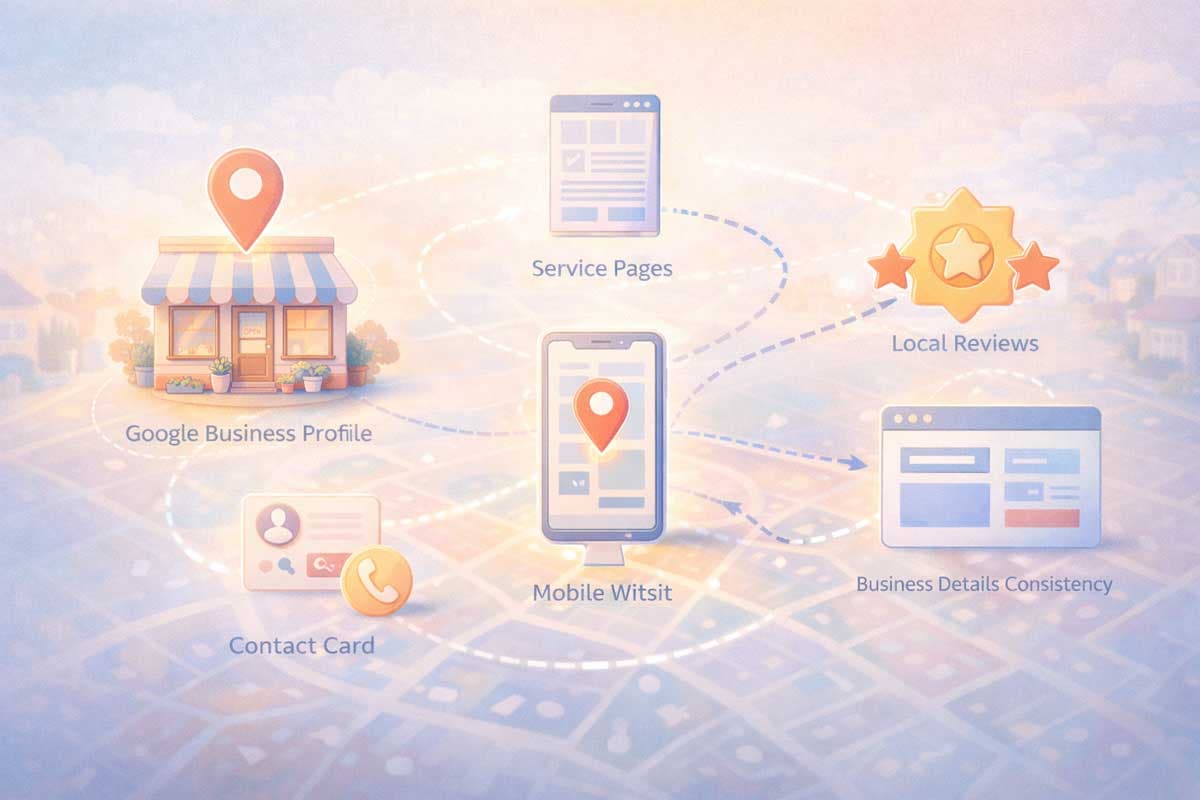
A good local SEO strategy does not start with trying to impress Google. It starts with making your business easier to understand, easier to trust, and easier to choose.
For small businesses, that often means tightening the fundamentals before chasing anything advanced. A stronger Google Business Profile, clearer service pages, better local relevance, stronger reviews, and a better mobile experience usually move the needle more than scattered SEO activity.
If your business already has a website but local visibility still feels inconsistent, the issue is often structural before it is promotional.
At Flamincode, we often help businesses improve the parts of their websites that stop local traffic from turning into real enquiries. Contact our team of experts to know more about what we do.
Frequently Asked Questions
How long does local SEO take for a small business?
Local SEO usually takes a few months to show meaningful traction, especially if your current setup is weak. Some improvements, such as Google Business Profile updates and review activity, often show earlier movement than deeper website changes.
Is Google Business Profile enough for local SEO?
No. It is important, but it works best when your website, reviews, service pages, and local trust signals support it properly.
Do I need a separate page for every suburb?
Not always. Only create suburb or location pages when they genuinely support a real service area and add useful context for users.
How important are reviews for local rankings?
They are highly important because they affect trust, click behaviour, and local credibility. They also influence how people compare your business with nearby competitors.
Does local SEO still matter if I already run Google Ads?
Yes. Ads can drive traffic, but local SEO helps your business build ongoing visibility and trust in organic local search. The two often work better together than separately.

Admin
Mostafa is a Wordsmith, storyteller, and language artisan weaving narratives and painting vivid imagery across digital landscapes with a spirited pen, he embraces the art of crafting compelling content as a copywriter, and content manager.

Based in
Melbourne, Australia
Your software dev partner, smooth process, exceptional results
Contacts
contact@flamincode.com.au
© All rights reserved to Flamincode