The Hidden Cost of Cheap Web Design in Australia

M Chetmars
Author
Across Australia, thousands of small businesses face the same decision every year.
They need a website.
A quick search reveals dozens of offers:
“Business website for $300”
“Professional web design $499”
“Full website in 48 hours”
For a small business owner trying to control expenses, these offers seem practical.
Why spend thousands of dollars on a website if someone can deliver one for a few hundred?
At first glance, the decision appears obvious.
Launch the cheaper site.
Get online quickly.
Save the budget for marketing.
But something interesting happens after the website has been running for a while.
The website starts creating friction instead of helping the business.
New pages become difficult to add.
Marketing campaigns require constant workarounds.
The site loads slowly as more plugins accumulate.
Eventually, the company faces an uncomfortable realisation.
The inexpensive website was not actually inexpensive.
It simply postponed the real cost.
Short Answer:
Cheap web design in Australia often focuses on launch speed, not business performance.
The lower price usually means the website relies heavily on templates, quick setup tools, and minimal planning.
Website Type | Initial Cost | Typical Outcome |
Ultra-cheap website | $300 – $800 | Fast launch, limited flexibility |
Budget small business website | $800 – $2000 | Acceptable structure, basic growth support |
Strategic web platform | $3000 – $8000+ | Designed for marketing and scalability |
All three versions may look similar during the first weeks after launch.
The difference becomes visible when the business begins relying on the website for growth.
Why Cheap Web Design Exists

Cheap web design did not appear by accident.
Modern website builders make it possible to assemble a functional site extremely quickly.
Page builders, templates, and automated tools reduce the amount of manual work required.
A freelancer can often create a basic business website in a few hours.
From the outside, this looks like a remarkable efficiency improvement.
In many cases, it actually is.
A café opening in Sydney might only need a simple website with opening hours and location details.
A freelance consultant might require only a basic introduction page and a contact form.
For projects like these, inexpensive websites can work perfectly well.
The challenge appears when businesses expect the same structure to support more complex activity.
Read More: Custom Web Design Services Australia
The Moment a Website Stops Being a Brochure

Many Australian businesses initially treat their website as a digital business card.
Its purpose is simple.
Explain what the company does.
Provide contact details.
Show that the business exists online.
At this stage, the website rarely faces heavy demands.
Visitors arrive occasionally.
The pages remain mostly static.
Updates are infrequent.
As the business grows, however, expectations begin to change.
Marketing campaigns direct traffic to specific pages.
Search engines bring visitors researching services.
Content begins expanding across multiple topics.
The website becomes something else entirely.
Instead of a brochure, it becomes a business tool.
And that shift exposes the weaknesses of cheaply assembled sites.
The Architecture Problem Beneath Cheap Websites
Many inexpensive websites rely on a simple structural model.
A template provides the page layout.
Content is inserted into pre-designed blocks.
Plugins add extra features when necessary.
This system works well when the site contains only a handful of pages.
As the site grows, complexity increases.
New sections require additional plugins.
Navigation becomes difficult to organise.
Performance suffers because the system was never designed to scale.
The visual design might still look modern.
But the underlying architecture begins struggling to support the expanding website.
Read More: Free Website Builders in Australia
Why Marketing Exposes Weak Websites
Marketing campaigns tend to reveal structural weaknesses very quickly.
Imagine a Melbourne business launching its first advertising campaign.
Visitors begin arriving on the website.
Some are searching for information.
Others are ready to contact the business immediately.
If the website structure is clear, these visitors move through the site naturally.
If the structure is messy, visitors struggle to find what they need.
They click through several pages.
They become confused about services.
Eventually they leave.
The business owner often blames the marketing campaign.
In reality the problem lies inside the website architecture.
The Maintenance Trap Many Businesses Fall Into

One of the hidden costs of cheap web design appears through maintenance.
When the original website lacks clear structure, every small change becomes more complicated.
Adding a page might require adjusting multiple layouts.
Changing navigation may affect several templates.
Installing new features introduces compatibility issues.
Instead of functioning as a stable platform, the website becomes fragile.
Small updates require disproportionate effort.
This gradually slows down the company’s ability to experiment with marketing and content.
The Real Question Businesses Should Ask
The price of a website matters.
Every business must manage its resources carefully.
But the real question is rarely “How cheap can this website be?”
The more useful question is:
What role will this website play in the business?
If the website functions only as a basic presence, a simple solution may be sufficient.
If the website will support marketing, lead generation, and long-term growth, its structure becomes far more important.
Understanding this difference helps Australian businesses choose the right level of investment.
Hot Take: Cheap Websites Rarely Fail Immediately
One reason cheap web design continues to attract businesses across Australia is that the problems do not appear right away.
The website launches.
It looks modern enough.
Customers can find the business online.
For the first few months everything appears fine.
Because of this delay, business owners often assume the decision was correct.
The website fulfilled its purpose and the company saved thousands of dollars.
But the role of a website rarely stays static.
As the business becomes more active online, the expectations placed on the site begin to change.
Marketing campaigns start directing traffic.
New services require dedicated pages.
Search engines begin evaluating the website’s structure.
At this stage, the limitations of the original system become harder to ignore.
What initially looked like an efficient decision slowly turns into a structural bottleneck.
Cheap Web Design vs Strategic Website Architecture
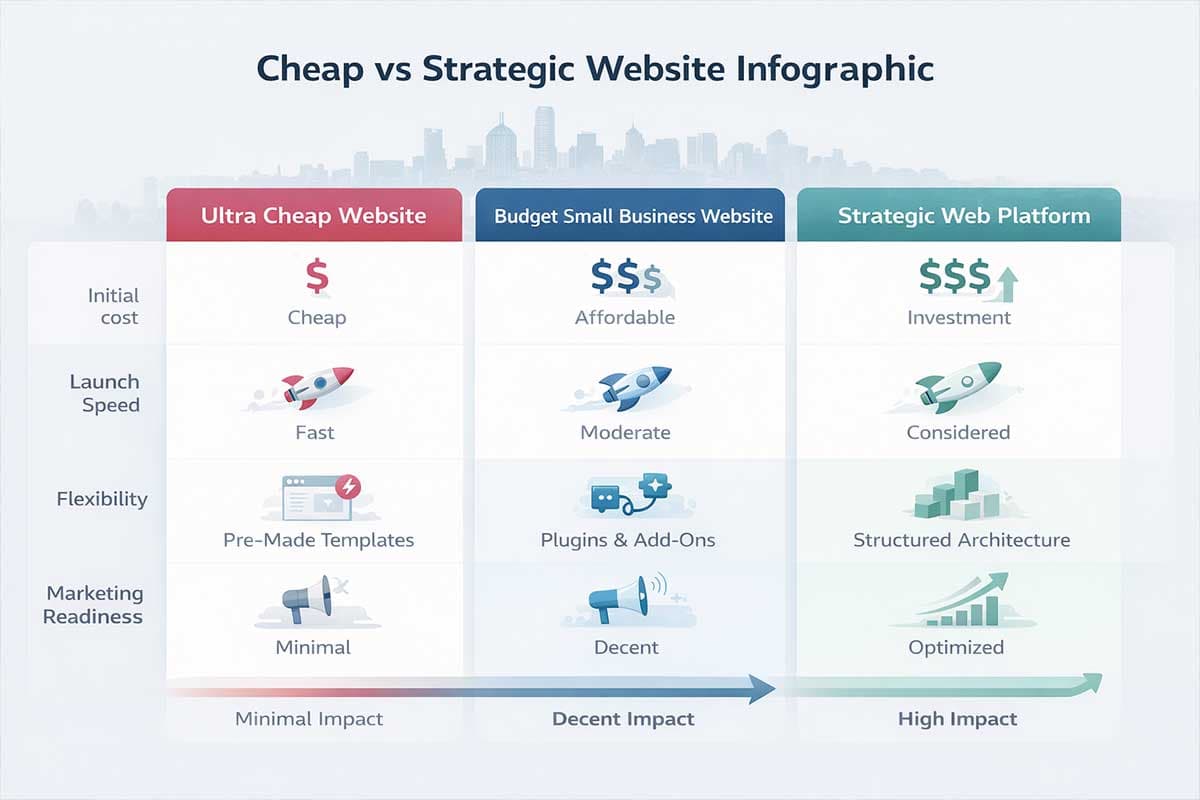
The difference between inexpensive websites and well-structured platforms usually appears beneath the surface.
Both may look professional to visitors. The underlying systems, however, operate very differently.
Structural Layer | Cheap Website Setup | Structured Business Website |
Site architecture | Template based layout | Planned content hierarchy |
Content management | Manual page editing | Structured content system |
Feature expansion | Plugin heavy | Integrated modules |
Performance stability | Degrades as site grows | Designed for scalability |
Marketing readiness | Limited | Supports campaigns and SEO |
In the early stages, these differences remain invisible.
They become obvious once the business begins relying on the website as a marketing platform.
Why Cheap Websites Struggle With Marketing
Marketing exposes structural weaknesses faster than any other activity.
A website built quickly with templates may function perfectly when it receives only occasional traffic.
Once campaigns begin driving visitors, the system faces several new demands.
Landing pages must align with advertising messages.
Service pages need clear navigation pathways.
Content should guide visitors toward enquiries.
Without a well-planned architecture, these elements become difficult to implement.
Pages begin overlapping in purpose.
Navigation grows confusing.
Conversion paths remain unclear.
Visitors often leave without taking action.
The business then invests more in marketing, hoping to improve results.
In many cases the real obstacle lies in the website structure itself.
The Scalability Issue Most Businesses Discover Late
A website rarely remains the same size forever.
Companies evolve.
New services appear.
Content expands.
Marketing campaigns target different audiences.
Cheap websites usually lack the flexibility to adapt smoothly to these changes.
Each addition introduces complexity.
More plugins appear.
Design consistency becomes harder to maintain.
Performance gradually declines.
What began as a simple website turns into a patchwork of fixes.
Eventually, businesses reach a familiar conclusion.
The site needs a complete rebuild.
The Rebuild Cycle Many Australian Businesses Experience
A pattern appears across many Australian companies.
The first website launches quickly and cheaply.
It works well enough during the early phase of the business.
After a few years, the company becomes more active online.
Traffic increases.
Marketing efforts expand.
Customers expect smoother digital experiences.
The original website begins limiting growth rather than supporting it.
At this point, the business invests in a new website built with a stronger architectural foundation.
Ironically, the second website often costs far more than the first.
The initial saving disappears because the cheap solution only delayed the real investment.
Why Website Architecture Matters for SEO and Growth

Search engines evaluate websites based on structure and clarity.
They attempt to understand how content relates across the site.
Cheap web design often focuses on launching individual pages rather than building a connected content system.
Without an internal structure, search engines struggle to interpret the expertise of the website.
Service pages remain isolated.
Supporting content lacks clear connections.
Navigation signals become inconsistent.
A well-structured website communicates authority more effectively.
Pages reinforce each other.
Topics connect naturally.
Search engines recognise the depth of coverage.
This difference often explains why some websites gain visibility while others remain hidden.
Read More: Is Web Design Different from Web Development?
The Strategic Question Australian Businesses Should Ask
When comparing web design quotes, businesses often focus on price first.
This is understandable.
Budgets matter, especially for smaller companies.
However, the more important question usually concerns the future role of the website.
Will the site simply display information?
Or will it support marketing, content growth, and customer acquisition?
If the website will become a central component of the company’s digital strategy, architecture becomes far more important than initial cost.
A well-planned website behaves like infrastructure.
It supports new initiatives without requiring constant rebuilding.
Final Thoughts
Cheap web design in Australia is appealing because it removes the barrier to launching a website.
For some businesses that is exactly what they need.
But websites rarely remain simple for long.
As companies grow, their digital presence becomes more important.
The website begins supporting marketing campaigns, search visibility, and customer interactions.
At this stage, the hidden cost of cheap web design becomes visible.
What started as a low-cost solution turns into a limitation.
Businesses then face a decision: continue patching the existing system or invest in a structure designed to grow with the company.
Many Australian businesses eventually discover that the real value of a website lies not in how quickly it launches, but in how effectively it supports the future of the business.
At some points, companies reach this turning point when marketing activity increases. Once the website becomes central to growth, structure and scalability matter far more than the initial price tag.
We are Flamincode. We build for the future. Tell us what you need, and we'll come up with the best solution for you. Check our services, like web development, for more.
Frequently Asked Questions
Why are cheap websites so common in Australia?
Modern tools make it possible to assemble websites quickly using templates and page builders. This allows providers to offer very low prices for basic projects.
Can a cheap website work for a small business?
Yes. Businesses that only need a simple online presence may find inexpensive websites sufficient during the early stage.
Why do many companies rebuild their websites later?
As businesses grow, they require better structure for marketing, content management, and integrations. Cheap websites often struggle to support these needs.
Does website architecture affect SEO?
Yes. Clear structure helps search engines understand how pages relate to each other and strengthens topical authority.
How should businesses evaluate web design providers?
Beyond price, businesses should consider scalability, content structure, performance, and the ability to support future growth.

Admin
Mostafa is a Wordsmith, storyteller, and language artisan weaving narratives and painting vivid imagery across digital landscapes with a spirited pen, he embraces the art of crafting compelling content as a copywriter, and content manager.

Based in
Melbourne, Australia
Your software dev partner, smooth process, exceptional results
Contacts
contact@flamincode.com.au
© All rights reserved to Flamincode