Why Your Small Business Website Needs a Redesign (Immediately!)

M Chetmars
Author
A lot of small business owners assume their website is doing its job because, on the surface, everything seems fine.
The site is online.
The pages exist.
The contact form still works.
The design does not look broken.
So when leads feel inconsistent or sales feel harder than they should, the blame usually lands somewhere else first. Advertising. SEO. Competition. Market conditions. Sometimes those things are part of the problem.
But in a surprising number of cases, the real issue sits much closer to home. The website itself is quietly underperforming.
At Flamincode, we often see small business websites remain live for years because they still feel “good enough,” even while they slowly create friction, weaken trust, and reduce conversion.
If your website no longer reflects how your business operates, fails to guide people clearly, or creates hesitation before action, a redesign is probably overdue.
Sign | What It Usually Means | Business Impact |
The site looks dated | Trust drops faster than expected | Fewer enquiries |
Mobile browsing feels awkward | Visitors lose patience early | Lower conversion |
Messaging feels vague or old | Your offer is not landing clearly | Weaker leads |
Updating the site is painful | The system is slowing you down | Slower growth |
The site gets traffic but weak action | Structural friction exists | Lost business |
A Website Does Not Need to Be Broken to Be Outdated
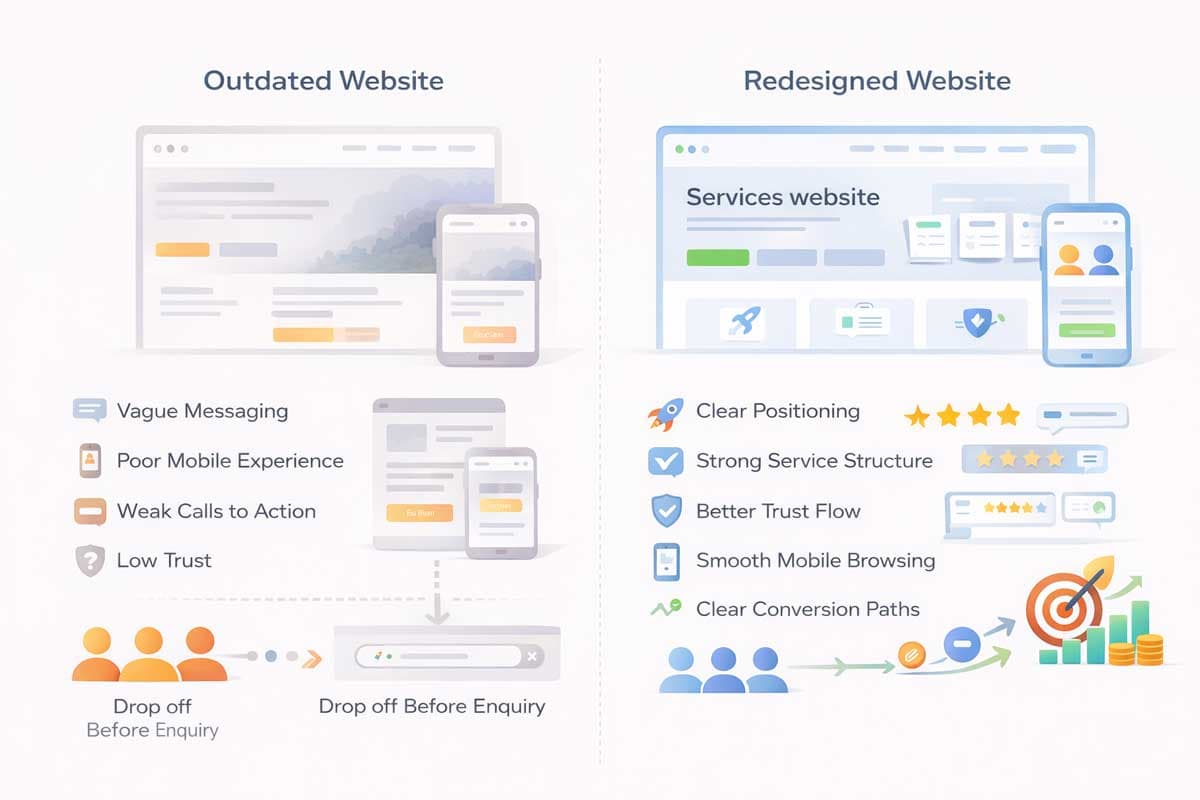
One of the most expensive assumptions a small business can make is thinking a website only needs attention once something visibly fails.
That is rarely how digital underperformance shows up.
Most websites do not stop helping in an obvious way. They do not crash. They do not disappear. They do not suddenly become unusable overnight. They simply become less effective over time, often without the owner noticing the decline clearly enough to act on it.
A website built three or four years ago may still load perfectly well, but the standards people bring to that experience are no longer the same. Buyers compare faster. They judge credibility earlier. They browse more aggressively on mobile. They tolerate less confusion. And they are quicker to leave if a site feels even slightly unclear, dated, or difficult to trust.
This is where a lot of small business websites quietly fall behind.
The owner sees a functioning website. The visitor sees a business that may not feel as current, organised, or credible as its competitors.
That gap matters.
A website should not be evaluated only on whether it still exists. It should be evaluated on whether it still supports the business properly. If it no longer builds trust quickly, guides people clearly, and supports the next step effectively, then it is already weaker than it should be, even if it still looks “fine” to the person who owns it.
Read More: When Should You Redesign Your Website?
Your Business Has Changed, but Your Website Has Not
This is one of the most common reasons a redesign becomes necessary.
Most small businesses do not stay the same for long. Services become more refined. Delivery becomes more mature. The type of client the business wants to attract becomes clearer. In many cases, the quality of the work improves significantly too.
But the website often gets left behind.
That creates a disconnect between what the business has become and what the website still communicates.
Sometimes the mismatch is obvious. A business that now handles more serious projects still has a website that feels basic. A company that has become more specialised still presents itself in broad, generic language. A business with stronger systems and better delivery still has a site that feels like it belongs to an earlier stage of growth.
Other times, the mismatch is more subtle. The tone is slightly off. The structure feels dated. The messaging still reflects an older version of the offer. The business has moved on, but the website has not.
This matters because a website is not only a place where people “find information.” It is often the first meaningful trust filter a buyer uses before deciding whether to enquire.
If the site presents an outdated version of the business, it creates friction before the conversation even starts.
That is why redesign is often less about changing aesthetics and more about realignment. The website needs to reflect the current business, not the version that existed years ago.
The Biggest Warning Sign Is Usually Conversion Friction
A lot of business owners think redesign becomes necessary once a website looks visually old.
In reality, the stronger signal is usually friction.
Friction is what happens when a person arrives with interest, but the website makes progress feel slower, less obvious, or less comfortable than it should. The visitor does not always leave because something is dramatically wrong. They leave because too many small hesitations build up before action happens.
This is where underperforming websites quietly lose business.
The homepage may not clarify the offer quickly enough. The service pages may stay too shallow to build real confidence. The next step may feel buried, vague, or premature. The mobile layout may create enough awkwardness to reduce momentum. The site may technically function, but it does not move people forward with enough certainty.
That is what conversion friction looks like in practice.
And this is one of the most important distinctions to make when thinking about redesign. A website redesign should not begin as a visual project. It should begin as a performance question.
Where are people hesitating?
What feels unclear too early?
What makes action feel harder than it should?
Those are the questions that matter.
Because if the website gets traffic but fails to produce enough action, the issue is often not reach. It is structure.
Most Small Business Websites Were Built to Exist, Not to Perform
This is one of the deeper reasons redesign becomes valuable.
A lot of small business websites were originally built with a very simple goal: have a website online.
That made sense at the time. The business needed an online presence. It needed something professional enough to show clients, appear in search, and support basic credibility. So the site was built around presence, not performance.
The problem is that what businesses need from a website usually changes as they grow.
A site that was “good enough” when the goal was simply to exist often becomes too weak once the business starts expecting the website to contribute more seriously to lead generation, trust-building, or sales support.
That is where the gap begins.
A website built to exist usually has the same pattern. The homepage feels broad and generic. The service pages are thin. The trust-building sequence is weak. The visitor is expected to do too much interpretive work alone. The site is there, but it is not carrying enough commercial weight.
That matters more for small businesses than many people realise.
Smaller teams do not have the luxury of wasting buyer attention. They do not always have a large sales team to compensate for a weak website. The site needs to do part of the heavy lifting. It needs to reassure, guide, filter, and support action more effectively than a brochure-style website ever could.
That is why redesign often becomes necessary not because the original site was a failure, but because the role of the website inside the business has changed.
Read More: Is SEO Worth It for Melbourne Businesses in 2026?
A Redesign Is Often About Clarity More Than Appearance
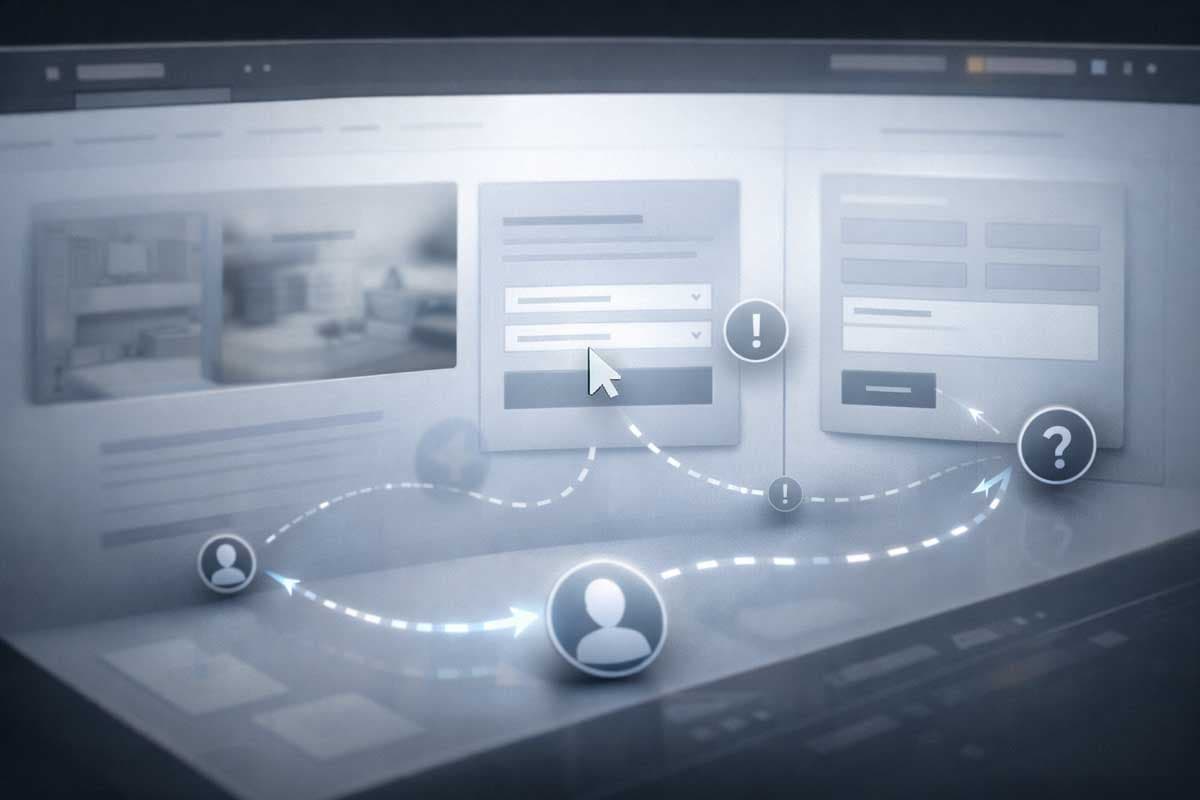
One of the easiest ways to misunderstand redesign is to treat it as a style update.
Of course visual quality matters. If a website looks messy, inconsistent, or clearly dated, that affects trust quickly. But appearance is only one layer of the problem. In many cases, the more important issue is clarity.
A website should make the business easy to understand.
That means a visitor should quickly grasp what you do, who you help, why your offer matters, and what they should do next. If those things are not clear enough, the website can still underperform badly even if the design is not terrible.
This is where a lot of small business websites lose momentum.
The owner knows the service too well, so the site ends up explaining things in the order the business thinks about them, not in the order the buyer needs to understand them. Important information arrives too late. Trust appears too weakly. Calls to action come before enough confidence has been built. The site may contain the right pieces, but the structure does not support decision-making properly.
That is why redesign is often more strategic than people expect.
A good redesign does not only improve how the website looks. It improves how the website thinks. It improves hierarchy, sequence, clarity, and user flow. And in many cases, those improvements have more business impact than any visual polish alone.
If Your Website Is Hard to Update, It Is Already Costing You
This is one of the most overlooked redesign signals, especially for growing small businesses.
If making changes to your website feels slow, frustrating, or dependent on technical help every time, then the site is already creating operational drag.
That drag often shows up in ways owners normalise without realising how costly it becomes over time.
You delay updating service pages. You avoid adding new offers. You put off improving weak wording. You skip publishing useful content. You leave outdated sections live because changing them feels annoying. The website becomes something the business works around instead of something it works with.
That is not a minor inconvenience. It affects how fast the business can adapt online.
A website should support momentum. It should make it easier to publish, improve, test, and evolve. If every small update feels like friction, the site is no longer functioning as a useful business tool.
This is why redesign should not only be viewed from the front end. In many cases, one of the strongest reasons to redesign is to improve maintainability behind the scenes.
A better site structure often means the business gains more control, more flexibility, and less dependency for simple improvements. That alone can create meaningful value over time, especially for a business trying to grow steadily.
Delaying a Redesign Usually Costs More Than Doing It Earlier

A lot of business owners postpone redesigns because the current website still feels usable enough.
That instinct makes sense. A redesign requires attention, investment, and decision-making. It is easy to keep pushing it forward because the current site does not feel like an emergency.
But that delay often becomes expensive in quieter ways.
A weak website rarely sends a clear invoice for the damage it causes. Instead, the cost shows up as accumulated drag. Lower trust. More hesitation. Less conversion. More effort required to get the same result. Advertising traffic that lands on a weak experience. Search traffic that reaches pages that are too thin to do much with attention once it arrives.
Over time, those losses stack up.
That is why redesign should not only be viewed as a design expense. In many cases, it is a correction to an asset that has already started underperforming.
And the longer a business leaves that underperformance in place, the more likely the website becomes misaligned with how the company needs to grow.
By the time many businesses finally decide to act, the redesign is no longer just about improvement. It is about recovering lost ground.
What a Good Small Business Website Redesign Should Fix
A redesign should not simply rearrange visuals and introduce a more modern style. If the underlying issues remain, the business ends up with a fresher-looking version of the same problem.
A useful redesign should fix the structural weaknesses that are holding the site back.
Area | Old Website Problem | What a Redesign Should Improve |
Homepage | Too generic or vague | Clear positioning and direction |
Service Pages | Thin, shallow, low trust | Better explanation and credibility |
Mobile UX | Clunky or frustrating | Smoother browsing and action |
Calls to Action | Buried or weak | Clear next steps |
Site Editing | Hard to maintain | Easier updates and growth |
User Flow | Visitors drift without direction | Stronger conversion path |
The point of redesign is not to make the website “look newer.” It is to make the site work more intelligently inside the business.
That means improving how it communicates, how it supports trust, how it handles buyer movement, and how well it fits the actual commercial role the website needs to play now.
A strong redesign should leave the business with a clearer digital system, not only a cleaner visual surface.
Read More: Website vs Landing Page: Which One Does Your Business Need?
A Better Website Should Improve How the Business Operates
This is the standard redesign should be judged against.
A small business website should not only look more current after a redesign. It should improve how the business works.
It should help shape stronger first impressions. It should reduce buyer hesitation. It should support better lead quality. It should make the next step easier to understand. And it should align more closely with how the business sells, communicates, and grows today.
That is the real difference between cosmetic redesign and strategic redesign.
A cosmetic redesign updates the appearance.
A strategic redesign improves the role the website plays inside the business.
At Flamincode, this is usually where the strongest website projects begin. Not with “we want something more modern,” but with “our current website no longer supports where the business is trying to go.”
That is usually the more useful starting point.
Final Take
A small business website does not need to be falling apart to need a redesign. In many cases, the site still looks acceptable on the surface. It still loads. It still exists. But if it no longer reflects the quality of the business, supports growth properly, or helps visitors move forward with confidence, then it is already costing more than it should.
If your business has grown but your website still feels like it belongs to an earlier version of the company, redesign is often not about making the site prettier. It is about rebuilding a stronger digital foundation.
And when that is done properly, the result is not only a better website. It is a more useful business asset.
Frequently Asked Questions
How often should a small business website be redesigned?
Most small business websites should be reviewed seriously every 2 to 4 years, depending on how much the business, customer expectations, and digital competition have changed.
Is a redesign better than building a new website from scratch?
That depends on the structure and condition of the current site. Some websites are worth redesigning. Others are restrictive enough that rebuilding is the cleaner and smarter option.
Will redesigning a website help with SEO?
It often helps if the redesign improves site structure, mobile usability, page speed, internal flow, and content clarity. A poorly handled redesign can also damage SEO, so the structure matters.
What is the difference between a refresh and a redesign?
A refresh usually updates the visual layer. A redesign changes the structure, messaging, flow, and user experience of the website.
What is the clearest sign a website is underperforming?
One of the clearest signs is when the site seems “fine” on the surface but still produces weak trust, low enquiries, poor mobile behaviour, or lower conversion than it should.

Admin
Mostafa is a Wordsmith, storyteller, and language artisan weaving narratives and painting vivid imagery across digital landscapes with a spirited pen, he embraces the art of crafting compelling content as a copywriter, and content manager.

Based in
Melbourne, Australia
Your software dev partner, smooth process, exceptional results
Contacts
contact@flamincode.com.au
© All rights reserved to Flamincode